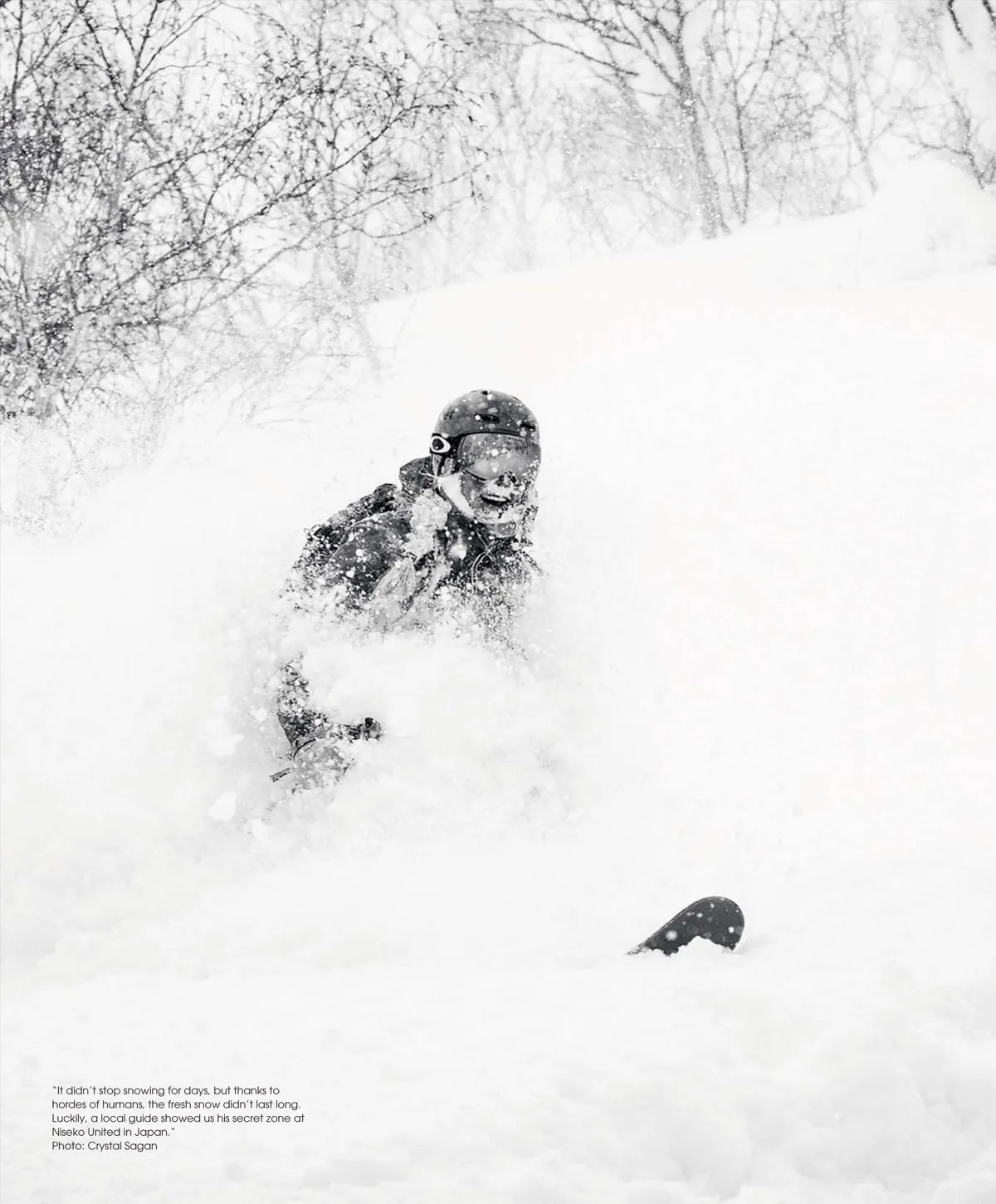
STRAIGHT LINE AUTHENTIC EXPRESSIONS WITH ANNELISE LOEVLIE Words Julie Brown nnelise Loevlie is a 35-year-old ski CEO. Four years ago, she took the reins of Icelantic Skis, an indie ski com-pany in Golden, CO, and the news was rightly celebrated. In an industry that’s top-to-bottom pretty much all men, here was a woman stepping into a position of leadership, taking control of a company her best friend from high school had founded. Her mission: stop the financial bleeding and whip the company into shape with some tough love. She was a woman in a boys club, whose time had come to shine, and it was celebrated across the internet and media spheres. Meanwhile, Loevlie was falling apart. “I was acting like all the people I was around, who were all dudes,” she says. She was working strict hours in a structured, industrial lifestyle. “I went into the deepest, darkest depression I’ve had,” she says. Like many women who ski with dudes and work in the ski industry, Loevlie approached her new role according to cultural norms established by the majority. And that nearly destroyed her. “That was the beginning of this feminine re-awakening,” she says. The real success story of Loevlie and Icelantic is about the culture of emotional fluidity and self care she has created in a male-dominated environment—on the chairlift and in the office. Not only is she much happier—“I just feel so much more comfortable in my own skin,” she says—but the skiing is better and business is doing good, too. had just seen Loevlie at a campout in July with 18 other women in the ski industry. We sat around a long table for real talk about emotions, babies, boyfriends, business partners and what it’s like to work with a bunch of male skiers. There were tears, affirmations and rosè, and then, after all the talk of feelings, we gelande quaffed—a game where mugs of beer slide down tables and are caught and chugged. It is perhaps the most aggressive binge-drinking game ever invented—by men. Loevlie, in a white one-piece outfit, her long blonde hair wild and waving, chugged gluten-free beer like a champ. Icelantic started during Loevlie’s high school days, when founder Ben Anderson, also a teenager, began making skis in his garage. Loevlie had already started building her resume as A I an entrepreneur by selling candy out of her locker. Anderson was her best customer. When she graduated from college with a degree in business, he asked her to work at Icelantic. Fitting in became harder when she became the CEO. She had written a letter to the company’s investors, outlining the problems she saw and the steps she wanted to take to clean them up. The company was losing money and Loevlie had to fire people and shut down an office in Switzerland to turn the course of the business. Those were necessary tasks, but in hindsight, Loevlie regrets her approach. “The way I acted was really not sympathetic and kind of harsh,” she says. Her thinking was, ‘This is business. This is what we need to do.’ It’s so funny to even say that right now because it’s so not me.” Loevlie says her head was disconnected from her body and soul. By denying who she really was, by trying to be one of the boys and acting out of character, Loevlie says her body went “haywire.” Along with depression, Loevlie had physical symptoms that snowballed into thyroid dysfunction. She got melanoma. She also got pregnant and had an abortion. “The abortion thing was huge. It was a really big thing on the feminine side, just being conscious of my ability to create,” she says. “That was a little seed planted in me that was like, ‘Holy fuck, I am a creator.’ But in a different way than men are.” I stopped and asked Loevlie if she wanted to talk about her abortion in a ski magazine, where such uncomfortable and controversial topics are left largely unacknowledged. However, women often talk about children and abortion. We see women who stop attending ski industry events as soon as they have children, and how there’s a double standard for dads, who get a kid-free week to attend ski tests for work. “I think the more [abortion] is talked about, the better it is for the world,” Loevlie says. It a dark time in Loevlie’s life, and it crested when she admitted herself to a Zen Buddhist retreat in the mountains of Colorado and took a vow of silence for 10 days. “For 10 days I sat in silence and meditated for 13 hours a day,” Loevlie says. “I had a really huge release on day seven, a realization that I was nowhere near living from my center. I was way off.” The Ski Journal 101
The Ski Journal Volume 12, Issue 3: Page 101