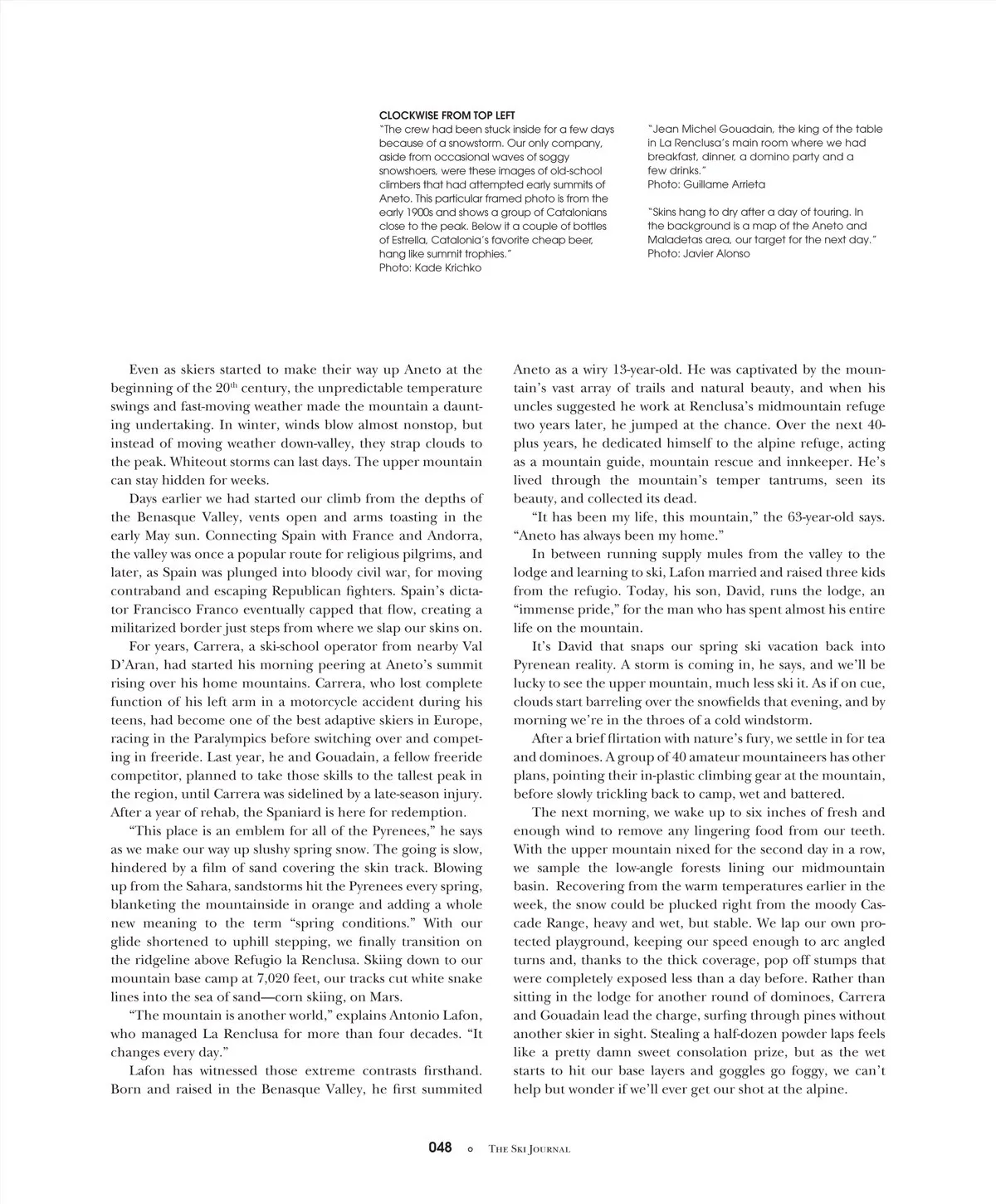
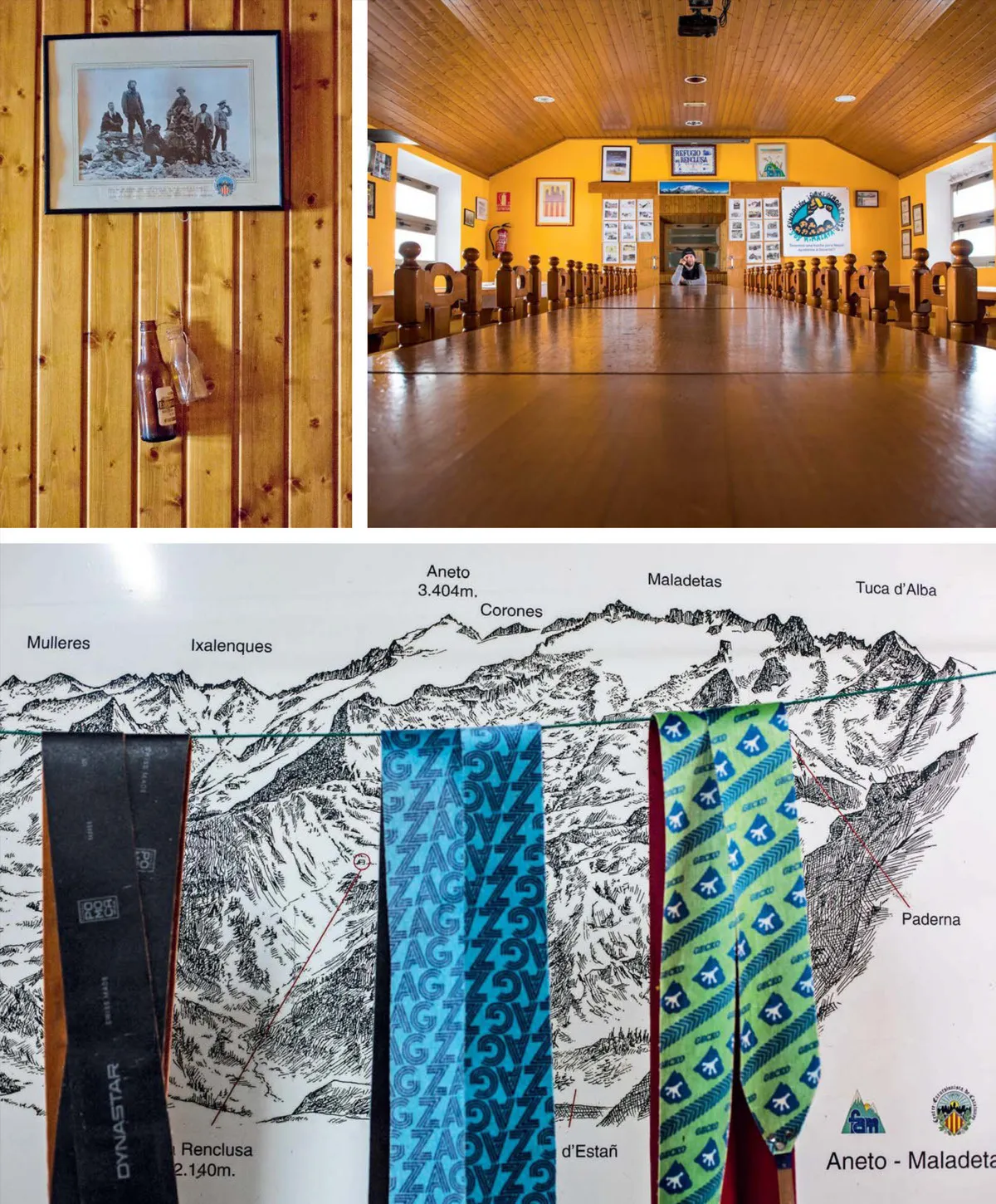
CLOCKWISE FROM TOP LEFT “The crew had been stuck inside for a few days because of a snowstorm. Our only company, aside from occasional waves of soggy snowshoers, were these images of old-school climbers that had attempted early summits of Aneto. This particular framed photo is from the early 1900s and shows a group of Catalonians close to the peak. Below it a couple of bottles of Estrella, Catalonia’s favorite cheap beer, hang like summit trophies.” Photo: Kade Krichko “Jean Michel Gouadain, the king of the table in La Renclusa’s main room where we had breakfast, dinner, a domino party and a few drinks.” Photo: Guillame Arrieta “Skins hang to dry after a day of touring. In the background is a map of the Aneto and Maladetas area, our target for the next day.” Photo: Javier Alonso Even as skiers started to make their way up Aneto at the beginning of the 20 th century, the unpredictable temperature swings and fast-moving weather made the mountain a daunt-ing undertaking. In winter, winds blow almost nonstop, but instead of moving weather down-valley, they strap clouds to the peak. Whiteout storms can last days. The upper mountain can stay hidden for weeks. Days earlier we had started our climb from the depths of the Benasque Valley, vents open and arms toasting in the early May sun. Connecting Spain with France and Andorra, the valley was once a popular route for religious pilgrims, and later, as Spain was plunged into bloody civil war, for moving contraband and escaping Republican fighters. Spain’s dicta-tor Francisco Franco eventually capped that flow, creating a militarized border just steps from where we slap our skins on. For years, Carrera, a ski-school operator from nearby Val D’Aran, had started his morning peering at Aneto’s summit rising over his home mountains. Carrera, who lost complete function of his left arm in a motorcycle accident during his teens, had become one of the best adaptive skiers in Europe, racing in the Paralympics before switching over and compet-ing in freeride. Last year, he and Gouadain, a fellow freeride competitor, planned to take those skills to the tallest peak in the region, until Carrera was sidelined by a late-season injury. After a year of rehab, the Spaniard is here for redemption. “This place is an emblem for all of the Pyrenees,” he says as we make our way up slushy spring snow. The going is slow, hindered by a film of sand covering the skin track. Blowing up from the Sahara, sandstorms hit the Pyrenees every spring, blanketing the mountainside in orange and adding a whole new meaning to the term “spring conditions.” With our glide shortened to uphill stepping, we finally transition on the ridgeline above Refugio la Renclusa. Skiing down to our mountain base camp at 7,020 feet, our tracks cut white snake lines into the sea of sand—corn skiing, on Mars. “The mountain is another world,” explains Antonio Lafon, who managed La Renclusa for more than four decades. “It changes every day.” Lafon has witnessed those extreme contrasts firsthand. Born and raised in the Benasque Valley, he first summited Aneto as a wiry 13-year-old. He was captivated by the moun-tain’s vast array of trails and natural beauty, and when his uncles suggested he work at Renclusa’s midmountain refuge two years later, he jumped at the chance. Over the next 40-plus years, he dedicated himself to the alpine refuge, acting as a mountain guide, mountain rescue and innkeeper. He’s lived through the mountain’s temper tantrums, seen its beauty, and collected its dead. “It has been my life, this mountain,” the 63-year-old says. “Aneto has always been my home.” In between running supply mules from the valley to the lodge and learning to ski, Lafon married and raised three kids from the refugio. Today, his son, David, runs the lodge, an “immense pride,” for the man who has spent almost his entire life on the mountain. It’s David that snaps our spring ski vacation back into Pyrenean reality. A storm is coming in, he says, and we’ll be lucky to see the upper mountain, much less ski it. As if on cue, clouds start barreling over the snowfields that evening, and by morning we’re in the throes of a cold windstorm. After a brief flirtation with nature’s fury, we settle in for tea and dominoes. A group of 40 amateur mountaineers has other plans, pointing their in-plastic climbing gear at the mountain, before slowly trickling back to camp, wet and battered. The next morning, we wake up to six inches of fresh and enough wind to remove any lingering food from our teeth. With the upper mountain nixed for the second day in a row, we sample the low-angle forests lining our midmountain basin. Recovering from the warm temperatures earlier in the week, the snow could be plucked right from the moody Cas-cade Range, heavy and wet, but stable. We lap our own pro-tected playground, keeping our speed enough to arc angled turns and, thanks to the thick coverage, pop off stumps that were completely exposed less than a day before. Rather than sitting in the lodge for another round of dominoes, Carrera and Gouadain lead the charge, surfing through pines without another skier in sight. Stealing a half-dozen powder laps feels like a pretty damn sweet consolation prize, but as the wet starts to hit our base layers and goggles go foggy, we can’t help but wonder if we’ll ever get our shot at the alpine. 048 The Ski Journal
The Ski Journal Volume 12, Issue 3: Page 48