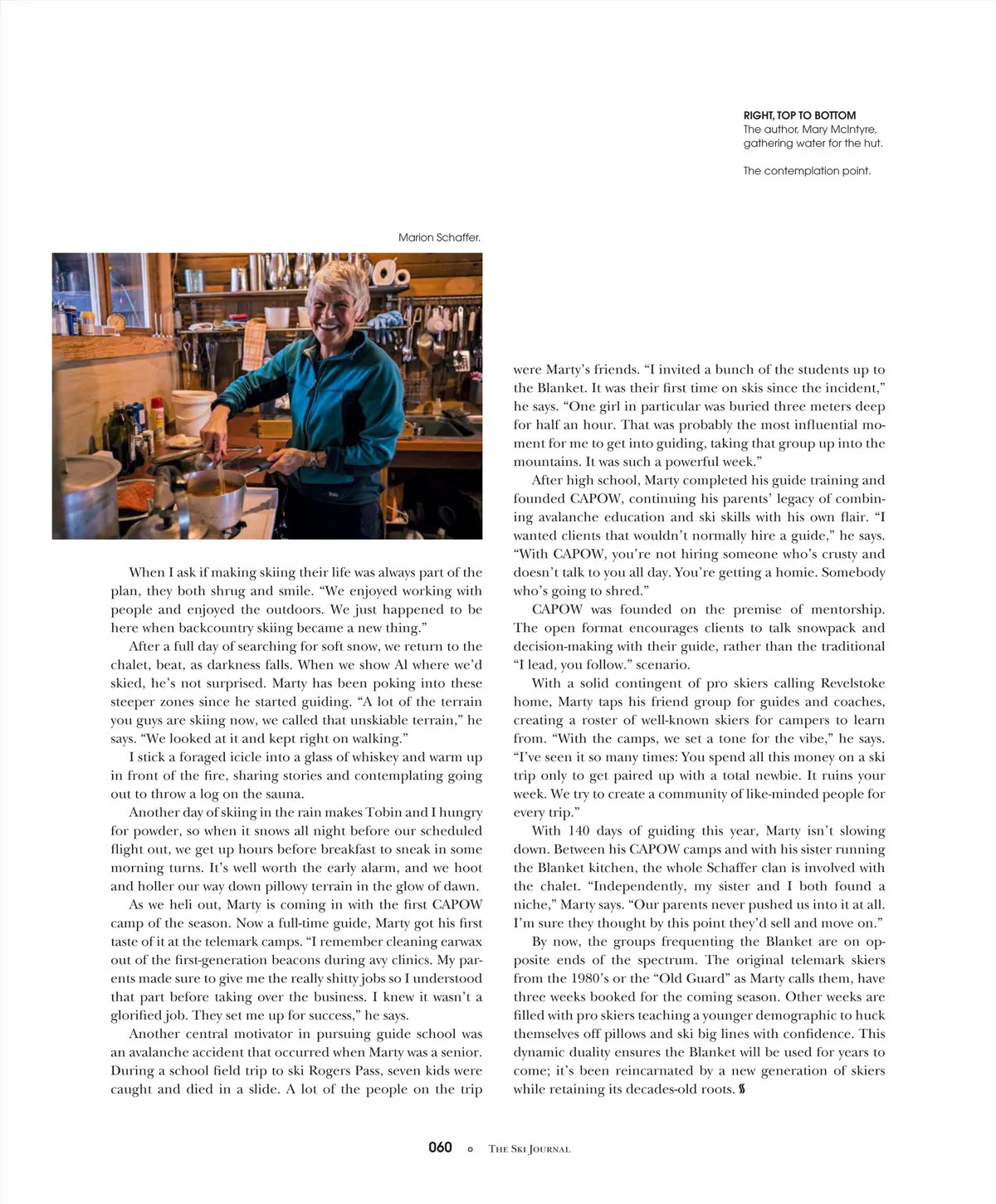
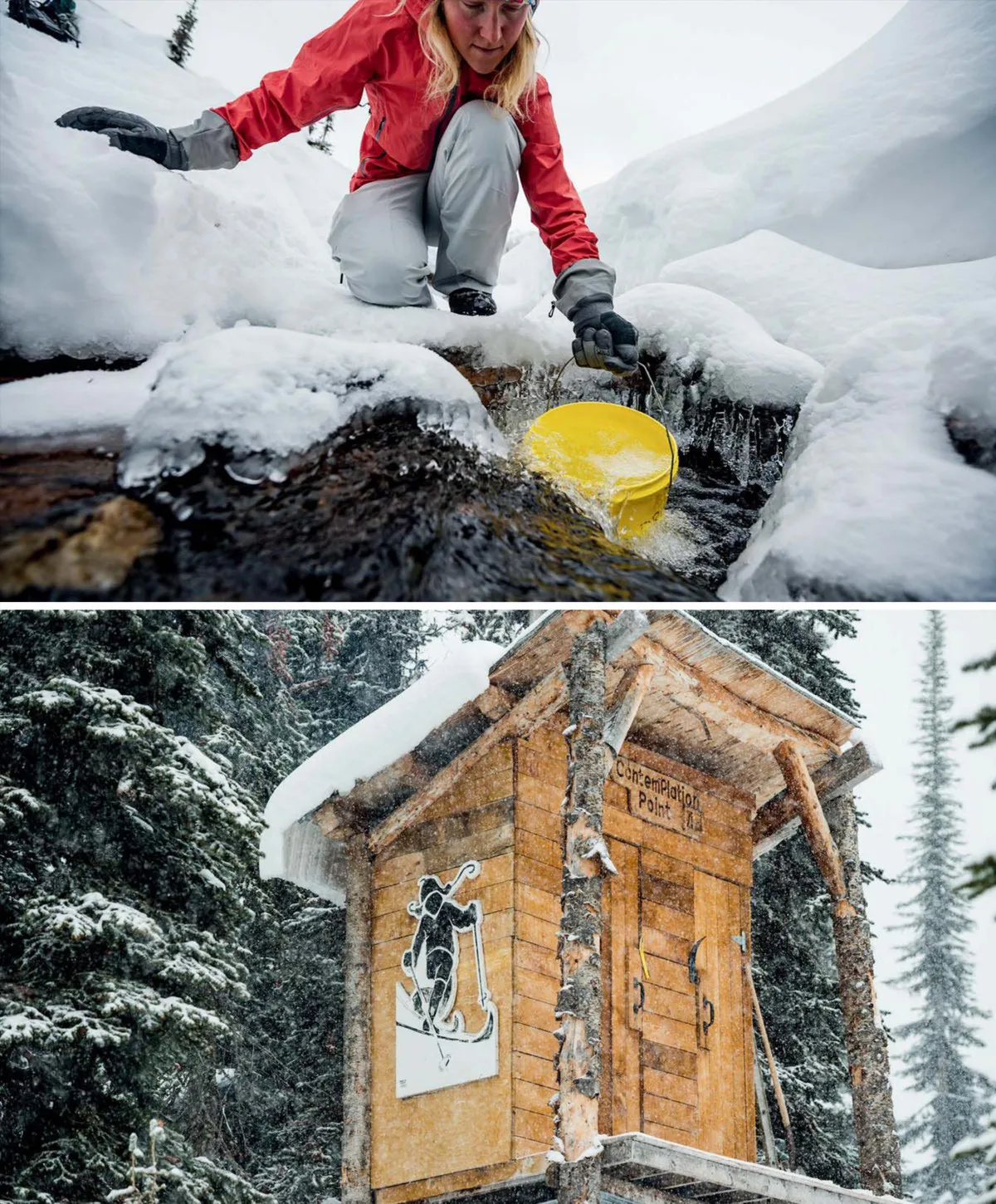
RIGHT, TOP TO BOTTOM The author, Mary McIntyre, gathering water for the hut. The contemplation point. Marion Schaffer. When I ask if making skiing their life was always part of the plan, they both shrug and smile. “We enjoyed working with people and enjoyed the outdoors. We just happened to be here when backcountry skiing became a new thing.” After a full day of searching for soft snow, we return to the chalet, beat, as darkness falls. When we show Al where we’d skied, he’s not surprised. Marty has been poking into these steeper zones since he started guiding. “A lot of the terrain you guys are skiing now, we called that unskiable terrain,” he says. “We looked at it and kept right on walking.” I stick a foraged icicle into a glass of whiskey and warm up in front of the fire, sharing stories and contemplating going out to throw a log on the sauna. Another day of skiing in the rain makes Tobin and I hungry for powder, so when it snows all night before our scheduled flight out, we get up hours before breakfast to sneak in some morning turns. It’s well worth the early alarm, and we hoot and holler our way down pillowy terrain in the glow of dawn. As we heli out, Marty is coming in with the first CAPOW camp of the season. Now a full-time guide, Marty got his first taste of it at the telemark camps. “I remember cleaning earwax out of the first-generation beacons during avy clinics. My par-ents made sure to give me the really shitty jobs so I understood that part before taking over the business. I knew it wasn’t a glorified job. They set me up for success,” he says. Another central motivator in pursuing guide school was an avalanche accident that occurred when Marty was a senior. During a school field trip to ski Rogers Pass, seven kids were caught and died in a slide. A lot of the people on the trip were Marty’s friends. “I invited a bunch of the students up to the Blanket. It was their first time on skis since the incident,” he says. “One girl in particular was buried three meters deep for half an hour. That was probably the most influential mo-ment for me to get into guiding, taking that group up into the mountains. It was such a powerful week.” After high school, Marty completed his guide training and founded CAPOW, continuing his parents’ legacy of combin-ing avalanche education and ski skills with his own flair. “I wanted clients that wouldn’t normally hire a guide,” he says. “With CAPOW, you’re not hiring someone who’s crusty and doesn’t talk to you all day. You’re getting a homie. Somebody who’s going to shred.” CAPOW was founded on the premise of mentorship. The open format encourages clients to talk snowpack and decision-making with their guide, rather than the traditional “I lead, you follow.” scenario. With a solid contingent of pro skiers calling Revelstoke home, Marty taps his friend group for guides and coaches, creating a roster of well-known skiers for campers to learn from. “With the camps, we set a tone for the vibe,” he says. “I’ve seen it so many times: You spend all this money on a ski trip only to get paired up with a total newbie. It ruins your week. We try to create a community of like-minded people for every trip.” With 140 days of guiding this year, Marty isn’t slowing down. Between his CAPOW camps and with his sister running the Blanket kitchen, the whole Schaffer clan is involved with the chalet. “Independently, my sister and I both found a niche,” Marty says. “Our parents never pushed us into it at all. I’m sure they thought by this point they’d sell and move on.” By now, the groups frequenting the Blanket are on op-posite ends of the spectrum. The original telemark skiers from the 1980’s or the “Old Guard” as Marty calls them, have three weeks booked for the coming season. Other weeks are filled with pro skiers teaching a younger demographic to huck themselves off pillows and ski big lines with confidence. This dynamic duality ensures the Blanket will be used for years to come; it’s been reincarnated by a new generation of skiers while retaining its decades-old roots. 060 The Ski Journal
The Ski Journal Volume 12, Issue 3: Page 60