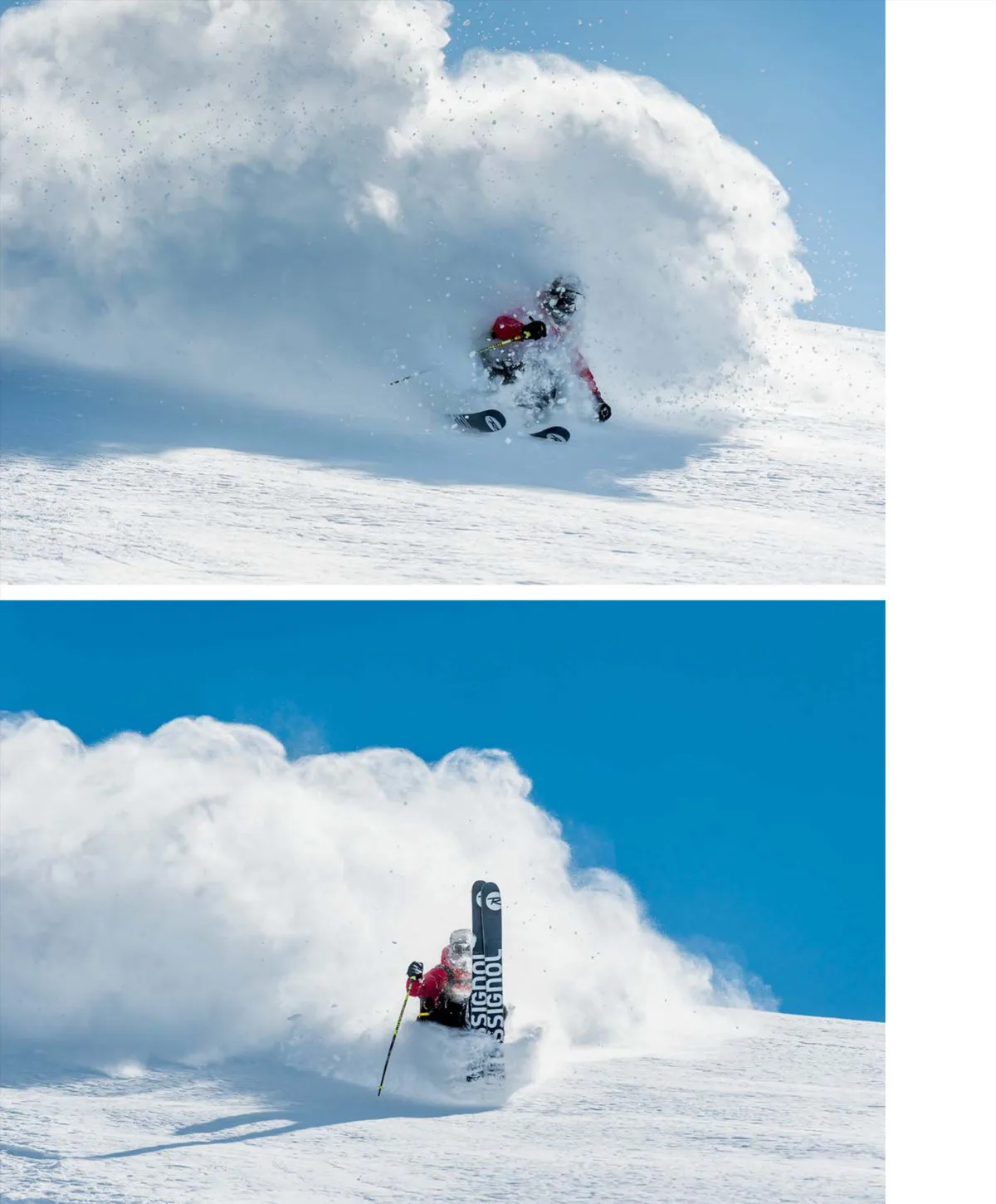
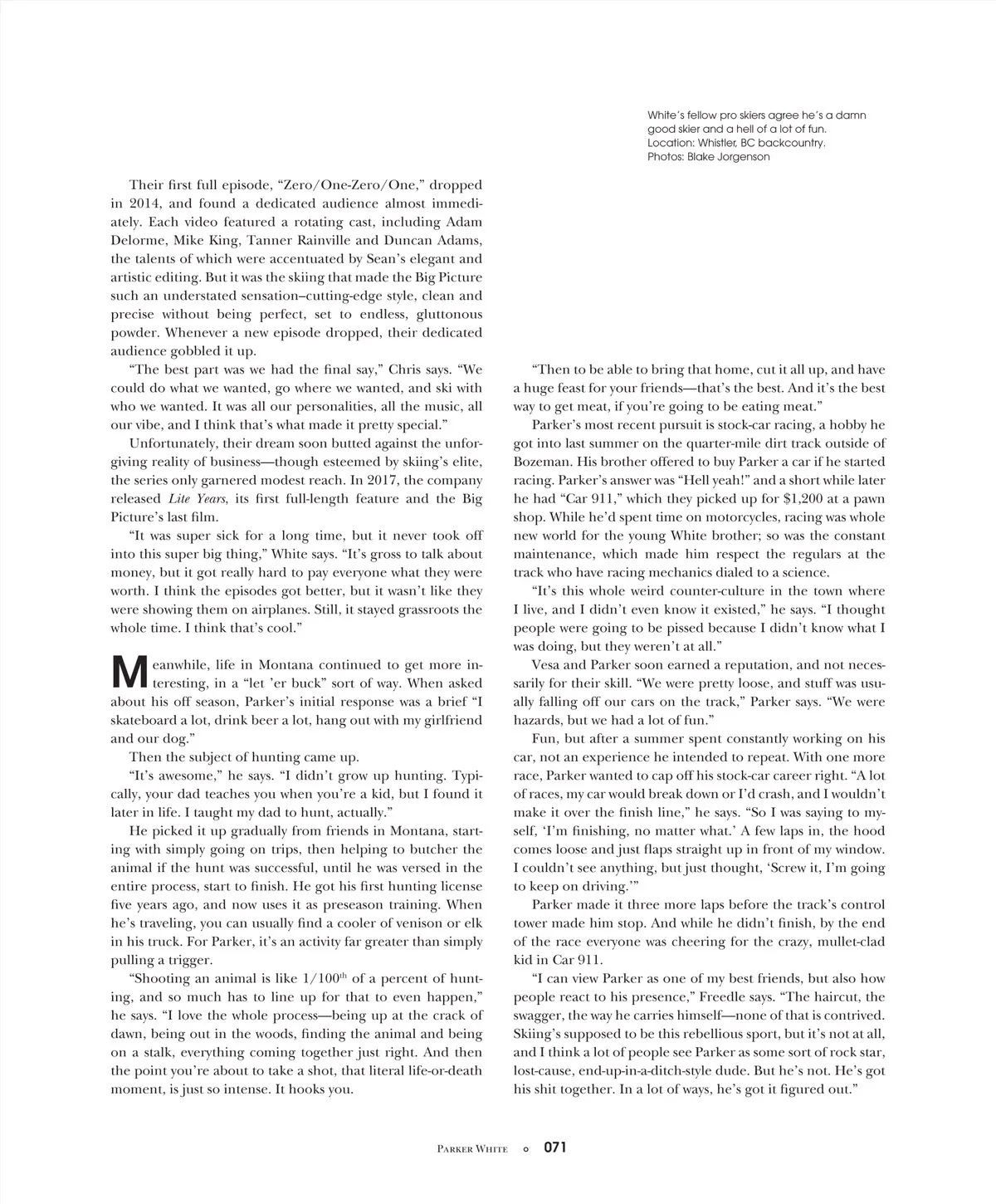
White’s fellow pro skiers agree he’s a damn good skier and a hell of a lot of fun. Location: Whistler, BC backcountry. Photos: Blake Jorgenson Their first full episode, “Zero/One-Zero/One,” dropped in 2014, and found a dedicated audience almost immedi-ately. Each video featured a rotating cast, including Adam Delorme, Mike King, Tanner Rainville and Duncan Adams, the talents of which were accentuated by Sean’s elegant and artistic editing. But it was the skiing that made the Big Picture such an understated sensation–cutting-edge style, clean and precise without being perfect, set to endless, gluttonous powder. Whenever a new episode dropped, their dedicated audience gobbled it up. “The best part was we had the final say,” Chris says. “We could do what we wanted, go where we wanted, and ski with who we wanted. It was all our personalities, all the music, all our vibe, and I think that’s what made it pretty special.” Unfortunately, their dream soon butted against the unfor-giving reality of business—though esteemed by skiing’s elite, the series only garnered modest reach. In 2017, the company released Lite Years , its first full-length feature and the Big Picture’s last film. “It was super sick for a long time, but it never took off into this super big thing,” White says. “It’s gross to talk about money, but it got really hard to pay everyone what they were worth. I think the episodes got better, but it wasn’t like they were showing them on airplanes. Still, it stayed grassroots the whole time. I think that’s cool.” eanwhile, life in Montana continued to get more in-teresting, in a “let ’er buck” sort of way. When asked about his off season, Parker’s initial response was a brief “I skateboard a lot, drink beer a lot, hang out with my girlfriend and our dog.” Then the subject of hunting came up. “It’s awesome,” he says. “I didn’t grow up hunting. Typi-cally, your dad teaches you when you’re a kid, but I found it later in life. I taught my dad to hunt, actually.” He picked it up gradually from friends in Montana, start-ing with simply going on trips, then helping to butcher the animal if the hunt was successful, until he was versed in the entire process, start to finish. He got his first hunting license five years ago, and now uses it as preseason training. When he’s traveling, you can usually find a cooler of venison or elk in his truck. For Parker, it’s an activity far greater than simply pulling a trigger. “Shooting an animal is like 1/100 th of a percent of hunt-ing, and so much has to line up for that to even happen,” he says. “I love the whole process—being up at the crack of dawn, being out in the woods, finding the animal and being on a stalk, everything coming together just right. And then the point you’re about to take a shot, that literal life-or-death moment, is just so intense. It hooks you. M “Then to be able to bring that home, cut it all up, and have a huge feast for your friends—that’s the best. And it’s the best way to get meat, if you’re going to be eating meat.” Parker’s most recent pursuit is stock-car racing, a hobby he got into last summer on the quarter-mile dirt track outside of Bozeman. His brother offered to buy Parker a car if he started racing. Parker’s answer was “Hell yeah!” and a short while later he had “Car 911,” which they picked up for $1,200 at a pawn shop. While he’d spent time on motorcycles, racing was whole new world for the young White brother; so was the constant maintenance, which made him respect the regulars at the track who have racing mechanics dialed to a science. “It’s this whole weird counter-culture in the town where I live, and I didn’t even know it existed,” he says. “I thought people were going to be pissed because I didn’t know what I was doing, but they weren’t at all.” Vesa and Parker soon earned a reputation, and not neces-sarily for their skill. “We were pretty loose, and stuff was usu-ally falling off our cars on the track,” Parker says. “We were hazards, but we had a lot of fun.” Fun, but after a summer spent constantly working on his car, not an experience he intended to repeat. With one more race, Parker wanted to cap off his stock-car career right. “A lot of races, my car would break down or I’d crash, and I wouldn’t make it over the finish line,” he says. “So I was saying to my-self, ‘I’m finishing, no matter what.’ A few laps in, the hood comes loose and just flaps straight up in front of my window. I couldn’t see anything, but just thought, ‘Screw it, I’m going to keep on driving.’” Parker made it three more laps before the track’s control tower made him stop. And while he didn’t finish, by the end of the race everyone was cheering for the crazy, mullet-clad kid in Car 911. “I can view Parker as one of my best friends, but also how people react to his presence,” Freedle says. “The haircut, the swagger, the way he carries himself—none of that is contrived. Skiing’s supposed to be this rebellious sport, but it’s not at all, and I think a lot of people see Parker as some sort of rock star, lost-cause, end-up-in-a-ditch-style dude. But he’s not. He’s got his shit together. In a lot of ways, he’s got it figured out.” Parker White 071
The Ski Journal Volume 12, Issue 3: Page 71