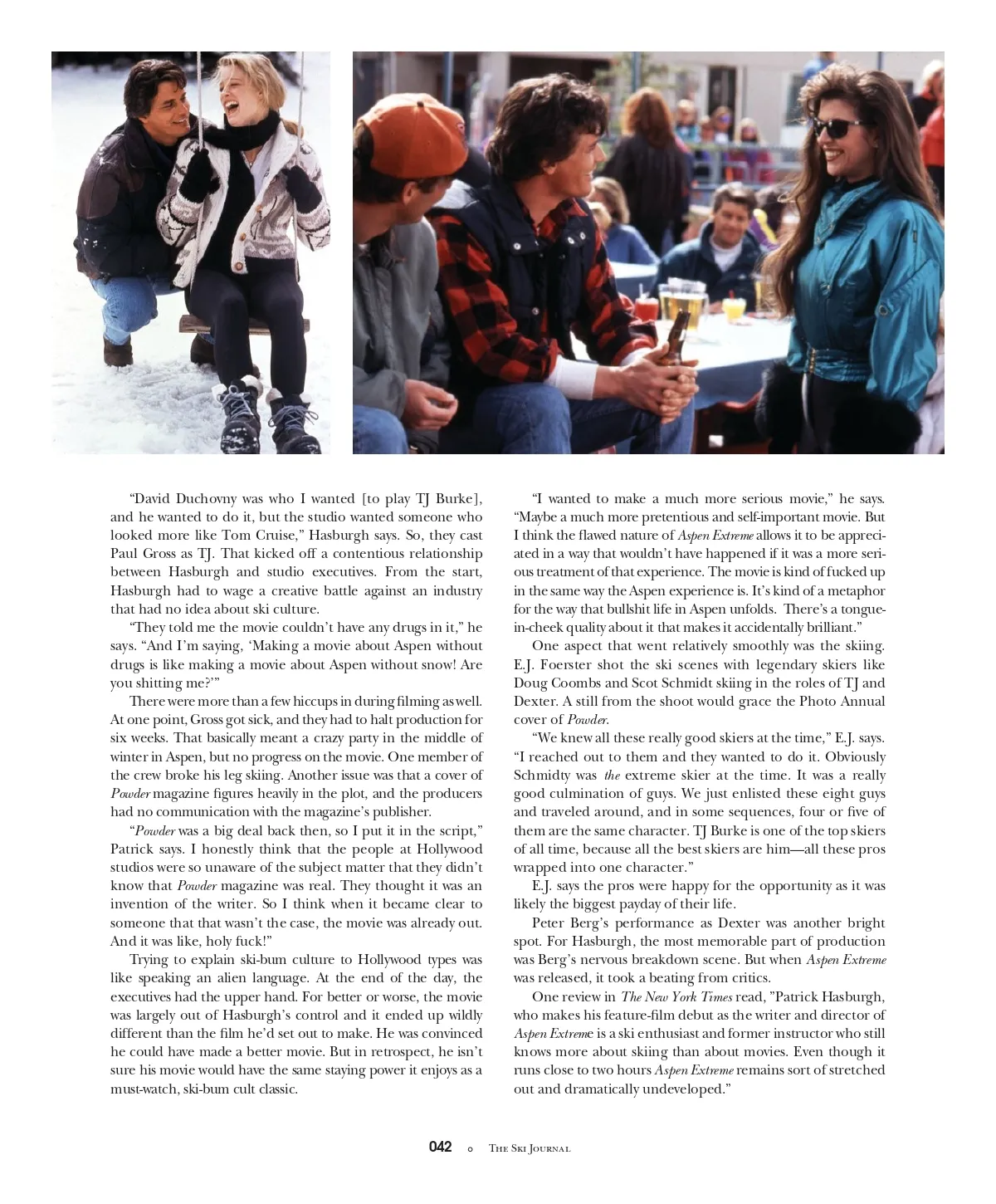
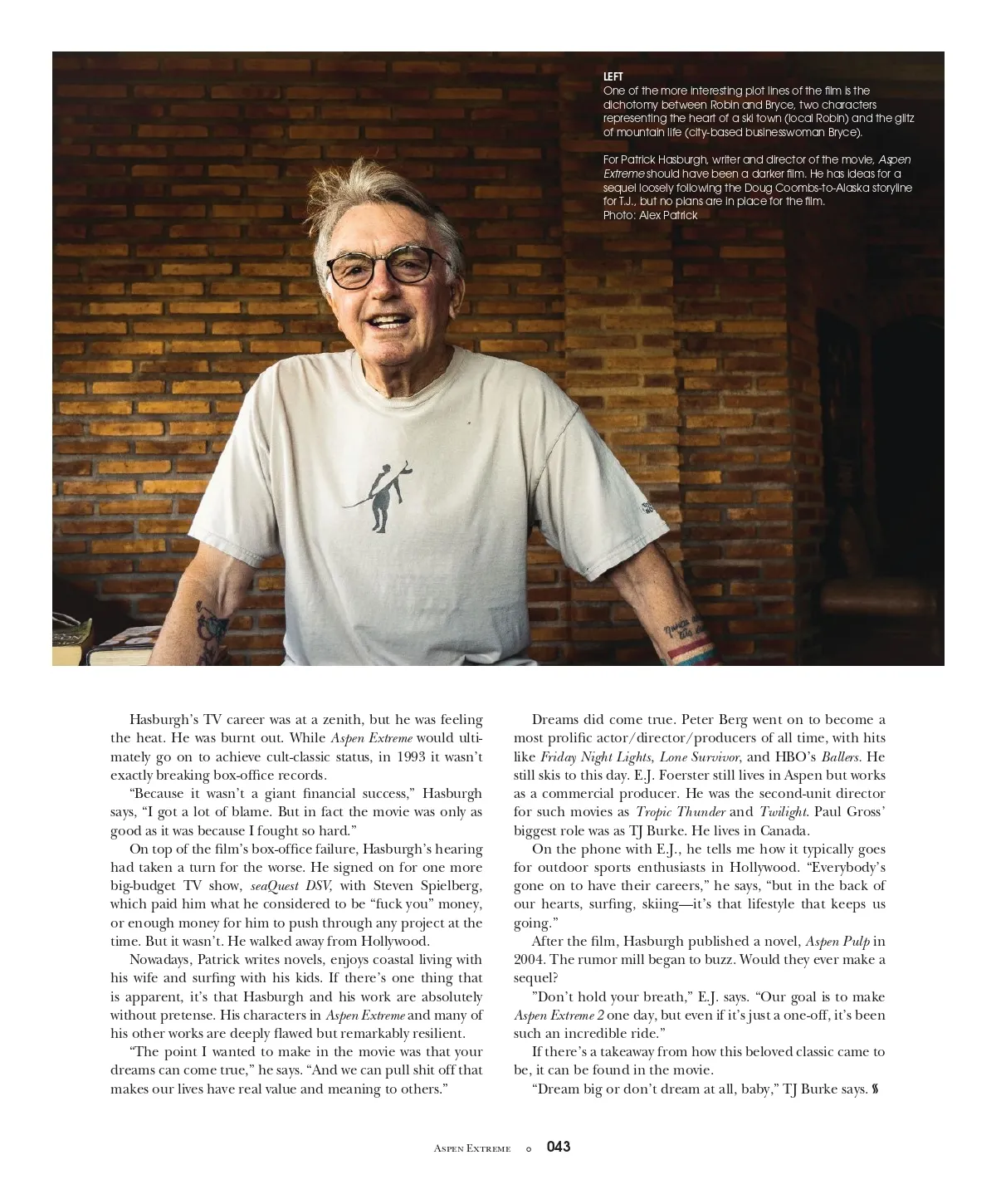
“David Duchovny was who I wanted [to play TJ Burke], and he wanted to do it, but the studio wanted someone who looked more like Tom Cruise,” Hasburgh says. So, they cast Paul Gross as TJ. That kicked off a contentious relationship between Hasburgh and studio executives. From the start, Hasburgh had to wage a creative battle against an industry that had no idea about ski culture. “They told me the movie couldn’t have any drugs in it,” he says. “And I’m saying, ‘Making a movie about Aspen without drugs is like making a movie about Aspen without snow! Are you shitting me?’” There were more than a few hiccups in during filming as well. At one point, Gross got sick, and they had to halt production for six weeks. That basically meant a crazy party in the middle of winter in Aspen, but no progress on the movie. One member of the crew broke his leg skiing. Another issue was that a cover of Powder magazine figures heavily in the plot, and the producers had no communication with the magazine’s publisher. “ Powder was a big deal back then, so I put it in the script,” Patrick says. I honestly think that the people at Hollywood studios were so unaware of the subject matter that they didn’t know that Powder magazine was real. They thought it was an invention of the writer. So I think when it became clear to someone that that wasn’t the case, the movie was already out. And it was like, holy fuck!” Trying to explain ski-bum culture to Hollywood types was like speaking an alien language. At the end of the day, the executives had the upper hand. For better or worse, the movie was largely out of Hasburgh’s control and it ended up wildly different than the film he’d set out to make. He was convinced he could have made a better movie. But in retrospect, he isn’t sure his movie would have the same staying power it enjoys as a must-watch, ski-bum cult classic. “I wanted to make a much more serious movie,” he says. “Maybe a much more pretentious and self-important movie. But I think the flawed nature of Aspen Extreme allows it to be appreci-ated in a way that wouldn’t have happened if it was a more seri-ous treatment of that experience. The movie is kind of fucked up in the same way the Aspen experience is. It’s kind of a metaphor for the way that bullshit life in Aspen unfolds. There’s a tongue-in-cheek quality about it that makes it accidentally brilliant.” One aspect that went relatively smoothly was the skiing. E.J. Foerster shot the ski scenes with legendary skiers like Doug Coombs and Scot Schmidt skiing in the roles of TJ and Dexter. A still from the shoot would grace the Photo Annual cover of Powder . “We knew all these really good skiers at the time,” E.J. says. “I reached out to them and they wanted to do it. Obviously Schmidty was the extreme skier at the time. It was a really good culmination of guys. We just enlisted these eight guys and traveled around, and in some sequences, four or five of them are the same character. TJ Burke is one of the top skiers of all time, because all the best skiers are him—all these pros wrapped into one character.” E.J. says the pros were happy for the opportunity as it was likely the biggest payday of their life. Peter Berg’s performance as Dexter was another bright spot. For Hasburgh, the most memorable part of production was Berg’s nervous breakdown scene. But when Aspen Extreme was released, it took a beating from critics. One review in The New York Times read, ”Patrick Hasburgh, who makes his feature-film debut as the writer and director of Aspen Extrem e is a ski enthusiast and former instructor who still knows more about skiing than about movies. Even though it runs close to two hours Aspen Extreme remains sort of stretched out and dramatically undeveloped.” 042 The Ski Journal
The Ski Journal Volume 13, Issue 2: Page 42