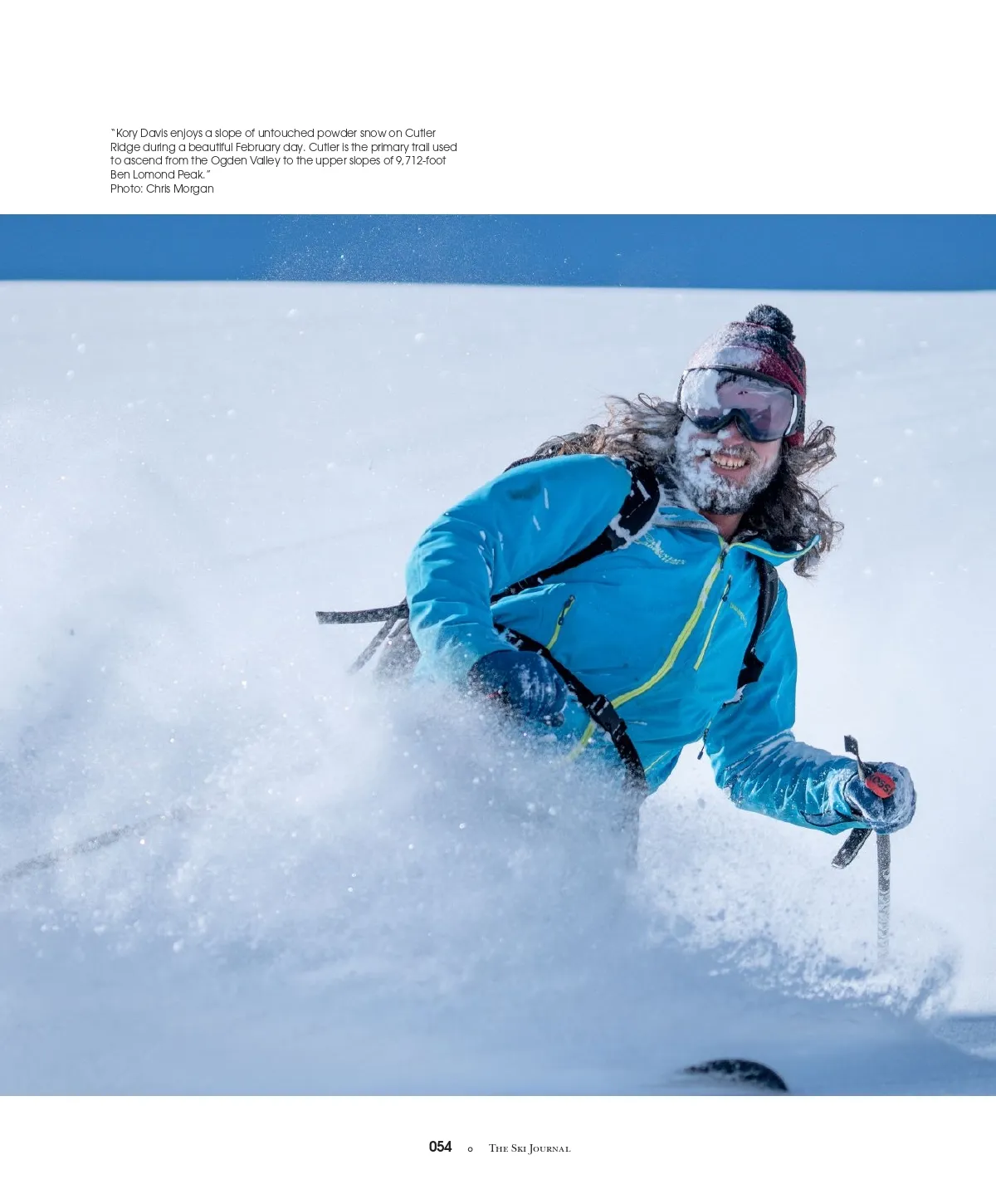
Words Derek Taylor HE calls it the Tom Brady storm. Kory Davis is addressing a packed house at the Shooting Star Saloon, the kitschy beer bar in Huntsville, UT, famous for its burgers and a stuffed St. Bernard head mounted to the wall. He’s referencing the several feet of snow that fell in the Ogden area over Super Bowl week. A Power Point presentation with photos of pit profiles and local avalanche activity—mostly collected from people in the community—illustrates his discussion. because there has to be someone within the party to enact the rescue. Even if someone was to survive the ride in Hells with-out an avalanche transceiver or a partner, by the time patrol found out about it and responded, you’re already probably 10, 15 minutes in at that point. I started to think maybe the rescue side’s the backwards end of it. Avalanche education makes more sense if you actually want to save lives.” Ogden Avalanche began as an Instagram account in De-cember 2016. Social media is still the primary means by which the organization collects and disseminates information, though they now have a website, ogdenavalanche.org, where they post local observations. The group received nonprofit status this past spring. The organization is, in part, a reaction to what some per-ceived as a lack of attention from the Utah Avalanche Center paid to the Ogden area. “I think that Utah Avalanche Center tries to do good job [for Ogden],” says Ben Bauter, president and executive director of Ogden Avalanche. “I think some-times there’s just a disconnect.” Davis and Bauter both have stone’s about times when the UAC forecast didn’t match up with the conditions in the Ogden mountains, usually when the Ogden area had little or even no snow on some aspects. In the cited instances, the UAC forecast was conservative, rating the danger as higher than it actually was. While on the surface that may seem like a safer approach, Bauter says it carries risks of its own. If people see a considerable rating for a long period, but aren’t see-ing reactions from the snow, they get comfortable with that rating Then, when the snowpack changes, that change isn’t reflected in the forecast. Davis speaks slowly. Long curly black hair sticks out from a hat the reads “Ogden Avalanche.” He looks like a scruffier version of Sage Cattabriga-Alosa. Though you can tell public speaking is not his favorite, for the most he part seems comfortable in front of this crowd, as if he knows most of them. In this community, it’s likely he does. This event is one of a handful of “state of the snowpack” discussions hosted each winter by Ogden Avalanche, an organization founded by Davis and other members of the backcountry community in Ogden, which is about 40 miles north of Salt Lake City. The crowd is diverse in ages and background—from the old guard, who emigrated here to escape the Cottonwood Canyon crowds in the 1980s, to Weber State University students just learning about snowpack and backcountry travel. They are united in their zest for get-ting into the backcountry in this heavily populated but often overlooked area. The Ogden Outdoor Adventure podcast is streaming the event live on various Facebook pages for those who couldn’t make it to the Ogden Valley. At 33 years old, Davis is already a 12-year snow-safety veteran. He took his first level one at Brighton in 2006, and backcountry skied in the Cottonwood Canyon for a few years before moving to Ogden to patrol at Snowbasin Resort in 2008. He worked there for three years, where he started teach-ing avalanche courses through the Utah Avalanche Center. A body recovery in Hells Canyon, a backcountry zone just out-side of Snowbasin’s boundary, was the trigger that convinced him to transition into avalanche education. “You realize that the search and rescue part’s fun and it’s an adrenaline rush,” Davis says. “But you rarely have live finds Raising Ogden Avalanche 055
The Ski Journal Volume 13, Issue 2: Page 55