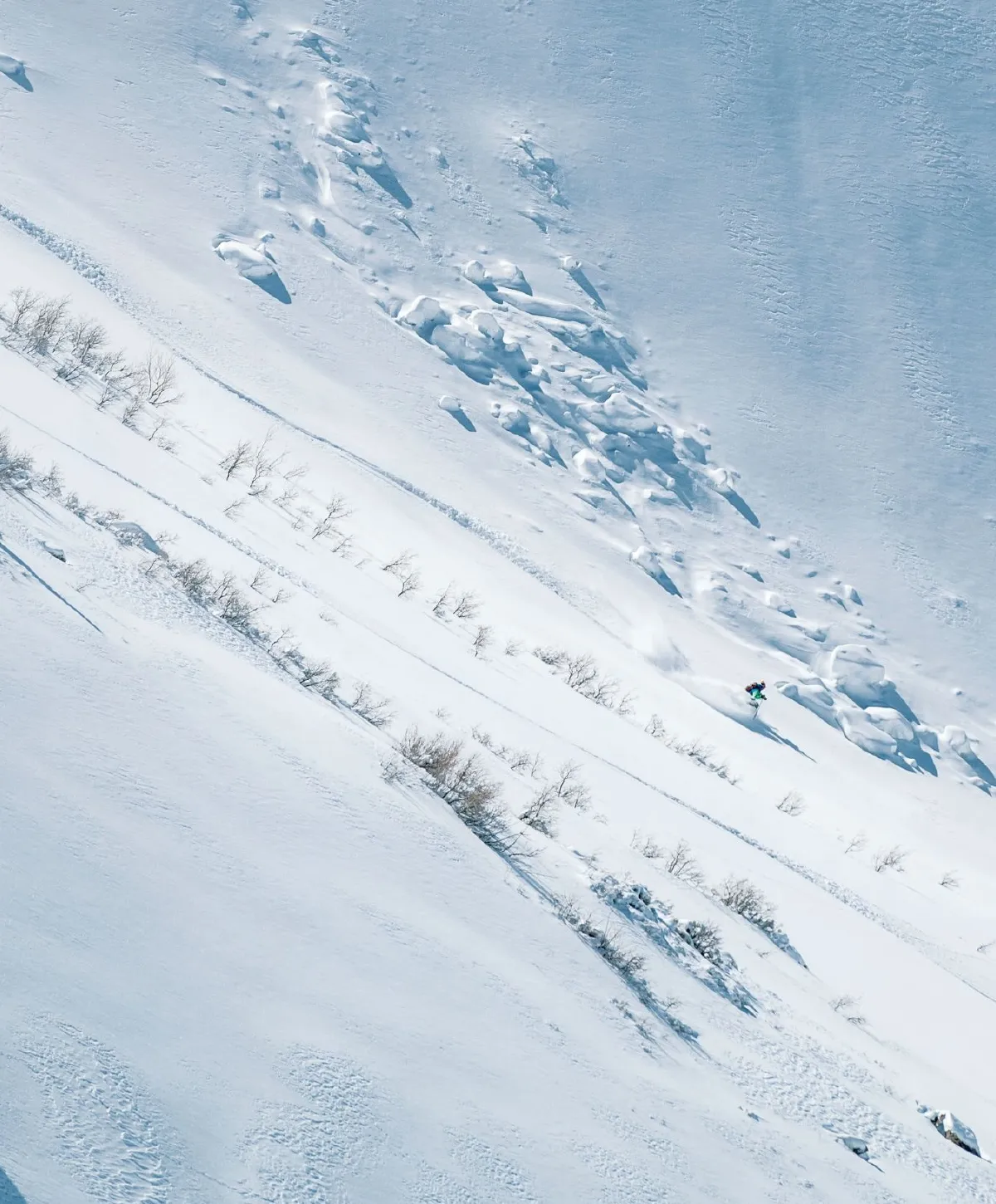
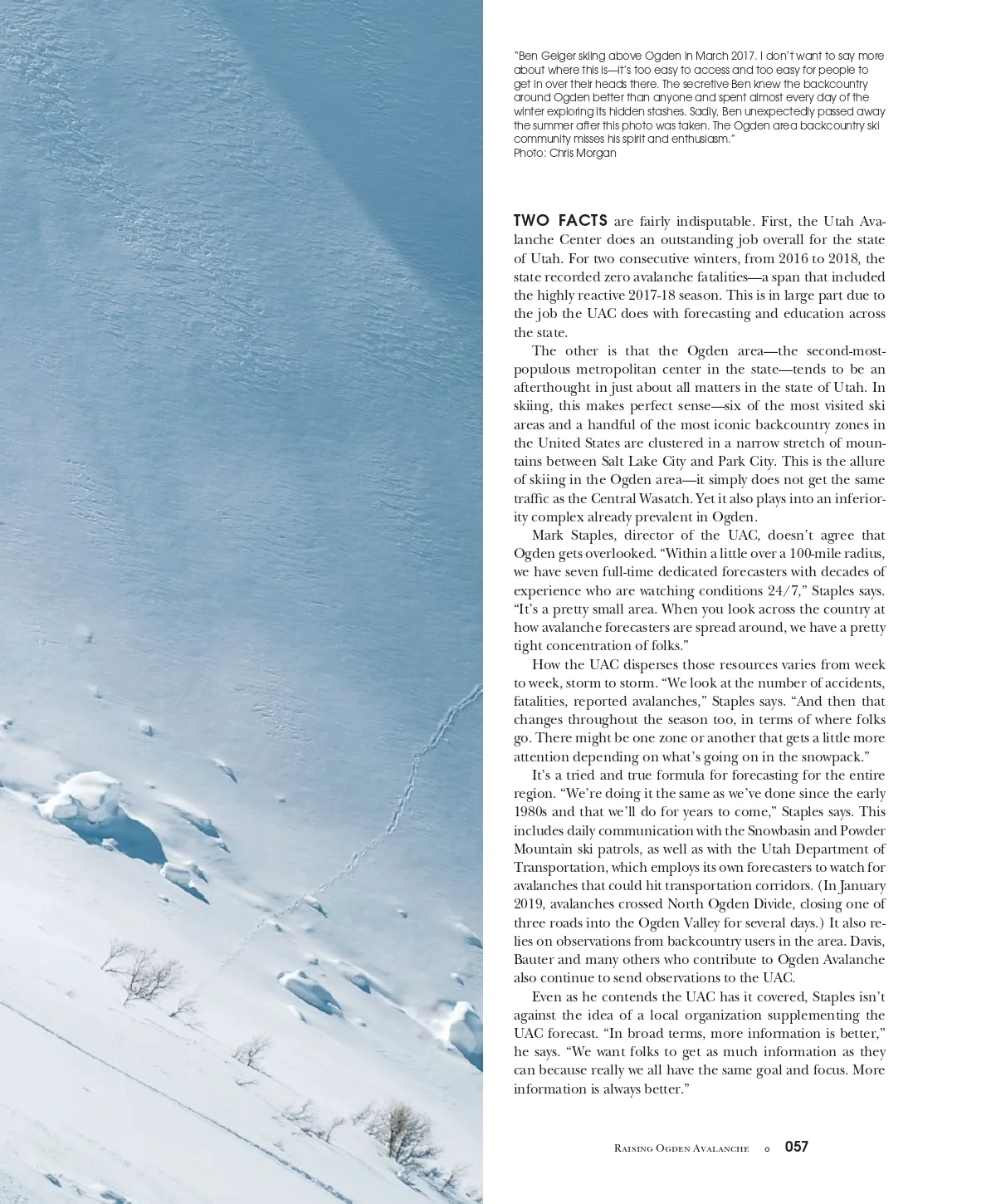
“Ben Geiger skiing above Ogden in March 2017. I don’t want to say more about where this is—it’s too easy to access and too easy for people to get in over their heads there. The secretive Ben knew the backcountry around Ogden better than anyone and spent almost every day of the winter exploring its hidden stashes. Sadly, Ben unexpectedly passed away the summer after this photo was taken. The Ogden area backcountry ski community misses his spirit and enthusiasm.” Photo: Chris Morgan TWO FACTS are fairly indisputable. First, the Utah Ava-lanche Center does an outstanding job overall for the state of Utah. For two consecutive winters, from 2016 to 2018, the state recorded zero avalanche fatalities—a span that included the highly reactive 2017-18 season. This is in large part due to the job the UAC does with forecasting and education across the state. The other is that the Ogden area—the second-most-populous metropolitan center in the state—tends to be an afterthought in just about all matters in the state of Utah. In skiing, this makes perfect sense—six of the most visited ski areas and a handful of the most iconic backcountry zones in the United States are clustered in a narrow stretch of moun-tains between Salt Lake City and Park City. This is the allure of skiing in the Ogden area—it simply does not get the same traffic as the Central Wasatch. Yet it also plays into an inferior-ity complex already prevalent in Ogden. Mark Staples, director of the UAC, doesn’t agree that Ogden gets overlooked. “Within a little over a 100-mile radius, we have seven full-time dedicated forecasters with decades of experience who are watching conditions 24/7,” Staples says. “It’s a pretty small area. When you look across the country at how avalanche forecasters are spread around, we have a pretty tight concentration of folks.” How the UAC disperses those resources varies from week to week, storm to storm. “We look at the number of accidents, fatalities, reported avalanches,” Staples says. “And then that changes throughout the season too, in terms of where folks go. There might be one zone or another that gets a little more attention depending on what’s going on in the snowpack.” It’s a tried and true formula for forecasting for the entire region. “We’re doing it the same as we’ve done since the early 1980s and that we’ll do for years to come,” Staples says. This includes daily communication with the Snowbasin and Powder Mountain ski patrols, as well as with the Utah Department of Transportation, which employs its own forecasters to watch for avalanches that could hit transportation corridors. (In January 2019, avalanches crossed North Ogden Divide, closing one of three roads into the Ogden Valley for several days.) It also re-lies on observations from backcountry users in the area. Davis, Bauter and many others who contribute to Ogden Avalanche also continue to send observations to the UAC. Even as he contends the UAC has it covered, Staples isn’t against the idea of a local organization supplementing the UAC forecast. “In broad terms, more information is better,” he says. “We want folks to get as much information as they can because really we all have the same goal and focus. More information is always better.” Raising Ogden Avalanche 057
The Ski Journal Volume 13, Issue 2: Page 57