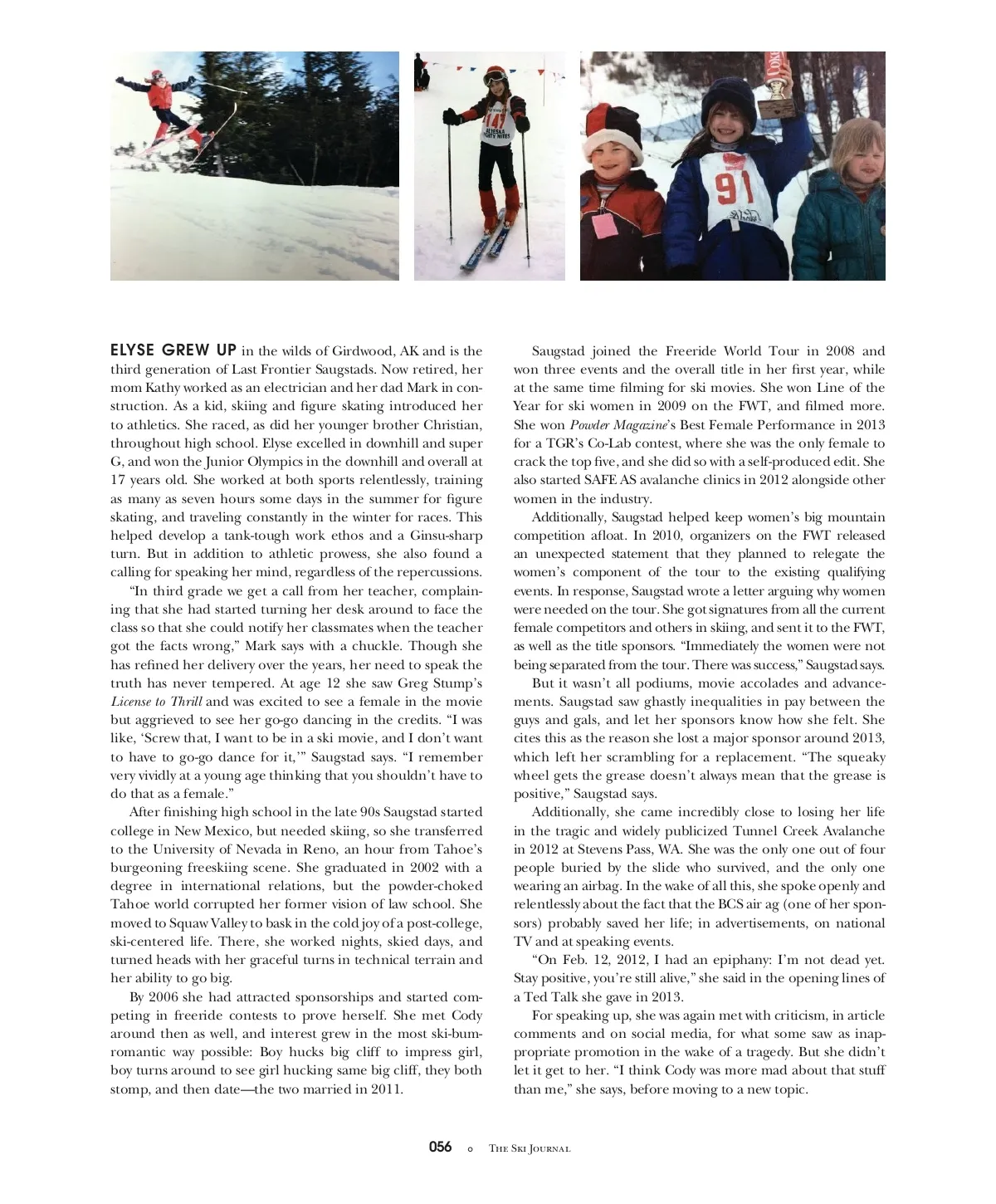
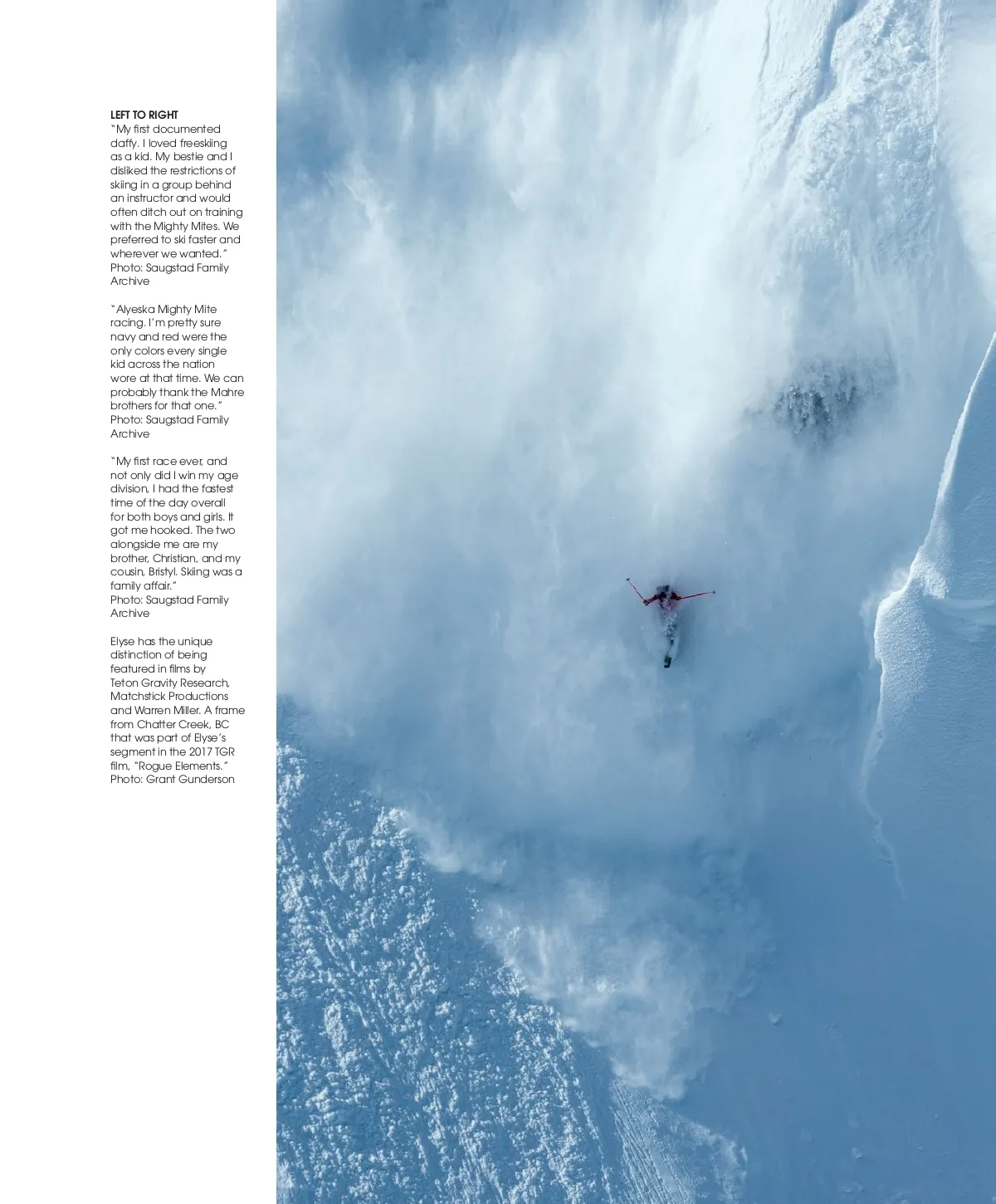
ELYSE GREW UP in the wilds of Girdwood, AK and is the third generation of Last Frontier Saugstads. Now retired, her mom Kathy worked as an electrician and her dad Mark in con-struction. As a kid, skiing and figure skating introduced her to athletics. She raced, as did her younger brother Christian, throughout high school. Elyse excelled in downhill and super G, and won the Junior Olympics in the downhill and overall at 17 years old. She worked at both sports relentlessly, training as many as seven hours some days in the summer for figure skating, and traveling constantly in the winter for races. This helped develop a tank-tough work ethos and a Ginsu-sharp turn. But in addition to athletic prowess, she also found a calling for speaking her mind, regardless of the repercussions. “In third grade we get a call from her teacher, complain-ing that she had started turning her desk around to face the class so that she could notify her classmates when the teacher got the facts wrong,” Mark says with a chuckle. Though she has refined her delivery over the years, her need to speak the truth has never tempered. At age 12 she saw Greg Stump’s License to Thrill and was excited to see a female in the movie but aggrieved to see her go-go dancing in the credits. “I was like, ‘Screw that, I want to be in a ski movie, and I don’t want to have to go-go dance for it,’” Saugstad says. “I remember very vividly at a young age thinking that you shouldn’t have to do that as a female.” After finishing high school in the late 90s Saugstad started college in New Mexico, but needed skiing, so she transferred to the University of Nevada in Reno, an hour from Tahoe’s burgeoning freeskiing scene. She graduated in 2002 with a degree in international relations, but the powder-choked Tahoe world corrupted her former vision of law school. She moved to Squaw Valley to bask in the cold joy of a post-college, ski-centered life. There, she worked nights, skied days, and turned heads with her graceful turns in technical terrain and her ability to go big. By 2006 she had attracted sponsorships and started com-peting in freeride contests to prove herself. She met Cody around then as well, and interest grew in the most ski-bum-romantic way possible: Boy hucks big cliff to impress girl, boy turns around to see girl hucking same big cliff, they both stomp, and then date—the two married in 2011. Saugstad joined the Freeride World Tour in 2008 and won three events and the overall title in her first year, while at the same time filming for ski movies. She won Line of the Year for ski women in 2009 on the FWT, and filmed more. She won Powder Magazine ’s Best Female Performance in 2013 for a TGR’s Co-Lab contest, where she was the only female to crack the top five, and she did so with a self-produced edit. She also started SAFE AS avalanche clinics in 2012 alongside other women in the industry. Additionally, Saugstad helped keep women’s big mountain competition afloat. In 2010, organizers on the FWT released an unexpected statement that they planned to relegate the women’s component of the tour to the existing qualifying events. In response, Saugstad wrote a letter arguing why women were needed on the tour. She got signatures from all the current female competitors and others in skiing, and sent it to the FWT, as well as the title sponsors. “Immediately the women were not being separated from the tour. There was success,” Saugstad says. But it wasn’t all podiums, movie accolades and advance-ments. Saugstad saw ghastly inequalities in pay between the guys and gals, and let her sponsors know how she felt. She cites this as the reason she lost a major sponsor around 2013, which left her scrambling for a replacement. “The squeaky wheel gets the grease doesn’t always mean that the grease is positive,” Saugstad says. Additionally, she came incredibly close to losing her life in the tragic and widely publicized Tunnel Creek Avalanche in 2012 at Stevens Pass, WA. She was the only one out of four people buried by the slide who survived, and the only one wearing an airbag. In the wake of all this, she spoke openly and relentlessly about the fact that the BCS air ag (one of her spon-sors) probably saved her life; in advertisements, on national TV and at speaking events. “On Feb. 12, 2012, I had an epiphany: I’m not dead yet. Stay positive, you’re still alive,” she said in the opening lines of a Ted Talk she gave in 2013. For speaking up, she was again met with criticism, in article comments and on social media, for what some saw as inap-propriate promotion in the wake of a tragedy. But she didn’t let it get to her. “I think Cody was more mad about that stuff than me,” she says, before moving to a new topic. 056 The Ski Journal
The Ski Journal Volume 13, Issue 3: Page 56