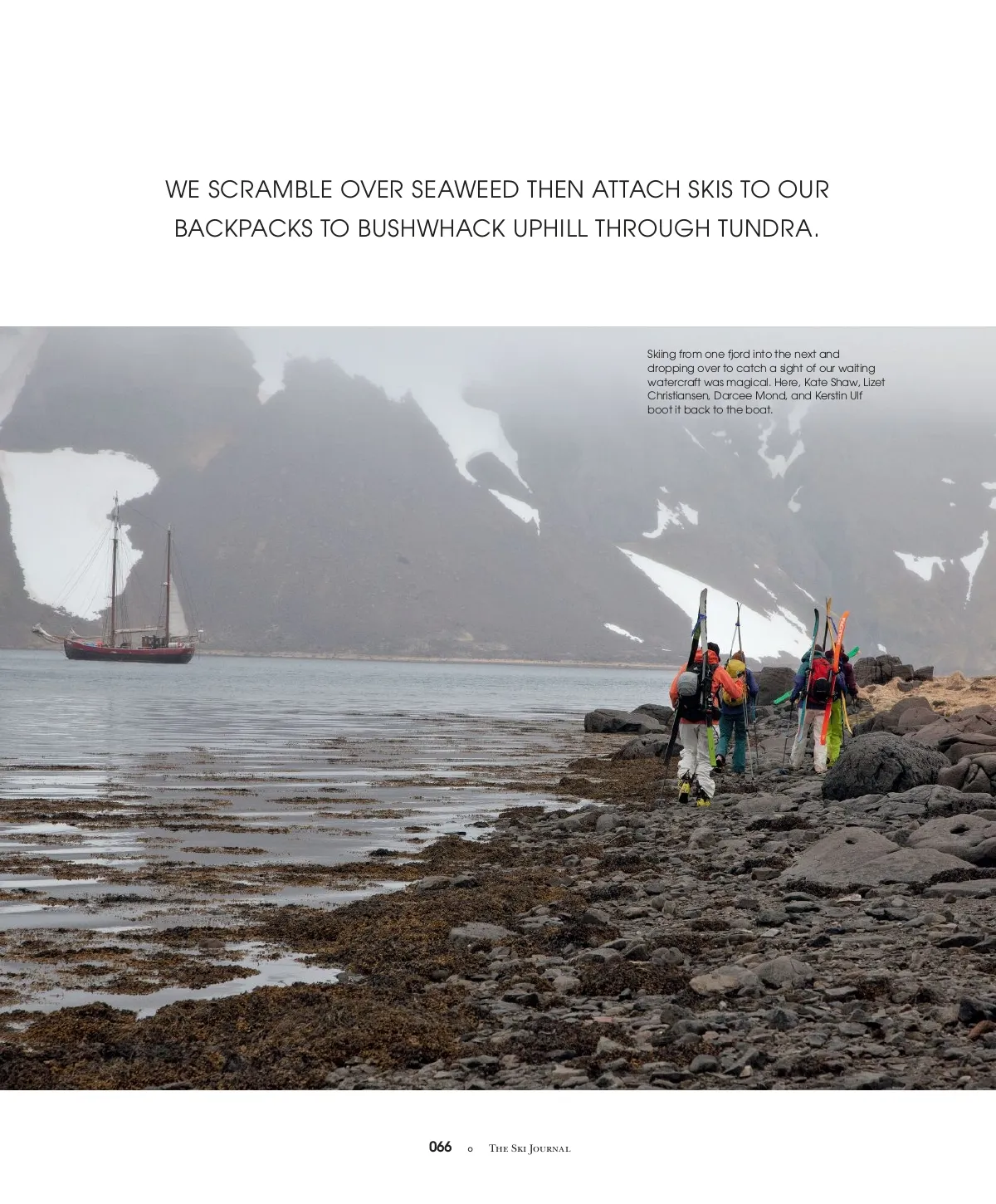
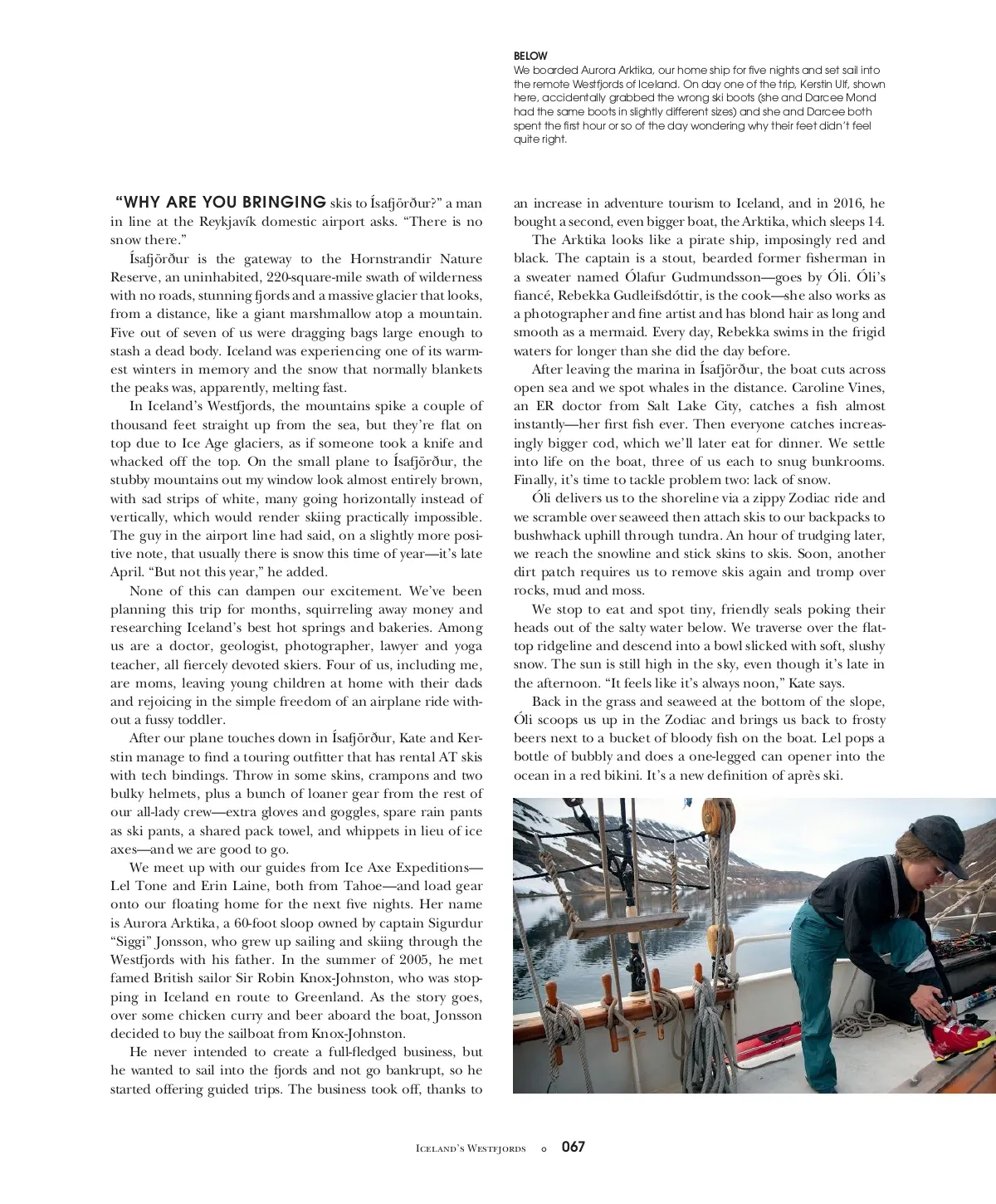
BELOW We boarded Aurora Arktika, our home ship for five nights and set sail into the remote Westfjords of Iceland. On day one of the trip, Kerstin Ulf, shown here, accidentally grabbed the wrong ski boots (she and Darcee Mond had the same boots in slightly different sizes) and she and Darcee both spent the first hour or so of the day wondering why their feet didn’t feel quite right. “WHY ARE YOU BRINGING skis to Ísafjörður?” a man in line at the Reykjavík domestic airport asks. “There is no snow there.” Ísafjörður is the gateway to the Hornstrandir Nature Reserve, an uninhabited, 220-square-mile swath of wilderness with no roads, stunning fjords and a massive glacier that looks, from a distance, like a giant marshmallow atop a mountain. Five out of seven of us were dragging bags large enough to stash a dead body. Iceland was experiencing one of its warm-est winters in memory and the snow that normally blankets the peaks was, apparently, melting fast. In Iceland’s Westfjords, the mountains spike a couple of thousand feet straight up from the sea, but they’re flat on top due to Ice Age glaciers, as if someone took a knife and whacked off the top. On the small plane to Ísafjörður, the stubby mountains out my window look almost entirely brown, with sad strips of white, many going horizontally instead of vertically, which would render skiing practically impossible. The guy in the airport line had said, on a slightly more posi-tive note, that usually there is snow this time of year—it’s late April. “But not this year,” he added. None of this can dampen our excitement. We’ve been planning this trip for months, squirreling away money and researching Iceland’s best hot springs and bakeries. Among us are a doctor, geologist, photographer, lawyer and yoga teacher, all fiercely devoted skiers. Four of us, including me, are moms, leaving young children at home with their dads and rejoicing in the simple freedom of an airplane ride with-out a fussy toddler. After our plane touches down in Ísafjörður, Kate and Ker-stin manage to find a touring outfitter that has rental AT skis with tech bindings. Throw in some skins, crampons and two bulky helmets, plus a bunch of loaner gear from the rest of our all-lady crew—extra gloves and goggles, spare rain pants as ski pants, a shared pack towel, and whippets in lieu of ice axes—and we are good to go. We meet up with our guides from Ice Axe Expeditions— Lel Tone and Erin Laine, both from Tahoe—and load gear onto our floating home for the next five nights. Her name is Aurora Arktika, a 60-foot sloop owned by captain Sigurdur “Siggi” Jonsson, who grew up sailing and skiing through the Westfjords with his father. In the summer of 2005, he met famed British sailor Sir Robin Knox-Johnston, who was stop-ping in Iceland en route to Greenland. As the story goes, over some chicken curry and beer aboard the boat, Jonsson decided to buy the sailboat from Knox-Johnston. He never intended to create a full-fledged business, but he wanted to sail into the fjords and not go bankrupt, so he started offering guided trips. The business took off, thanks to an increase in adventure tourism to Iceland, and in 2016, he bought a second, even bigger boat, the Arktika, which sleeps 14. The Arktika looks like a pirate ship, imposingly red and black. The captain is a stout, bearded former fisherman in a sweater named Ólafur Gudmundsson—goes by Óli. Óli’s fiancé, Rebekka Gudleifsdóttir, is the cook—she also works as a photographer and fine artist and has blond hair as long and smooth as a mermaid. Every day, Rebekka swims in the frigid waters for longer than she did the day before. After leaving the marina in Ísafjörður, the boat cuts across open sea and we spot whales in the distance. Caroline Vines, an ER doctor from Salt Lake City, catches a fish almost instantly—her first fish ever. Then everyone catches increas-ingly bigger cod, which we’ll later eat for dinner. We settle into life on the boat, three of us each to snug bunkrooms. Finally, it’s time to tackle problem two: lack of snow. Óli delivers us to the shoreline via a zippy Zodiac ride and we scramble over seaweed then attach skis to our backpacks to bushwhack uphill through tundra. An hour of trudging later, we reach the snowline and stick skins to skis. Soon, another dirt patch requires us to remove skis again and tromp over rocks, mud and moss. We stop to eat and spot tiny, friendly seals poking their heads out of the salty water below. We traverse over the flat-top ridgeline and descend into a bowl slicked with soft, slushy snow. The sun is still high in the sky, even though it’s late in the afternoon. “It feels like it’s always noon,” Kate says. Back in the grass and seaweed at the bottom of the slope, Óli scoops us up in the Zodiac and brings us back to frosty beers next to a bucket of bloody fish on the boat. Lel pops a bottle of bubbly and does a one-legged can opener into the ocean in a red bikini. It’s a new definition of après ski. Iceland’s Westfjords 067
The Ski Journal Volume 13, Issue 3: Page 67