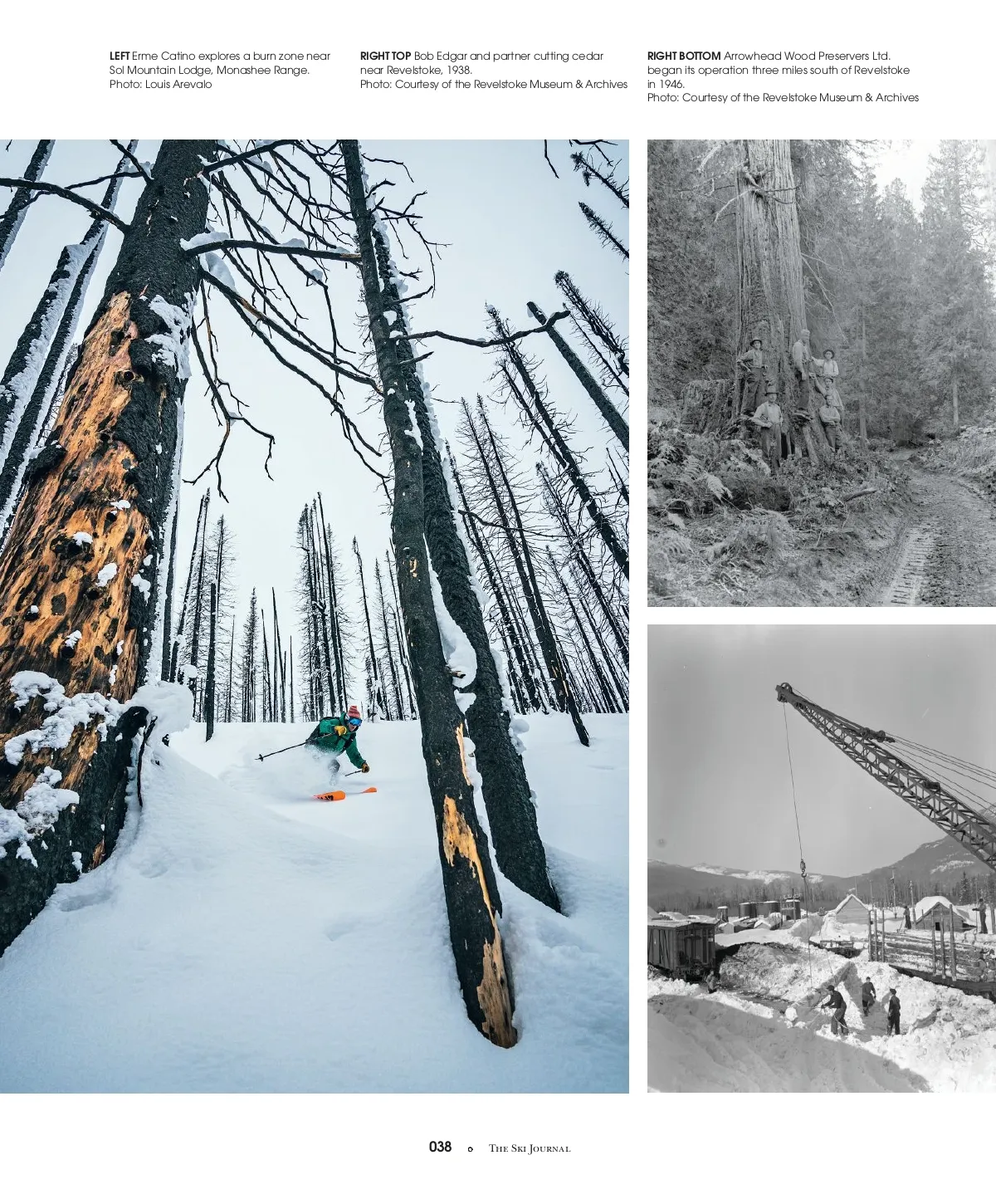
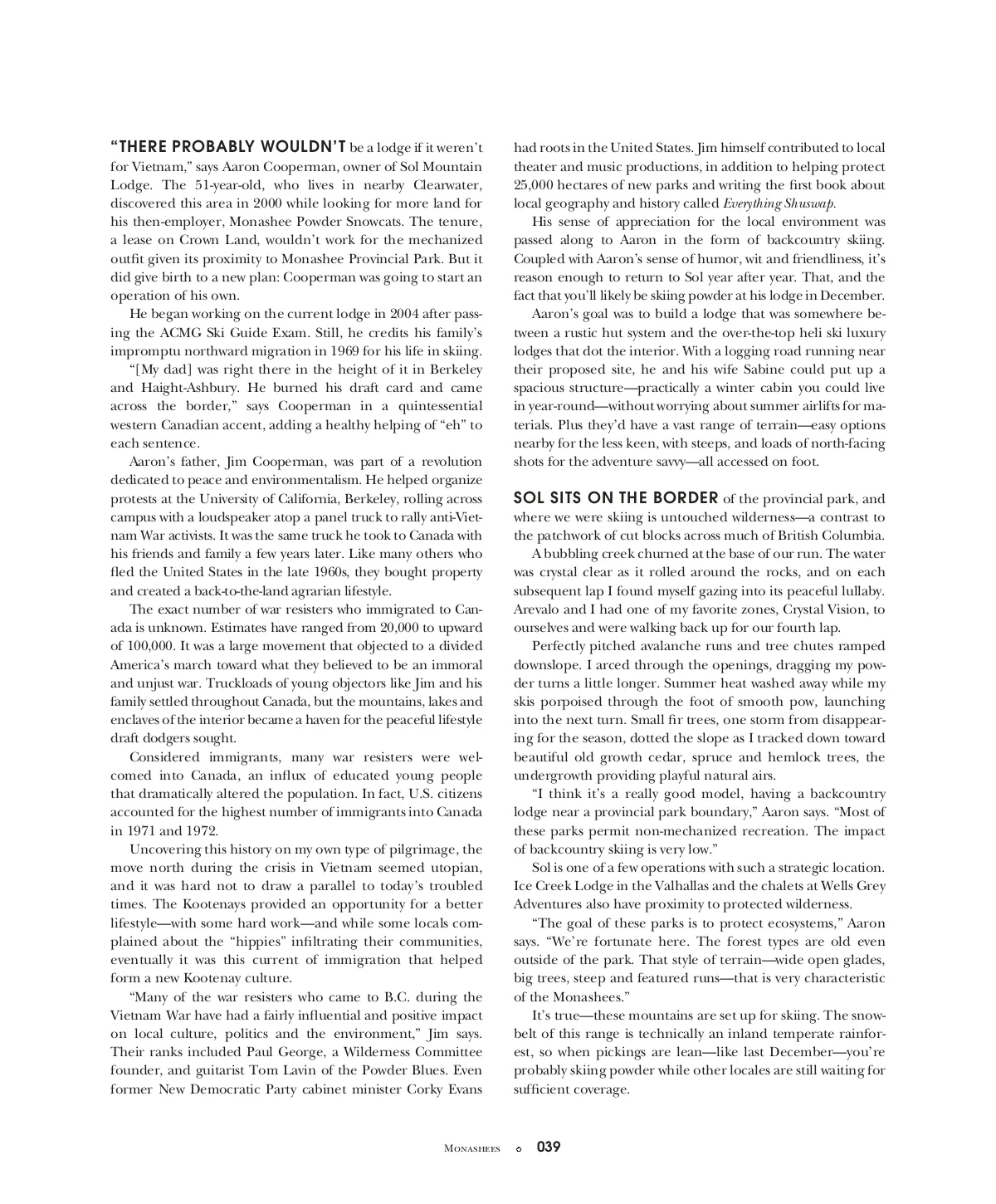
“THERE PROBABLY WOULDN’T be a lodge if it weren’t for Vietnam,” says Aaron Cooperman, owner of Sol Mountain Lodge. The 51-year-old, who lives in nearby Clearwater, discovered this area in 2000 while looking for more land for his then-employer, Monashee Powder Snowcats. The tenure, a lease on Crown Land, wouldn’t work for the mechanized outfit given its proximity to Monashee Provincial Park. But it did give birth to a new plan: Cooperman was going to start an operation of his own. He began working on the current lodge in 2004 after pass-ing the ACMG Ski Guide Exam. Still, he credits his family’s impromptu northward migration in 1969 for his life in skiing. “[My dad] was right there in the height of it in Berkeley and Haight-Ashbury. He burned his draft card and came across the border,” says Cooperman in a quintessential western Canadian accent, adding a healthy helping of “eh” to each sentence. Aaron’s father, Jim Cooperman, was part of a revolution dedicated to peace and environmentalism. He helped organize protests at the University of California, Berkeley, rolling across campus with a loudspeaker atop a panel truck to rally anti-Viet-nam War activists. It was the same truck he took to Canada with his friends and family a few years later. Like many others who fled the United States in the late 1960s, they bought property and created a back-to-the-land agrarian lifestyle. The exact number of war resisters who immigrated to Can-ada is unknown. Estimates have ranged from 20,000 to upward of 100,000. It was a large movement that objected to a divided America’s march toward what they believed to be an immoral and unjust war. Truckloads of young objectors like Jim and his family settled throughout Canada, but the mountains, lakes and enclaves of the interior became a haven for the peaceful lifestyle draft dodgers sought. Considered immigrants, many war resisters were wel-comed into Canada, an influx of educated young people that dramatically altered the population. In fact, U.S. citizens accounted for the highest number of immigrants into Canada in 1971 and 1972. Uncovering this history on my own type of pilgrimage, the move north during the crisis in Vietnam seemed utopian, and it was hard not to draw a parallel to today’s troubled times. The Kootenays provided an opportunity for a better lifestyle—with some hard work—and while some locals com-plained about the “hippies” infiltrating their communities, eventually it was this current of immigration that helped form a new Kootenay culture. “Many of the war resisters who came to B.C. during the Vietnam War have had a fairly influential and positive impact on local culture, politics and the environment,” Jim says. Their ranks included Paul George, a Wilderness Committee founder, and guitarist Tom Lavin of the Powder Blues. Even former New Democratic Party cabinet minister Corky Evans had roots in the United States. Jim himself contributed to local theater and music productions, in addition to helping protect 25,000 hectares of new parks and writing the first book about local geography and history called Everything Shuswap. His sense of appreciation for the local environment was passed along to Aaron in the form of backcountry skiing. Coupled with Aaron’s sense of humor, wit and friendliness, it’s reason enough to return to Sol year after year. That, and the fact that you’ll likely be skiing powder at his lodge in December. Aaron’s goal was to build a lodge that was somewhere be-tween a rustic hut system and the over-the-top heli ski luxury lodges that dot the interior. With a logging road running near their proposed site, he and his wife Sabine could put up a spacious structure—practically a winter cabin you could live in year-round—without worrying about summer airlifts for ma-terials. Plus they’d have a vast range of terrain—easy options nearby for the less keen, with steeps, and loads of north-facing shots for the adventure savvy—all accessed on foot. SOL SITS ON THE BORDER of the provincial park, and where we were skiing is untouched wilderness—a contrast to the patchwork of cut blocks across much of British Columbia. A bubbling creek churned at the base of our run. The water was crystal clear as it rolled around the rocks, and on each subsequent lap I found myself gazing into its peaceful lullaby. Arevalo and I had one of my favorite zones, Crystal Vision, to ourselves and were walking back up for our fourth lap. Perfectly pitched avalanche runs and tree chutes ramped downslope. I arced through the openings, dragging my pow-der turns a little longer. Summer heat washed away while my skis porpoised through the foot of smooth pow, launching into the next turn. Small fir trees, one storm from disappear-ing for the season, dotted the slope as I tracked down toward beautiful old growth cedar, spruce and hemlock trees, the undergrowth providing playful natural airs. “I think it’s a really good model, having a backcountry lodge near a provincial park boundary,” Aaron says. “Most of these parks permit non-mechanized recreation. The impact of backcountry skiing is very low.” Sol is one of a few operations with such a strategic location. Ice Creek Lodge in the Valhallas and the chalets at Wells Grey Adventures also have proximity to protected wilderness. “The goal of these parks is to protect ecosystems,” Aaron says. “We’re fortunate here. The forest types are old even outside of the park. That style of terrain—wide open glades, big trees, steep and featured runs—that is very characteristic of the Monashees.” It’s true—these mountains are set up for skiing. The snow-belt of this range is technically an inland temperate rainfor-est, so when pickings are lean—like last December—you’re probably skiing powder while other locales are still waiting for sufficient coverage. Monashees 039
The Ski Journal Volume 14, Issue 1: Page 39