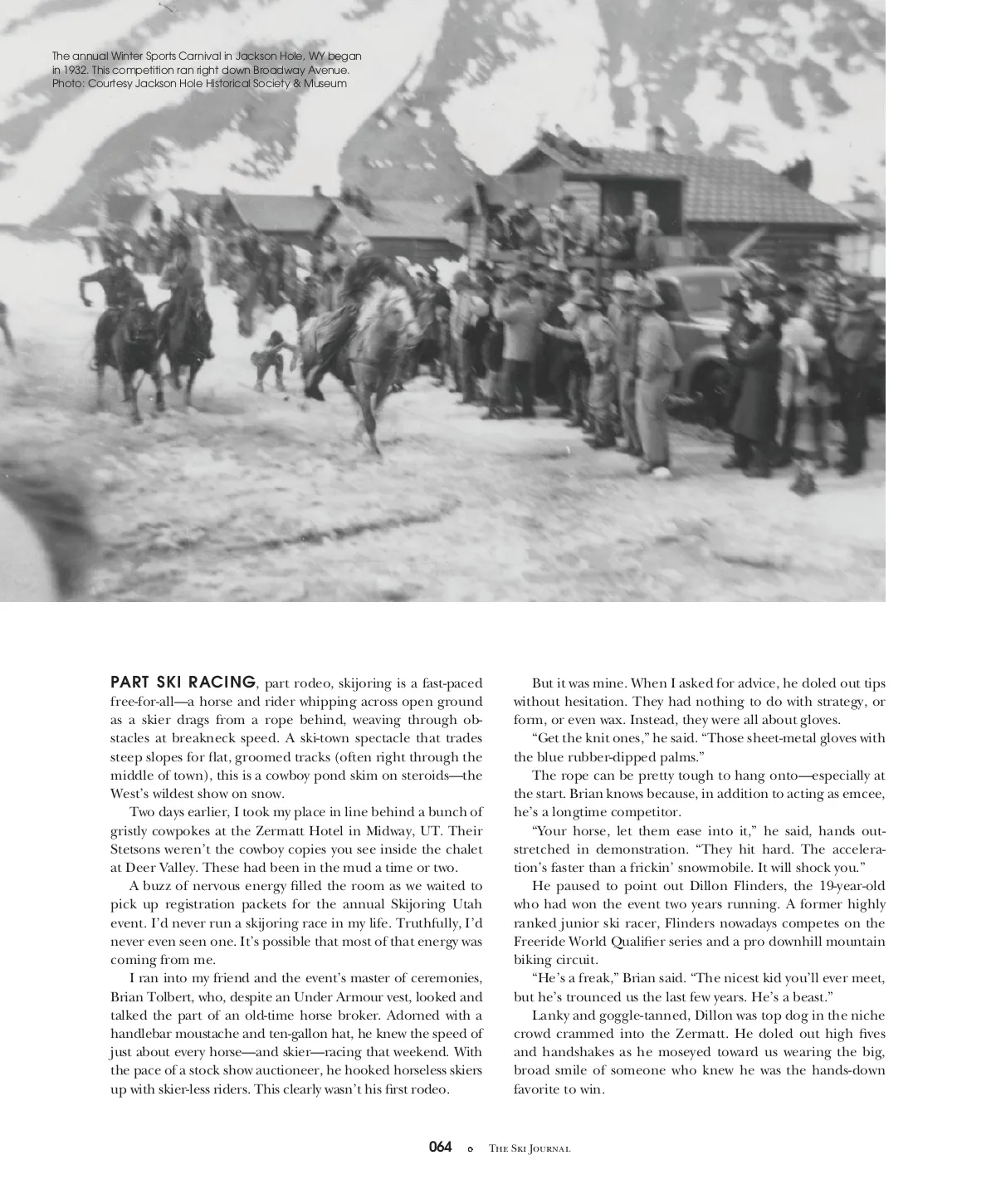
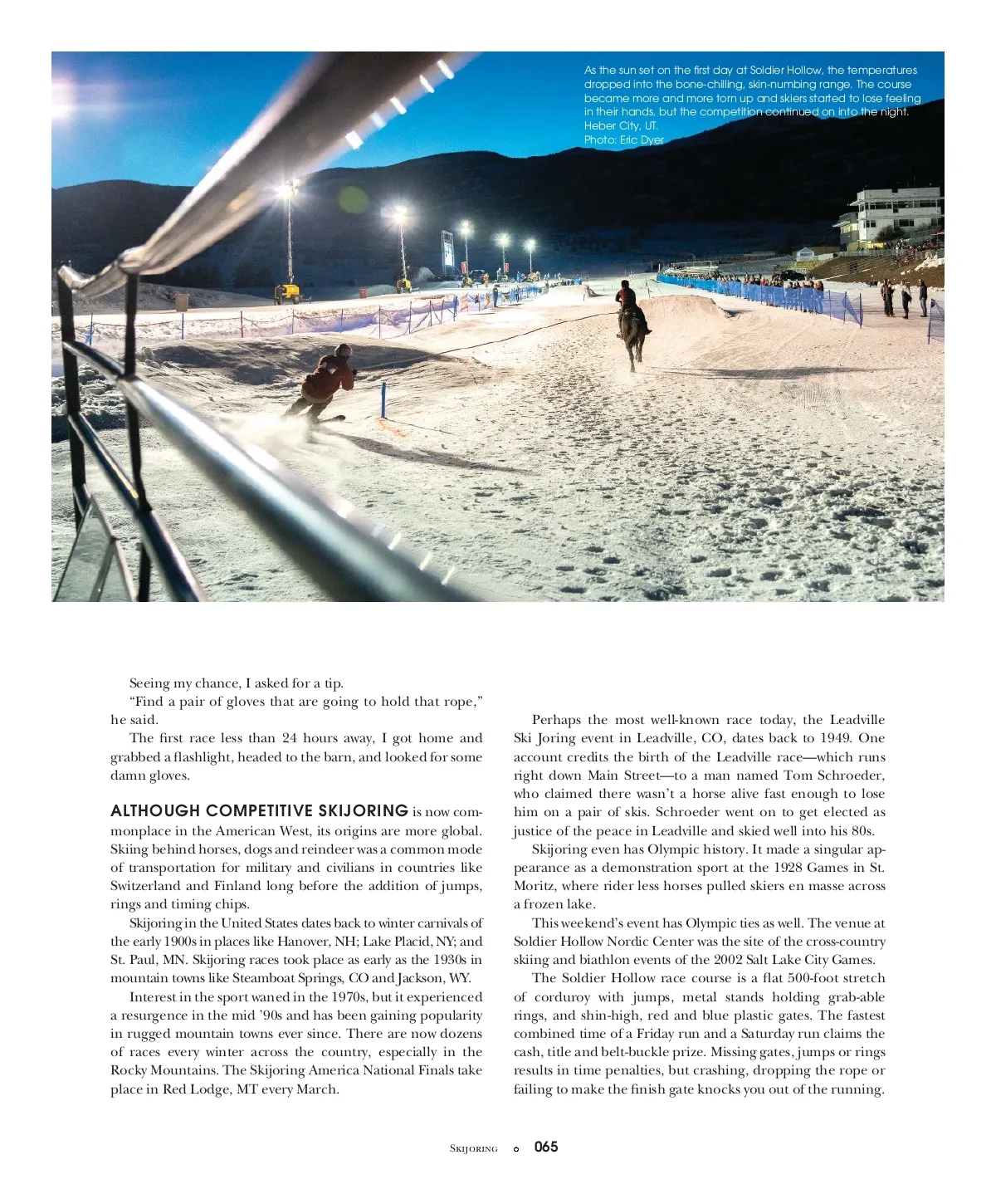
As the sun set on the first day at Soldier Hollow, the temperatures dropped into the bone-chilling, skin-numbing range. The course became more and more torn up and skiers started to lose feeling in their hands, but the competition continued on into the night. Heber City, UT. Photo: Eric Dyer Seeing my chance, I asked for a tip. “Find a pair of gloves that are going to hold that rope,” he said. The first race less than 24 hours away, I got home and grabbed a flashlight, headed to the barn, and looked for some damn gloves. ALTHOUGH COMPETITIVE SKIJORING is now com-monplace in the American West, its origins are more global. Skiing behind horses, dogs and reindeer was a common mode of transportation for military and civilians in countries like Switzerland and Finland long before the addition of jumps, rings and timing chips. Skijoring in the United States dates back to winter carnivals of the early 1900s in places like Hanover, NH; Lake Placid, NY; and St. Paul, MN. Skijoring races took place as early as the 1930s in mountain towns like Steamboat Springs, CO and Jackson, WY. Interest in the sport waned in the 1970s, but it experienced a resurgence in the mid ’90s and has been gaining popularity in rugged mountain towns ever since. There are now dozens of races every winter across the country, especially in the Rocky Mountains. The Skijoring America National Finals take place in Red Lodge, MT every March. Perhaps the most well-known race today, the Leadville Ski Joring event in Leadville, CO, dates back to 1949. One account credits the birth of the Leadville race—which runs right down Main Street—to a man named Tom Schroeder, who claimed there wasn’t a horse alive fast enough to lose him on a pair of skis. Schroeder went on to get elected as justice of the peace in Leadville and skied well into his 80s. Skijoring even has Olympic history. It made a singular ap-pearance as a demonstration sport at the 1928 Games in St. Moritz, where rider less horses pulled skiers en masse across a frozen lake. This weekend’s event has Olympic ties as well. The venue at Soldier Hollow Nordic Center was the site of the cross-country skiing and biathlon events of the 2002 Salt Lake City Games. The Soldier Hollow race course is a flat 500-foot stretch of corduroy with jumps, metal stands holding grab-able rings, and shin-high, red and blue plastic gates. The fastest combined time of a Friday run and a Saturday run claims the cash, title and belt-buckle prize. Missing gates, jumps or rings results in time penalties, but crashing, dropping the rope or failing to make the finish gate knocks you out of the running. Skijoring 065
The Ski Journal Volume 14, Issue 1: Page 65