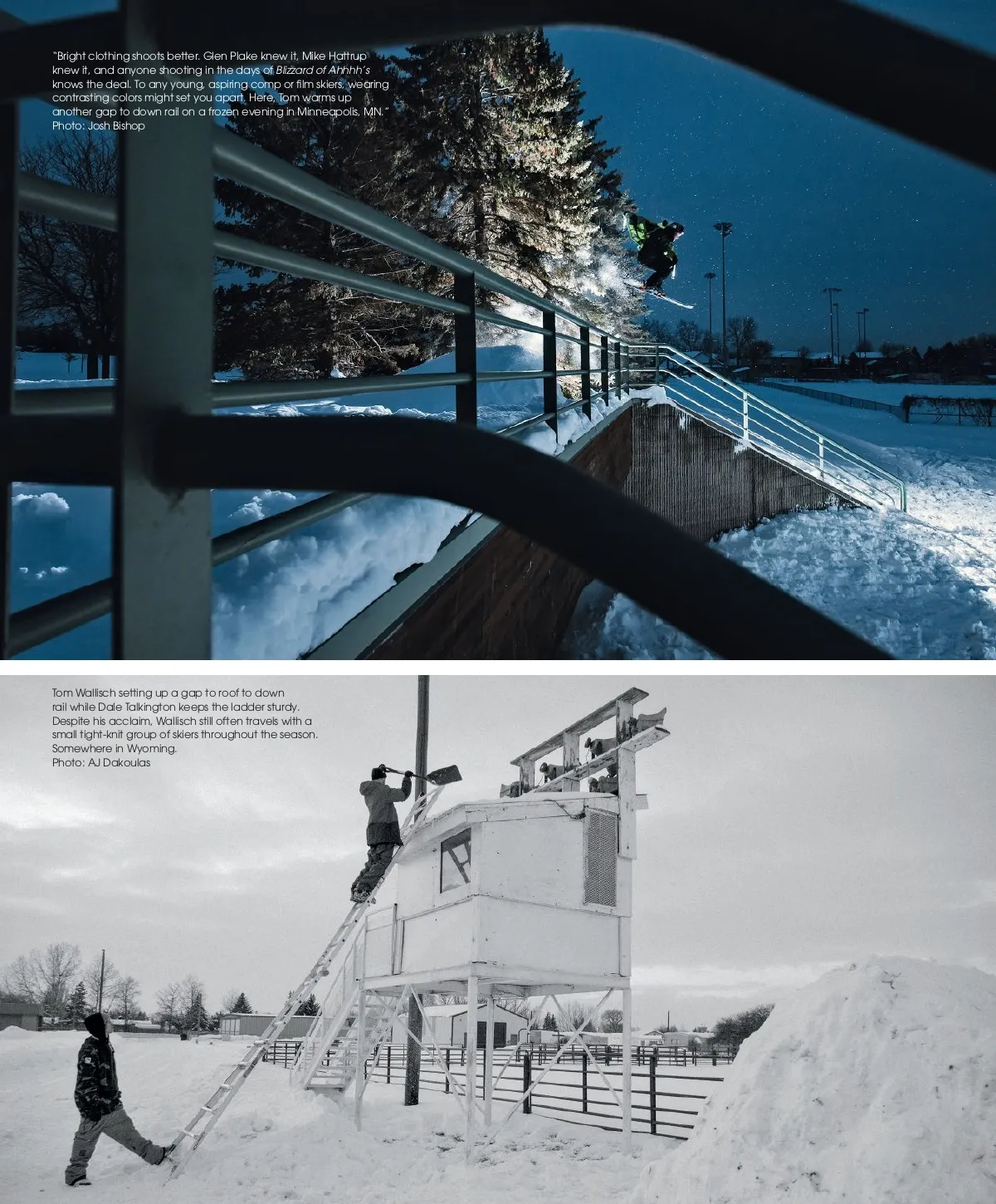
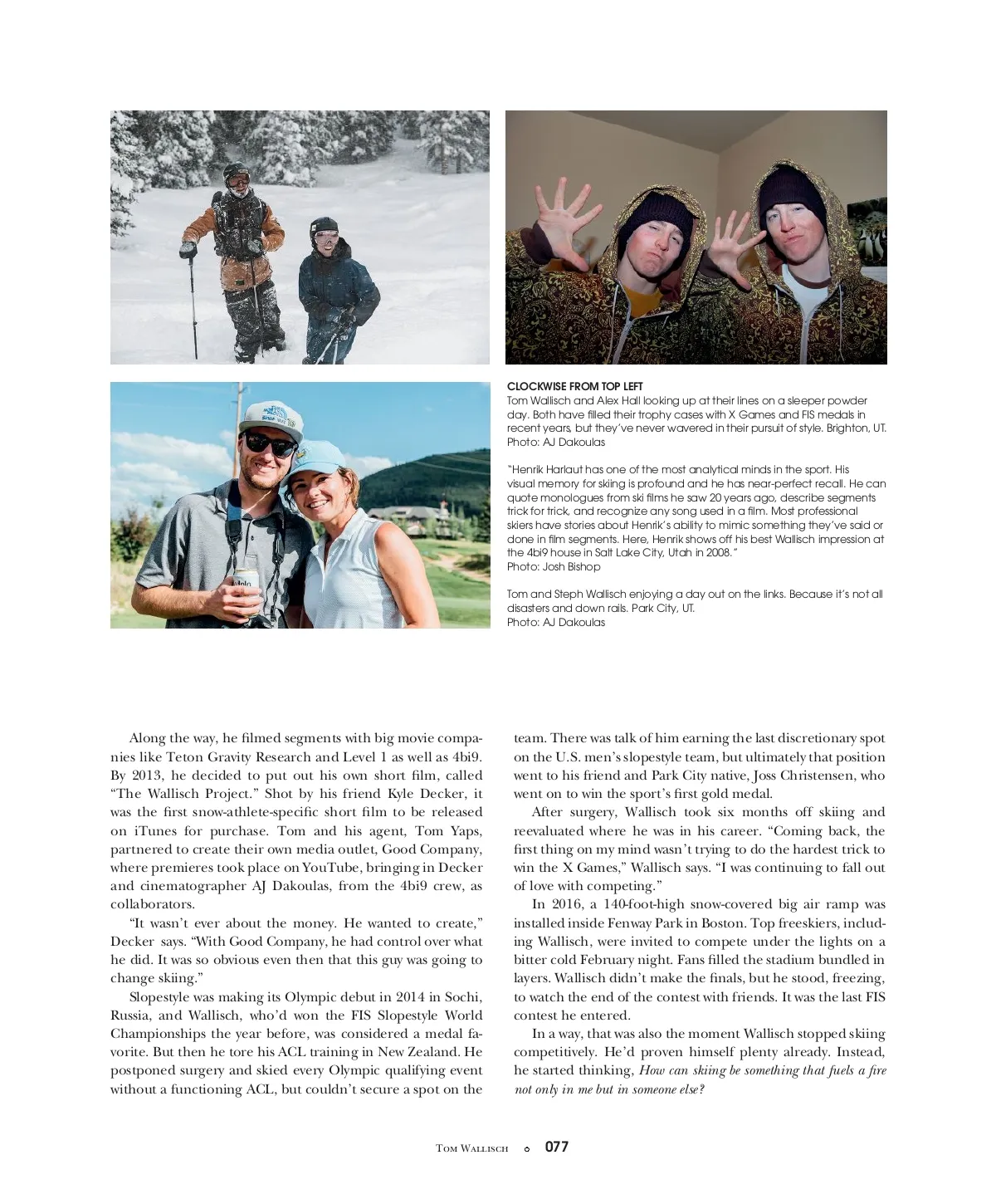
CLOCKWISE FROM TOP LEFT Tom Wallisch and Alex Hall looking up at their lines on a sleeper powder day. Both have filled their trophy cases with X Games and FIS medals in recent years, but they’ve never wavered in their pursuit of style. Brighton, UT. Photo: AJ Dakoulas “Henrik Harlaut has one of the most analytical minds in the sport. His visual memory for skiing is profound and he has near-perfect recall. He can quote monologues from ski films he saw 20 years ago, describe segments trick for trick, and recognize any song used in a film. Most professional skiers have stories about Henrik’s ability to mimic something they’ve said or done in film segments. Here, Henrik shows off his best Wallisch impression at the 4bi9 house in Salt Lake City, Utah in 2008.” Photo: Josh Bishop Tom and Steph Wallisch enjoying a day out on the links. Because it’s not all disasters and down rails. Park City, UT. Photo: AJ Dakoulas Along the way, he filmed segments with big movie compa-nies like Teton Gravity Research and Level 1 as well as 4bi9. By 2013, he decided to put out his own short film, called “The Wallisch Project.” Shot by his friend Kyle Decker, it was the first snow-athlete-specific short film to be released on iTunes for purchase. Tom and his agent, Tom Yaps, partnered to create their own media outlet, Good Company, where premieres took place on YouTube, bringing in Decker and cinematographer AJ Dakoulas, from the 4bi9 crew, as collaborators. “It wasn’t ever about the money. He wanted to create,” Decker says. “With Good Company, he had control over what he did. It was so obvious even then that this guy was going to change skiing.” Slopestyle was making its Olympic debut in 2014 in Sochi, Russia, and Wallisch, who’d won the FIS Slopestyle World Championships the year before, was considered a medal fa-vorite. But then he tore his ACL training in New Zealand. He postponed surgery and skied every Olympic qualifying event without a functioning ACL, but couldn’t secure a spot on the team. There was talk of him earning the last discretionary spot on the U.S. men’s slopestyle team, but ultimately that position went to his friend and Park City native, Joss Christensen, who went on to win the sport’s first gold medal. After surgery, Wallisch took six months off skiing and reevaluated where he was in his career. “Coming back, the first thing on my mind wasn’t trying to do the hardest trick to win the X Games,” Wallisch says. “I was continuing to fall out of love with competing.” In 2016, a 140-foot-high snow-covered big air ramp was installed inside Fenway Park in Boston. Top freeskiers, includ-ing Wallisch, were invited to compete under the lights on a bitter cold February night. Fans filled the stadium bundled in layers. Wallisch didn’t make the finals, but he stood, freezing, to watch the end of the contest with friends. It was the last FIS contest he entered. In a way, that was also the moment Wallisch stopped skiing competitively. He’d proven himself plenty already. Instead, he started thinking, How can skiing be something that fuels a fire not only in me but in someone else? Tom Wallisch 077
The Ski Journal Volume 14, Issue 1: Page 77