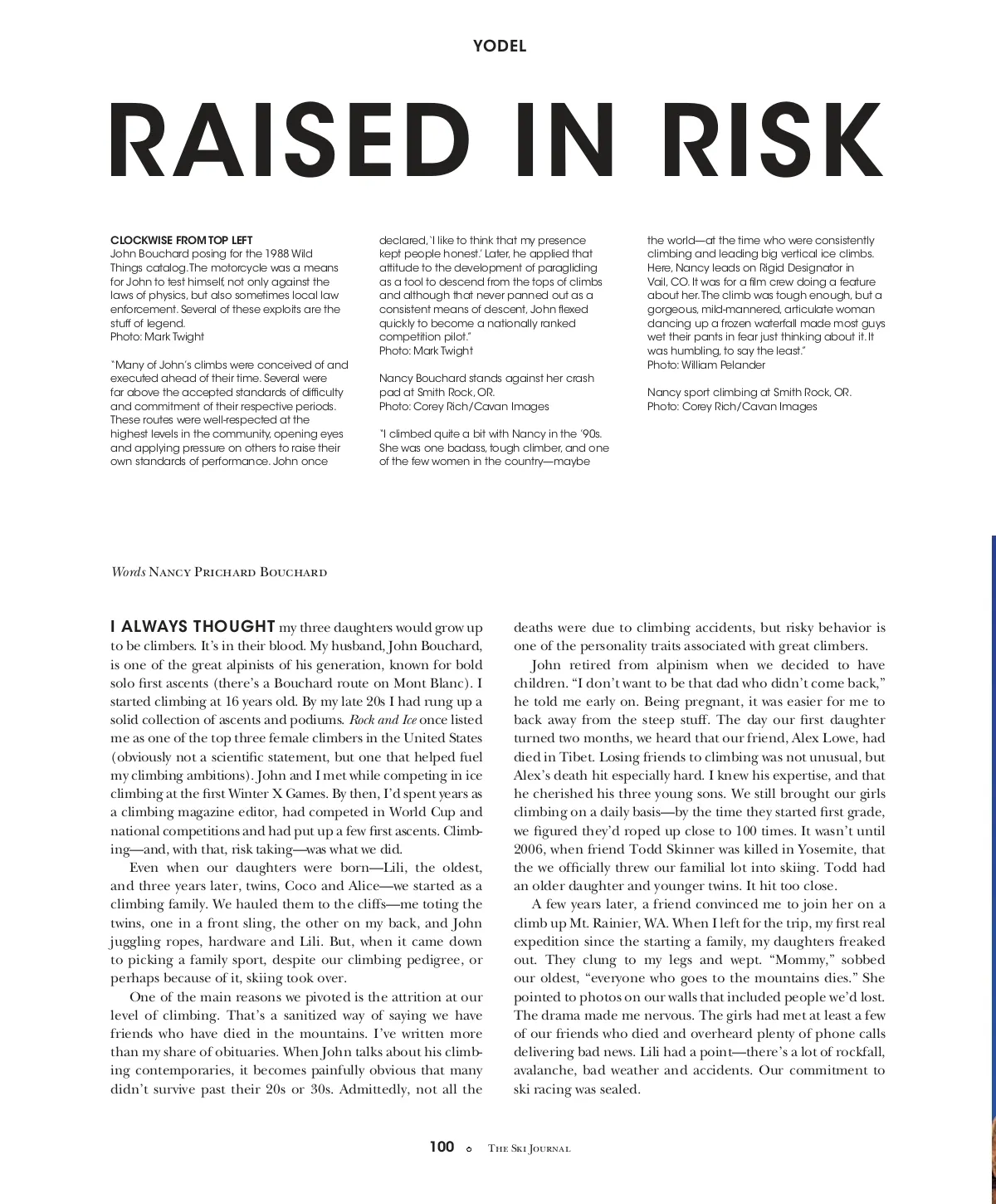
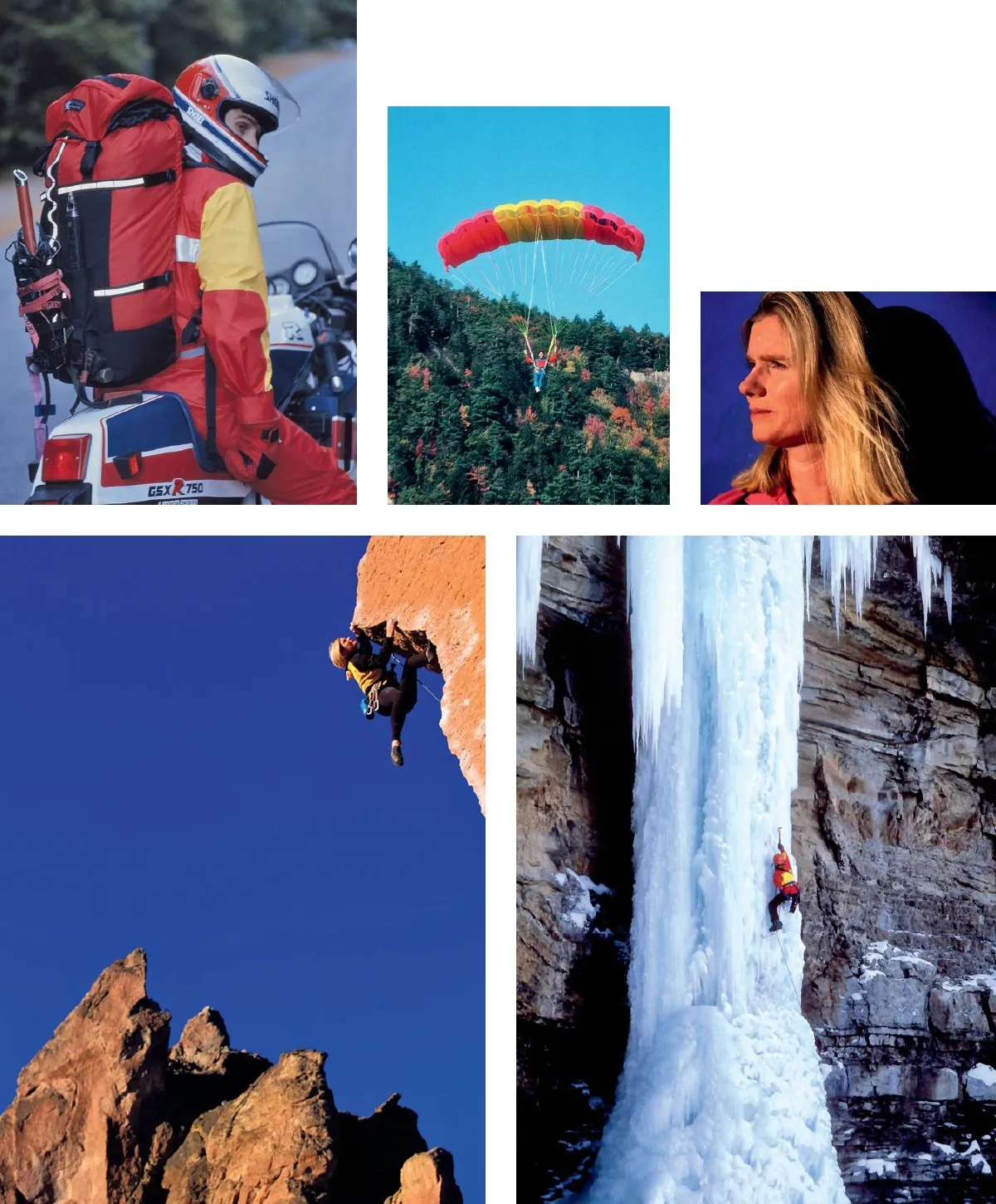
YODEL RAISED IN RISK CLOCKWISE FROM TOP LEFT John Bouchard posing for the 1988 Wild Things catalog. The motorcycle was a means for John to test himself, not only against the laws of physics, but also sometimes local law enforcement. Several of these exploits are the stuff of legend. Photo: Mark Twight “Many of John’s climbs were conceived of and executed ahead of their time. Several were far above the accepted standards of difficulty and commitment of their respective periods. These routes were well-respected at the highest levels in the community, opening eyes and applying pressure on others to raise their own standards of performance. John once declared, ‘I like to think that my presence kept people honest.’ Later, he applied that attitude to the development of paragliding as a tool to descend from the tops of climbs and although that never panned out as a consistent means of descent, John flexed quickly to become a nationally ranked competition pilot.” Photo: Mark Twight Nancy Bouchard stands against her crash pad at Smith Rock, OR. Photo: Corey Rich/Cavan Images “I climbed quite a bit with Nancy in the ’90s. She was one badass, tough climber, and one of the few women in the country—maybe the world—at the time who were consistently climbing and leading big vertical ice climbs. Here, Nancy leads on Rigid Designator in Vail, CO. It was for a film crew doing a feature about her. The climb was tough enough, but a gorgeous, mild-mannered, articulate woman dancing up a frozen waterfall made most guys wet their pants in fear just thinking about it. It was humbling, to say the least.” Photo: William Pelander Nancy sport climbing at Smith Rock, OR. Photo: Corey Rich/Cavan Images Words Nancy Prichard Bouchard I ALWAYS THOUGHT my three daughters would grow up to be climbers. It’s in their blood. My husband, John Bouchard, is one of the great alpinists of his generation, known for bold solo first ascents (there’s a Bouchard route on Mont Blanc). I started climbing at 16 years old. By my late 20s I had rung up a solid collection of ascents and podiums. Rock and Ice once listed me as one of the top three female climbers in the United States (obviously not a scientific statement, but one that helped fuel my climbing ambitions). John and I met while competing in ice climbing at the first Winter X Games. By then, I’d spent years as a climbing magazine editor, had competed in World Cup and national competitions and had put up a few first ascents. Climb-ing—and, with that, risk taking—was what we did. Even when our daughters were born—Lili, the oldest, and three years later, twins, Coco and Alice—we started as a climbing family. We hauled them to the cliffs—me toting the twins, one in a front sling, the other on my back, and John juggling ropes, hardware and Lili. But, when it came down to picking a family sport, despite our climbing pedigree, or perhaps because of it, skiing took over. One of the main reasons we pivoted is the attrition at our level of climbing. That’s a sanitized way of saying we have friends who have died in the mountains. I’ve written more than my share of obituaries. When John talks about his climb-ing contemporaries, it becomes painfully obvious that many didn’t survive past their 20s or 30s. Admittedly, not all the deaths were due to climbing accidents, but risky behavior is one of the personality traits associated with great climbers. John retired from alpinism when we decided to have children. “I don’t want to be that dad who didn’t come back,” he told me early on. Being pregnant, it was easier for me to back away from the steep stuff. The day our first daughter turned two months, we heard that our friend, Alex Lowe, had died in Tibet. Losing friends to climbing was not unusual, but Alex’s death hit especially hard. I knew his expertise, and that he cherished his three young sons. We still brought our girls climbing on a daily basis—by the time they started first grade, we figured they’d roped up close to 100 times. It wasn’t until 2006, when friend Todd Skinner was killed in Yosemite, that the we officially threw our familial lot into skiing. Todd had an older daughter and younger twins. It hit too close. A few years later, a friend convinced me to join her on a climb up Mt. Rainier, WA. When I left for the trip, my first real expedition since the starting a family, my daughters freaked out. They clung to my legs and wept. “Mommy,” sobbed our oldest, “everyone who goes to the mountains dies.” She pointed to photos on our walls that included people we’d lost. The drama made me nervous. The girls had met at least a few of our friends who died and overheard plenty of phone calls delivering bad news. Lili had a point—there’s a lot of rockfall, avalanche, bad weather and accidents. Our commitment to ski racing was sealed. 100 The Ski Journal
The Ski Journal Volume 14, Issue 3: Page 100