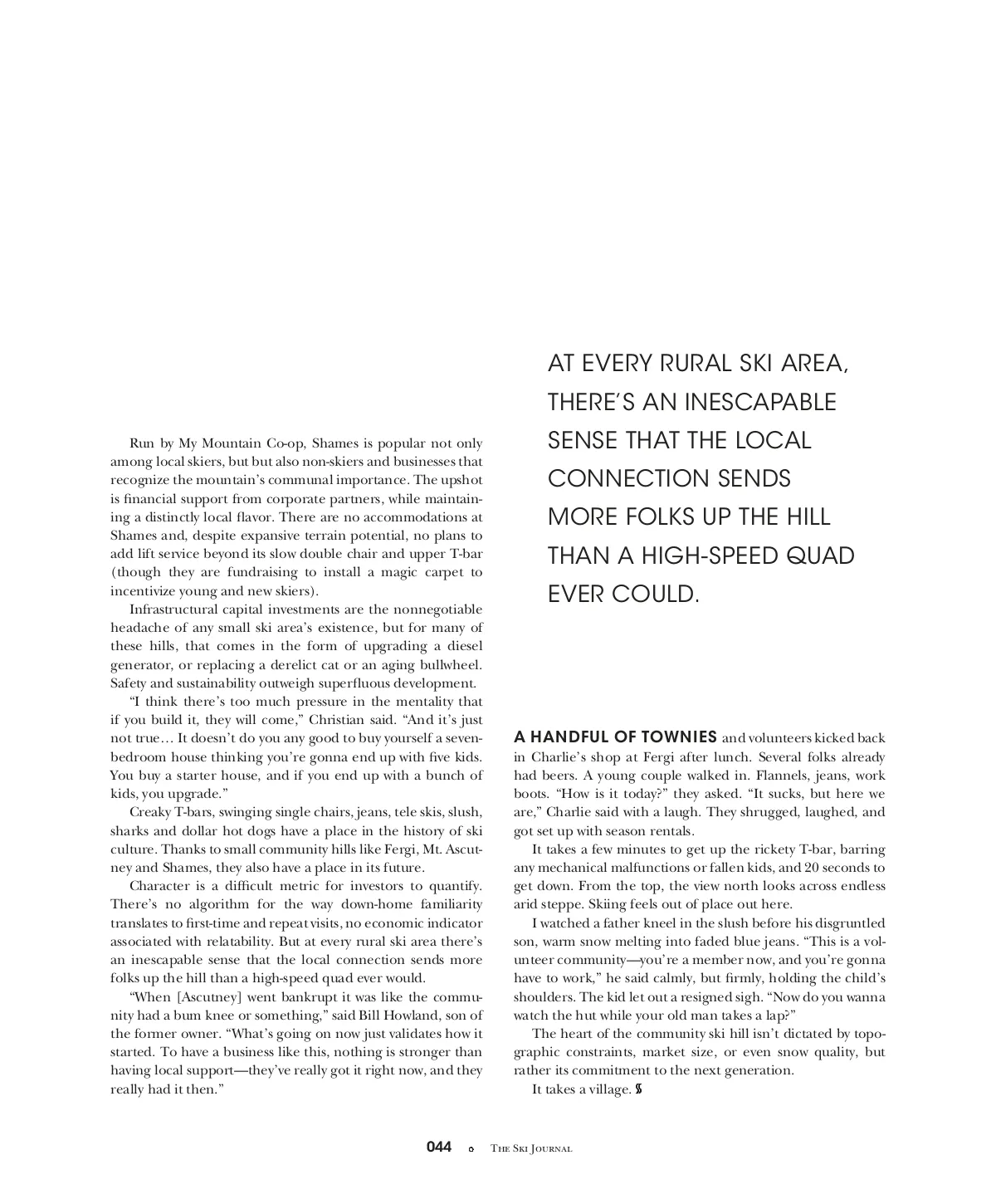
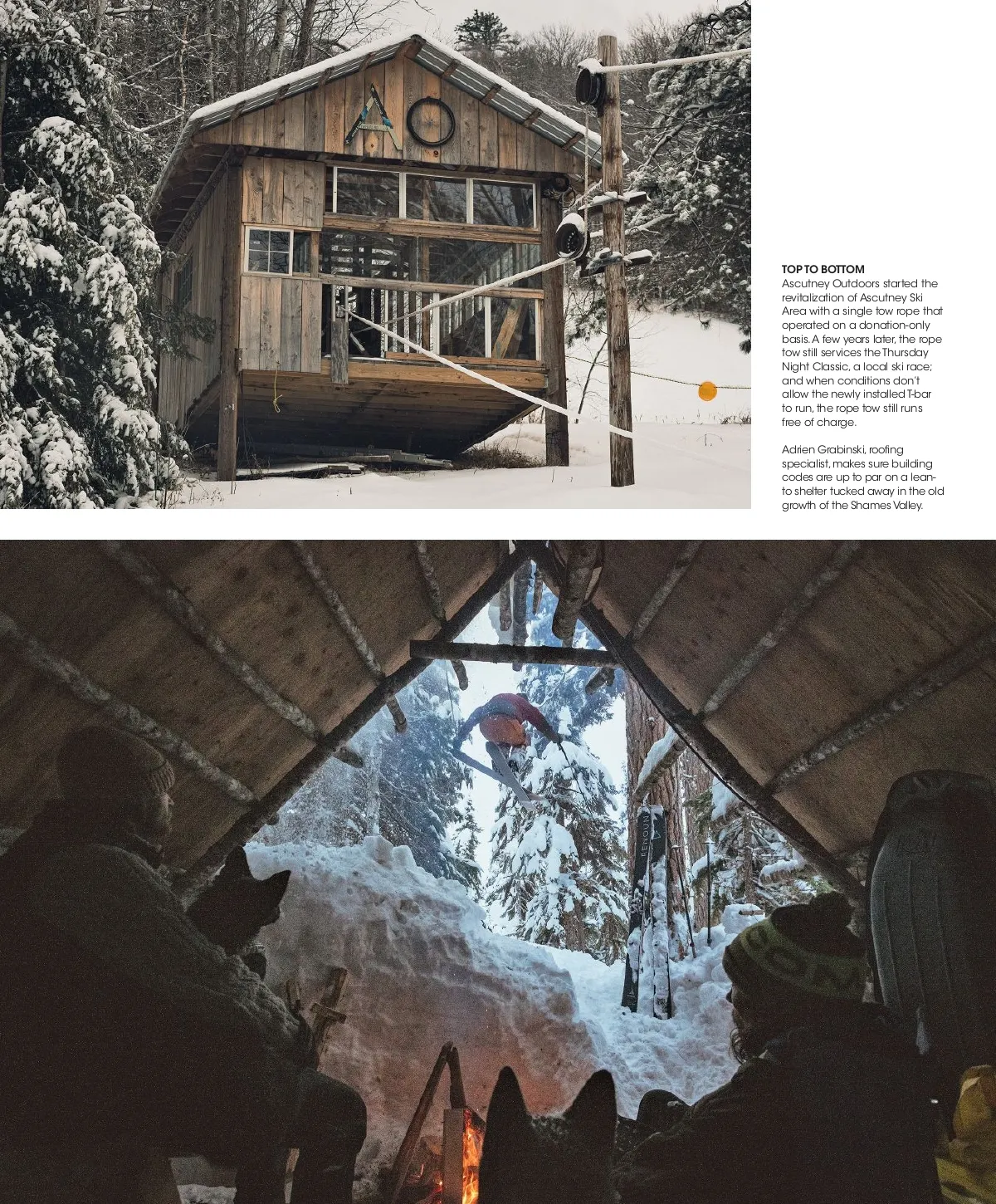
AT EVERY RURAL SKI AREA, THERE’S AN INESCAPABLE Run by My Mountain Co-op, Shames is popular not only among local skiers, but but also non-skiers and businesses that recognize the mountain’s communal importance. The upshot is financial support from corporate partners, while maintain-ing a distinctly local flavor. There are no accommodations at Shames and, despite expansive terrain potential, no plans to add lift service beyond its slow double chair and upper T-bar (though they are fundraising to install a magic carpet to incentivize young and new skiers). Infrastructural capital investments are the nonnegotiable headache of any small ski area’s existence, but for many of these hills, that comes in the form of upgrading a diesel generator, or replacing a derelict cat or an aging bullwheel. Safety and sustainability outweigh superfluous development. “I think there’s too much pressure in the mentality that if you build it, they will come,” Christian said. “And it’s just not true… It doesn’t do you any good to buy yourself a seven-bedroom house thinking you’re gonna end up with five kids. You buy a starter house, and if you end up with a bunch of kids, you upgrade.” Creaky T-bars, swinging single chairs, jeans, tele skis, slush, sharks and dollar hot dogs have a place in the history of ski culture. Thanks to small community hills like Fergi, Mt. Ascut-ney and Shames, they also have a place in its future. Character is a difficult metric for investors to quantify. There’s no algorithm for the way down-home familiarity translates to first-time and repeat visits, no economic indicator associated with relatability. But at every rural ski area there’s an inescapable sense that the local connection sends more folks up the hill than a high-speed quad ever would. “When [Ascutney] went bankrupt it was like the commu-nity had a bum knee or something,” said Bill Howland, son of the former owner. “What’s going on now just validates how it started. To have a business like this, nothing is stronger than having local support—they’ve really got it right now, and they really had it then.” SENSE THAT THE LOCAL CONNECTION SENDS MORE FOLKS UP THE HILL THAN A HIGH-SPEED QUAD EVER COULD. A HANDFUL OF TOWNIES and volunteers kicked back in Charlie’s shop at Fergi after lunch. Several folks already had beers. A young couple walked in. Flannels, jeans, work boots. “How is it today?” they asked. “It sucks, but here we are,” Charlie said with a laugh. They shrugged, laughed, and got set up with season rentals. It takes a few minutes to get up the rickety T-bar, barring any mechanical malfunctions or fallen kids, and 20 seconds to get down. From the top, the view north looks across endless arid steppe. Skiing feels out of place out here. I watched a father kneel in the slush before his disgruntled son, warm snow melting into faded blue jeans. “This is a vol-unteer community—you’re a member now, and you’re gonna have to work,” he said calmly, but firmly, holding the child’s shoulders. The kid let out a resigned sigh. “Now do you wanna watch the hut while your old man takes a lap?” The heart of the community ski hill isn’t dictated by topo-graphic constraints, market size, or even snow quality, but rather its commitment to the next generation. It takes a village. 044 The Ski Journal
The Ski Journal Volume 14, Issue 3: Page 44