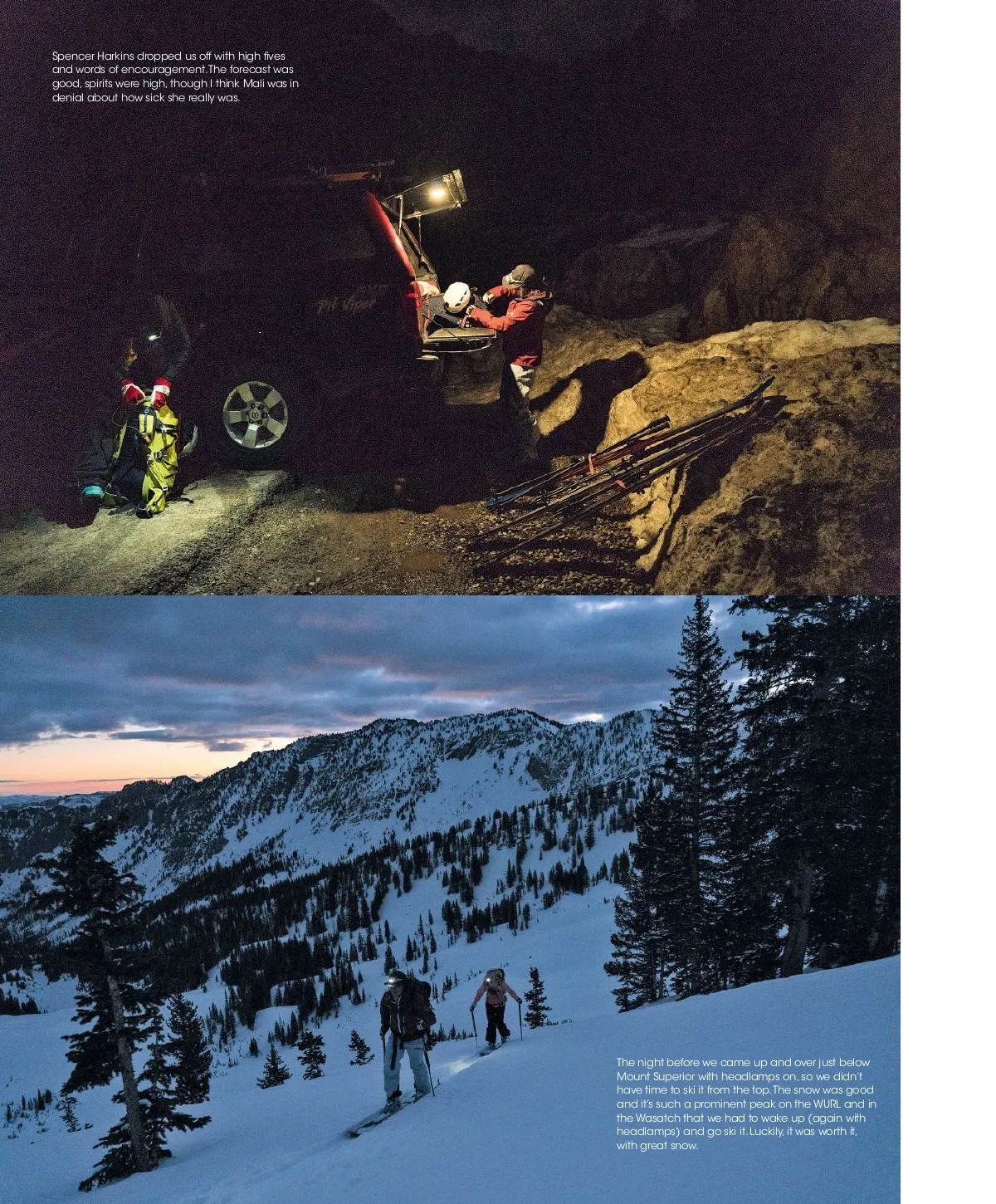
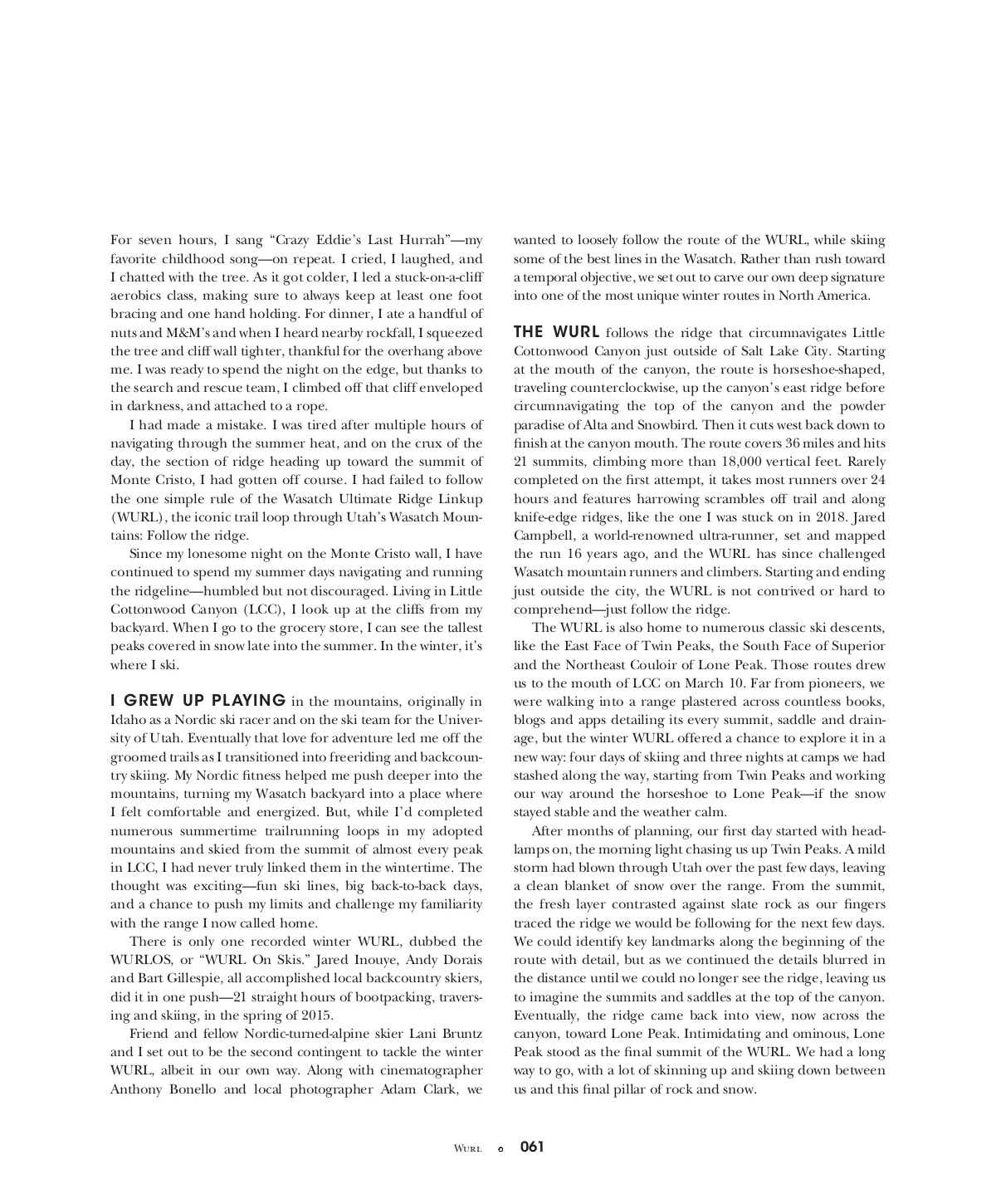
For seven hours, I sang “Crazy Eddie’s Last Hurrah”—my favorite childhood song—on repeat. I cried, I laughed, and I chatted with the tree. As it got colder, I led a stuck-on-a-cliff aerobics class, making sure to always keep at least one foot bracing and one hand holding. For dinner, I ate a handful of nuts and M&M’s and when I heard nearby rockfall, I squeezed the tree and cliff wall tighter, thankful for the overhang above me. I was ready to spend the night on the edge, but thanks to the search and rescue team, I climbed off that cliff enveloped in darkness, and attached to a rope. I had made a mistake. I was tired after multiple hours of navigating through the summer heat, and on the crux of the day, the section of ridge heading up toward the summit of Monte Cristo, I had gotten off course. I had failed to follow the one simple rule of the Wasatch Ultimate Ridge Linkup (WURL), the iconic trail loop through Utah’s Wasatch Moun-tains: Follow the ridge. Since my lonesome night on the Monte Cristo wall, I have continued to spend my summer days navigating and running the ridgeline—humbled but not discouraged. Living in Little Cottonwood Canyon (LCC), I look up at the cliffs from my backyard. When I go to the grocery store, I can see the tallest peaks covered in snow late into the summer. In the winter, it’s where I ski. wanted to loosely follow the route of the WURL, while skiing some of the best lines in the Wasatch. Rather than rush toward a temporal objective, we set out to carve our own deep signature into one of the most unique winter routes in North America. I GREW UP PLAYING in the mountains, originally in Idaho as a Nordic ski racer and on the ski team for the Univer-sity of Utah. Eventually that love for adventure led me off the groomed trails as I transitioned into freeriding and backcoun-try skiing. My Nordic fitness helped me push deeper into the mountains, turning my Wasatch backyard into a place where I felt comfortable and energized. But, while I’d completed numerous summertime trailrunning loops in my adopted mountains and skied from the summit of almost every peak in LCC, I had never truly linked them in the wintertime. The thought was exciting—fun ski lines, big back-to-back days, and a chance to push my limits and challenge my familiarity with the range I now called home. There is only one recorded winter WURL, dubbed the WURLOS, or “WURL On Skis.” Jared Inouye, Andy Dorais and Bart Gillespie, all accomplished local backcountry skiers, did it in one push—21 straight hours of bootpacking, travers-ing and skiing, in the spring of 2015. Friend and fellow Nordic-turned-alpine skier Lani Bruntz and I set out to be the second contingent to tackle the winter WURL, albeit in our own way. Along with cinematographer Anthony Bonello and local photographer Adam Clark, we THE WURL follows the ridge that circumnavigates Little Cottonwood Canyon just outside of Salt Lake City. Starting at the mouth of the canyon, the route is horseshoe-shaped, traveling counterclockwise, up the canyon’s east ridge before circumnavigating the top of the canyon and the powder paradise of Alta and Snowbird. Then it cuts west back down to finish at the canyon mouth. The route covers 36 miles and hits 21 summits, climbing more than 18,000 vertical feet. Rarely completed on the first attempt, it takes most runners over 24 hours and features harrowing scrambles off trail and along knife-edge ridges, like the one I was stuck on in 2018. Jared Campbell, a world-renowned ultra-runner, set and mapped the run 16 years ago, and the WURL has since challenged Wasatch mountain runners and climbers. Starting and ending just outside the city, the WURL is not contrived or hard to comprehend—just follow the ridge. The WURL is also home to numerous classic ski descents, like the East Face of Twin Peaks, the South Face of Superior and the Northeast Couloir of Lone Peak. Those routes drew us to the mouth of LCC on March 10. Far from pioneers, we were walking into a range plastered across countless books, blogs and apps detailing its every summit, saddle and drain-age, but the winter WURL offered a chance to explore it in a new way: four days of skiing and three nights at camps we had stashed along the way, starting from Twin Peaks and working our way around the horseshoe to Lone Peak—if the snow stayed stable and the weather calm. After months of planning, our first day started with head-lamps on, the morning light chasing us up Twin Peaks. A mild storm had blown through Utah over the past few days, leaving a clean blanket of snow over the range. From the summit, the fresh layer contrasted against slate rock as our fingers traced the ridge we would be following for the next few days. We could identify key landmarks along the beginning of the route with detail, but as we continued the details blurred in the distance until we could no longer see the ridge, leaving us to imagine the summits and saddles at the top of the canyon. Eventually, the ridge came back into view, now across the canyon, toward Lone Peak. Intimidating and ominous, Lone Peak stood as the final summit of the WURL. We had a long way to go, with a lot of skinning up and skiing down between us and this final pillar of rock and snow. Wurl 061
The Ski Journal Volume 14, Issue 3: Page 61