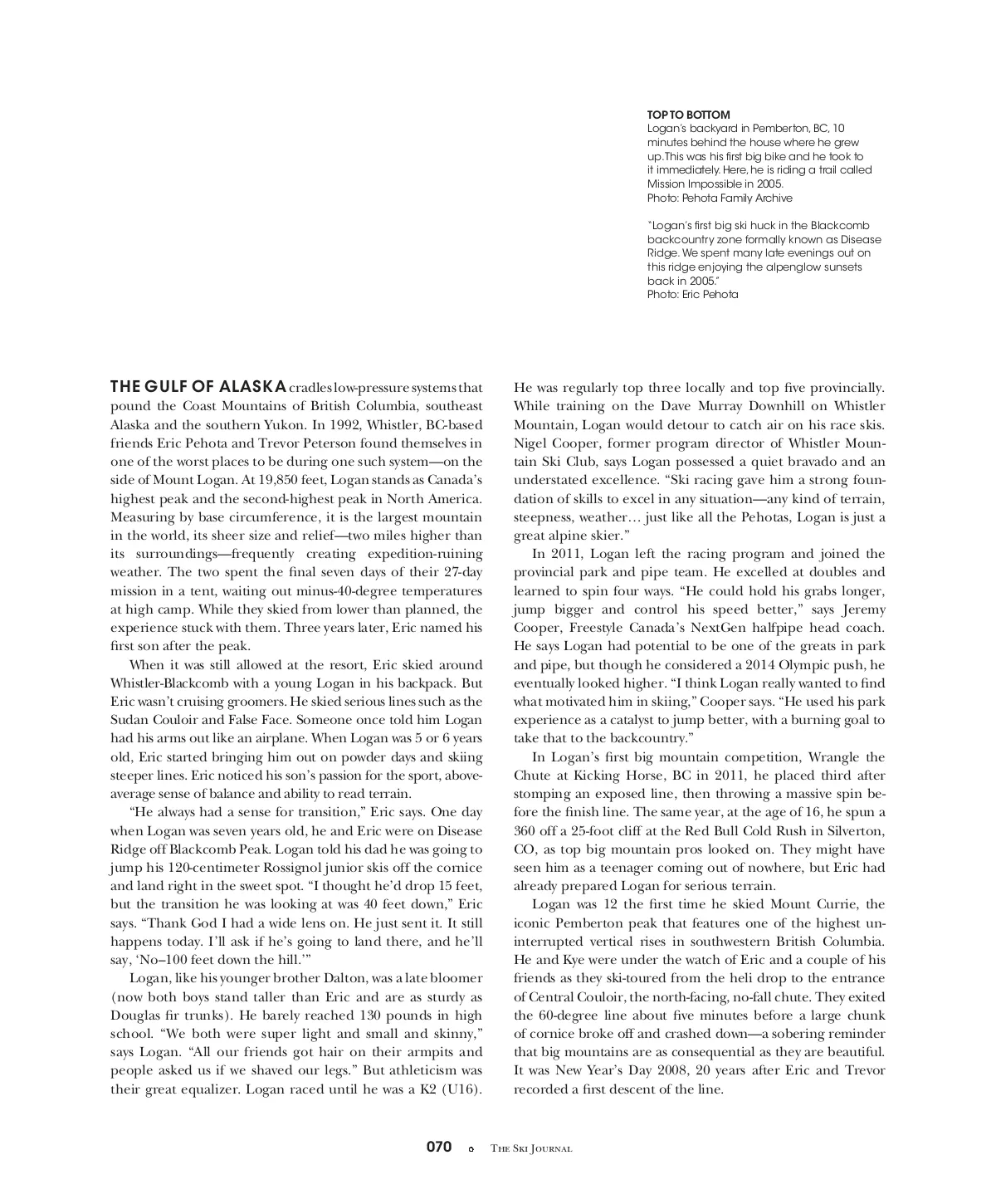
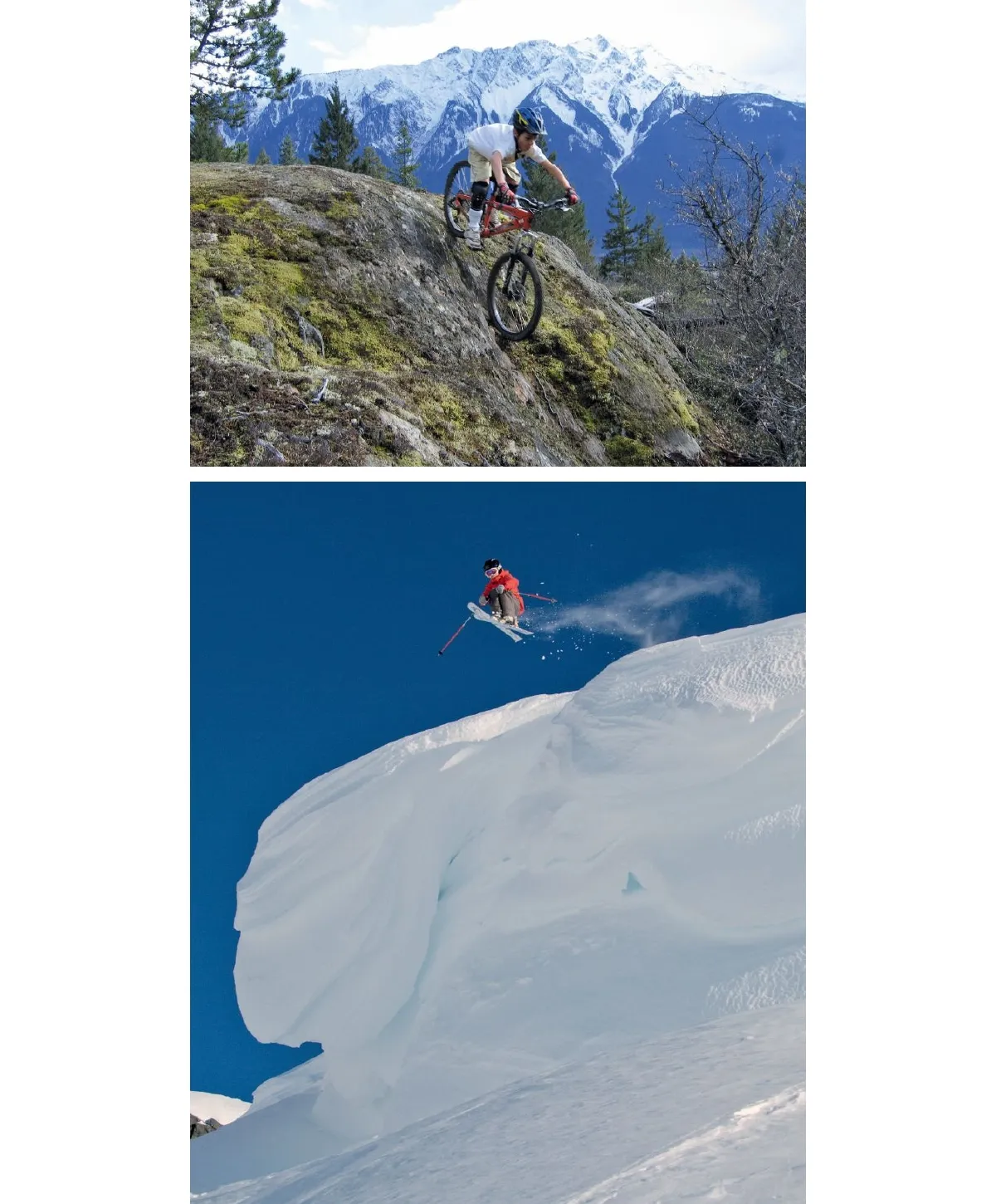
TOP TO BOTTOM Logan’s backyard in Pemberton, BC, 10 minutes behind the house where he grew up. This was his first big bike and he took to it immediately. Here, he is riding a trail called Mission Impossible in 2005. Photo: Pehota Family Archive “Logan’s first big ski huck in the Blackcomb backcountry zone formally known as Disease Ridge. We spent many late evenings out on this ridge enjoying the alpenglow sunsets back in 2005.” Photo: Eric Pehota THE GULF OF ALASKA cradles low-pressure systems that pound the Coast Mountains of British Columbia, southeast Alaska and the southern Yukon. In 1992, Whistler, BC-based friends Eric Pehota and Trevor Peterson found themselves in one of the worst places to be during one such system—on the side of Mount Logan. At 19,850 feet, Logan stands as Canada’s highest peak and the second-highest peak in North America. Measuring by base circumference, it is the largest mountain in the world, its sheer size and relief—two miles higher than its surroundings—frequently creating expedition-ruining weather. The two spent the final seven days of their 27-day mission in a tent, waiting out minus-40-degree temperatures at high camp. While they skied from lower than planned, the experience stuck with them. Three years later, Eric named his first son after the peak. When it was still allowed at the resort, Eric skied around Whistler-Blackcomb with a young Logan in his backpack. But Eric wasn’t cruising groomers. He skied serious lines such as the Sudan Couloir and False Face. Someone once told him Logan had his arms out like an airplane. When Logan was 5 or 6 years old, Eric started bringing him out on powder days and skiing steeper lines. Eric noticed his son’s passion for the sport, above-average sense of balance and ability to read terrain. “He always had a sense for transition,” Eric says. One day when Logan was seven years old, he and Eric were on Disease Ridge off Blackcomb Peak. Logan told his dad he was going to jump his 120-centimeter Rossignol junior skis off the cornice and land right in the sweet spot. “I thought he’d drop 15 feet, but the transition he was looking at was 40 feet down,” Eric says. “Thank God I had a wide lens on. He just sent it. It still happens today. I’ll ask if he’s going to land there, and he’ll say, ‘No–100 feet down the hill.’” Logan, like his younger brother Dalton, was a late bloomer (now both boys stand taller than Eric and are as sturdy as Douglas fir trunks). He barely reached 130 pounds in high school. “We both were super light and small and skinny,” says Logan. “All our friends got hair on their armpits and people asked us if we shaved our legs.” But athleticism was their great equalizer. Logan raced until he was a K2 (U16). He was regularly top three locally and top five provincially. While training on the Dave Murray Downhill on Whistler Mountain, Logan would detour to catch air on his race skis. Nigel Cooper, former program director of Whistler Moun-tain Ski Club, says Logan possessed a quiet bravado and an understated excellence. “Ski racing gave him a strong foun-dation of skills to excel in any situation—any kind of terrain, steepness, weather… just like all the Pehotas, Logan is just a great alpine skier.” In 2011, Logan left the racing program and joined the provincial park and pipe team. He excelled at doubles and learned to spin four ways. “He could hold his grabs longer, jump bigger and control his speed better,” says Jeremy Cooper, Freestyle Canada’s NextGen halfpipe head coach. He says Logan had potential to be one of the greats in park and pipe, but though he considered a 2014 Olympic push, he eventually looked higher. “I think Logan really wanted to find what motivated him in skiing,” Cooper says. “He used his park experience as a catalyst to jump better, with a burning goal to take that to the backcountry.” In Logan’s first big mountain competition, Wrangle the Chute at Kicking Horse, BC in 2011, he placed third after stomping an exposed line, then throwing a massive spin be-fore the finish line. The same year, at the age of 16, he spun a 360 off a 25-foot cliff at the Red Bull Cold Rush in Silverton, CO, as top big mountain pros looked on. They might have seen him as a teenager coming out of nowhere, but Eric had already prepared Logan for serious terrain. Logan was 12 the first time he skied Mount Currie, the iconic Pemberton peak that features one of the highest un-interrupted vertical rises in southwestern British Columbia. He and Kye were under the watch of Eric and a couple of his friends as they ski-toured from the heli drop to the entrance of Central Couloir, the north-facing, no-fall chute. They exited the 60-degree line about five minutes before a large chunk of cornice broke off and crashed down—a sobering reminder that big mountains are as consequential as they are beautiful. It was New Year’s Day 2008, 20 years after Eric and Trevor recorded a first descent of the line. 070 The Ski Journal
The Ski Journal Volume 14, Issue 3: Page 70