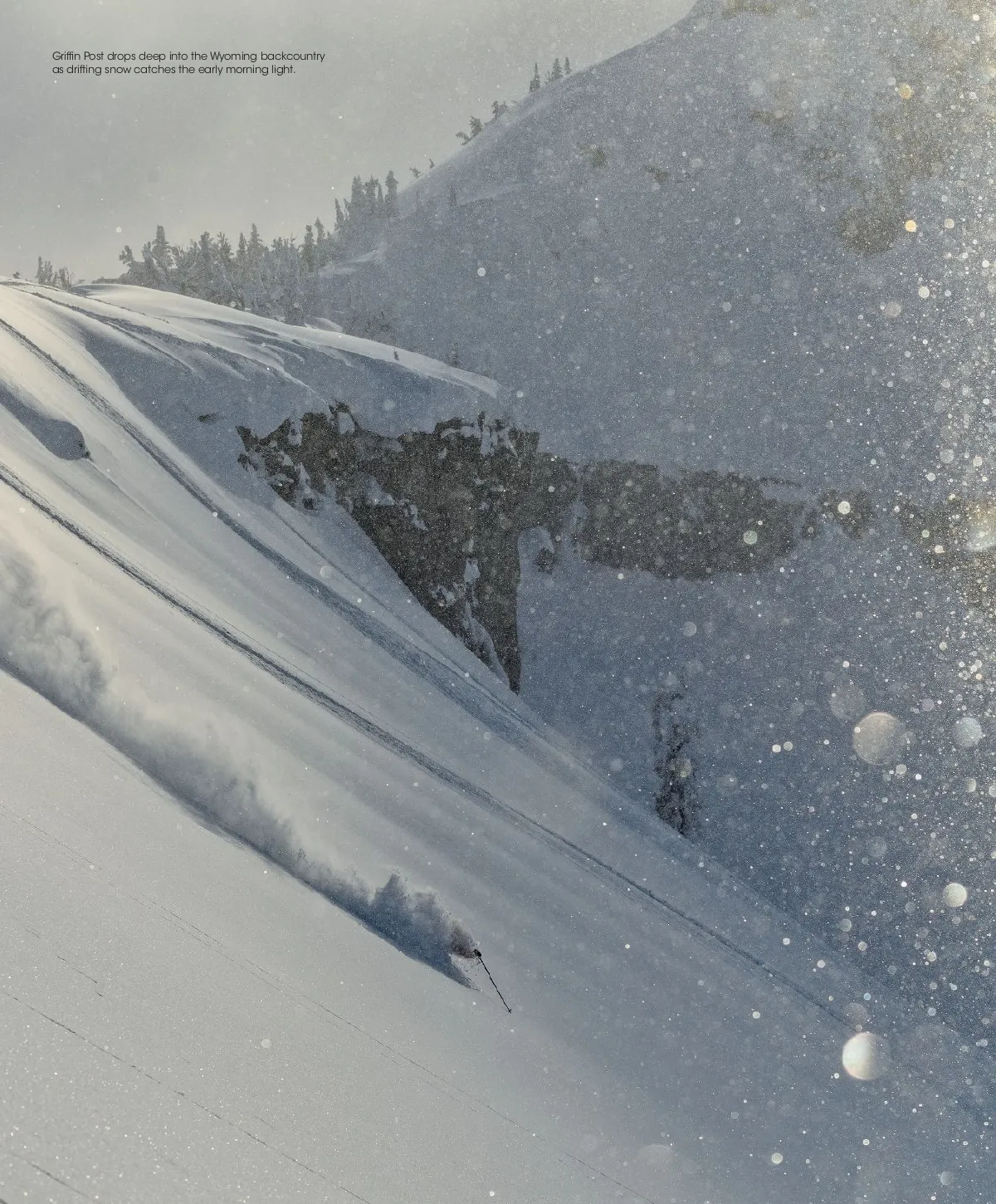
Words Frederick Reimers Photos and Captions Fredrik Marmsater digital cameras came along, photography was chemistry. It’s easy to picture the darkroom and its trays of chemicals: hydroquinone, acetic acid, ammonium thiosulfate—the developer, the stop bath and the fixer. But even the creative act of opening the shutter, allowing photons into the camera to oxidize halide crystals in the film, is chemical reaction. Before he became a photographer at age 35, Fredrik Marm-sater was a biochemist, creating cancer medications for a pharmaceutical company in Boulder, CO. When he quit in 2010, burned out and disillusioned by, as he says, “medical research for profit,” he left behind the test tubes and lab coats (not to mention the generous salary), but retained the skill of visual problem solving. “Organic chemistry is a lot of three-dimensional models,” Marmsater says, drinking a beer at a Grand Teton Brewing near his home in Victor, ID. “Picturing molecules and elec-trons and how they dock into proteins in a reaction—I could always visualize it.” It’s similar to the way he now visualizes a photograph before he even lifts his camera. “It’s how you see a setting, and how you put your subject in that setting, and being able to read a topo map and figure out the right spot to shoot for backlighting,” he says, speaking quickly and with a vestige of accent from his native Sweden. “I’m a sucker for backlighting.” So too, apparently, are the dozens of magazines and commercial clients for whom Marmsater has become a go-to lensman over the last decade, from Patagonia to Trail Runner to myriad ski publications. But Marmsater is almost more legendary for how he gets his shots than what he captures within them. Far from posting up at some sunny terrain park or halfway down Jackson Hole’s Hobacks after the privilege of an early tram, Marmsater is typically found in very remote and steep terrain taking the same risks as the ski mountaineers he’s shooting—and moving just as quickly. “He’s one of the few photographers who can set a bootpack with his pack full of 40 extra pounds of lenses and still pull away from you,” pro skier Griffin Post says. “He’s a beast.” Like Jimmy Chin, Marmsater has made a career out of being out there amongst it. As The Ski Journal photo editor Andrew Marshall put it, “as in surfing, some people nail it from the beach or the boat, while others are actually in the water, shooting inside the barrel.” Those foot-powered settings combine with Marmsater’s carefully plotted compositions to convey motion and a sense of almost inevitable arrival, of a difficult challenge met with grace and skill. A runner bounds high on a ridgetop with mountains to the horizon; a skier is poised mid-turn halfway down an impossible couloir, implying the achievement of just getting to that remote, ethereal place. It’s in the way Marmsater organizes his lines, leading the eye through the subject to the destination, and in the way those subjects are anointed with light. Often it’s backlight illuminating a plume of powder or a striding trail runner like some divine spotlight. UNTIL MARMSATER WAS BORN in Stockholm but moved to Panama City, FL during high school when his father’s work as an engineer took the Marmsater family there. “It was quite a culture shock in a lot of ways,” Marmsater says of living in the Gulf Coast town. There was, of course, no skiing. Like a lot of Swedes, he’d grown up riding the button lift on the local hill under lights after school. In Florida, he kept active playing volleyball, soccer and waterskiing. “I was a garbage student, actually,” he says. It wasn’t until community college that he met a chemistry teacher who turned his academic career around. “She put the screws to me and held me accountable,” he says. “Once I applied myself, I found chemistry just clicked. I could see it.” It clicked well enough that after two years at Florida State University, Marmsater had his pick of doctorate programs, ul-timately choosing the University of Utah because the students assigned to tour him around campus took him skiing instead. He felt right at home. “I’d only been on skis twice since mov-ing from Sweden,” he says, “but skiing had always been my favorite sport.” Fredrik Marmsater Gallerie 083
The Ski Journal Volume 14, Issue 3: Page 83