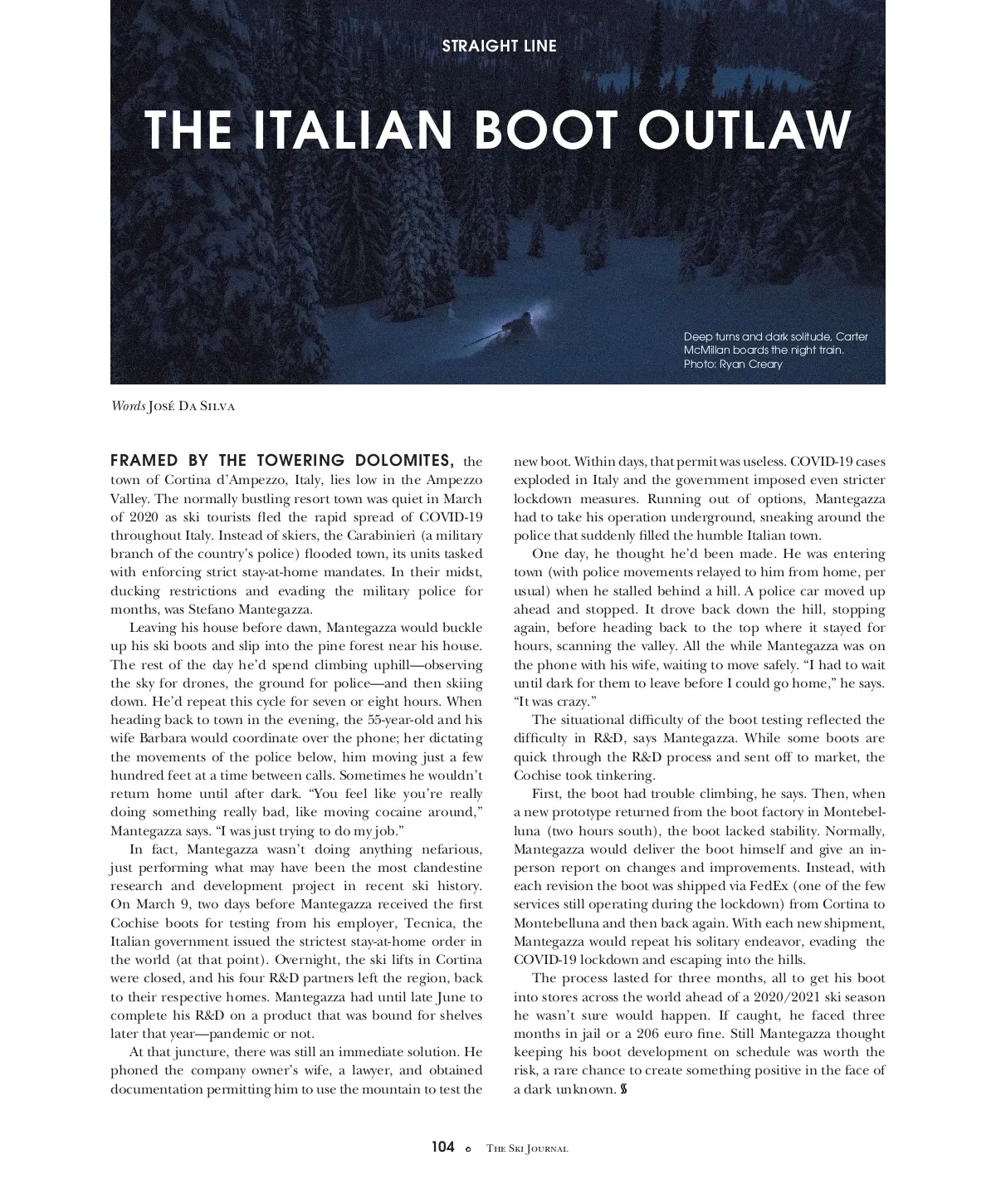
STRAIGHT LINE THE ITALIAN BOOT OUTLAW Deep turns and dark solitude, Carter McMillan boards the night train. Photo: Ryan Creary Words José Da Silva FRAMED BY THE TOWERING DOLOMITES, the town of Cortina d’Ampezzo, Italy, lies low in the Ampezzo Valley. The normally bustling resort town was quiet in March of 2020 as ski tourists fled the rapid spread of COVID-19 throughout Italy. Instead of skiers, the Carabinieri (a military branch of the country’s police) flooded town, its units tasked with enforcing strict stay-at-home mandates. In their midst, ducking restrictions and evading the military police for months, was Stefano Mantegazza. Leaving his house before dawn, Mantegazza would buckle up his ski boots and slip into the pine forest near his house. The rest of the day he’d spend climbing uphill—observing the sky for drones, the ground for police—and then skiing down. He’d repeat this cycle for seven or eight hours. When heading back to town in the evening, the 55-year-old and his wife Barbara would coordinate over the phone; her dictating the movements of the police below, him moving just a few hundred feet at a time between calls. Sometimes he wouldn’t return home until after dark. “You feel like you’re really doing something really bad, like moving cocaine around,” Mantegazza says. “I was just trying to do my job.” In fact, Mantegazza wasn’t doing anything nefarious, just performing what may have been the most clandestine research and development project in recent ski history. On March 9, two days before Mantegazza received the first Cochise boots for testing from his employer, Tecnica, the Italian government issued the strictest stay-at-home order in the world (at that point). Overnight, the ski lifts in Cortina were closed, and his four R&D partners left the region, back to their respective homes. Mantegazza had until late June to complete his R&D on a product that was bound for shelves later that year—pandemic or not. At that juncture, there was still an immediate solution. He phoned the company owner’s wife, a lawyer, and obtained documentation permitting him to use the mountain to test the new boot. Within days, that permit was useless. COVID-19 cases exploded in Italy and the government imposed even stricter lockdown measures. Running out of options, Mantegazza had to take his operation underground, sneaking around the police that suddenly filled the humble Italian town. One day, he thought he’d been made. He was entering town (with police movements relayed to him from home, per usual) when he stalled behind a hill. A police car moved up ahead and stopped. It drove back down the hill, stopping again, before heading back to the top where it stayed for hours, scanning the valley. All the while Mantegazza was on the phone with his wife, waiting to move safely. “I had to wait until dark for them to leave before I could go home,” he says. “It was crazy.” The situational difficulty of the boot testing reflected the difficulty in R&D, says Mantegazza. While some boots are quick through the R&D process and sent off to market, the Cochise took tinkering. First, the boot had trouble climbing, he says. Then, when a new prototype returned from the boot factory in Montebel-luna (two hours south), the boot lacked stability. Normally, Mantegazza would deliver the boot himself and give an in-person report on changes and improvements. Instead, with each revision the boot was shipped via FedEx (one of the few services still operating during the lockdown) from Cortina to Montebelluna and then back again. With each new shipment, Mantegazza would repeat his solitary endeavor, evading the COVID-19 lockdown and escaping into the hills. The process lasted for three months, all to get his boot into stores across the world ahead of a 2020/2021 ski season he wasn’t sure would happen. If caught, he faced three months in jail or a 206 euro fine. Still Mantegazza thought keeping his boot development on schedule was worth the risk, a rare chance to create something positive in the face of a dark unknown. 104 The Ski Journal
The Ski Journal Volume 15, Issue 1: Page 104