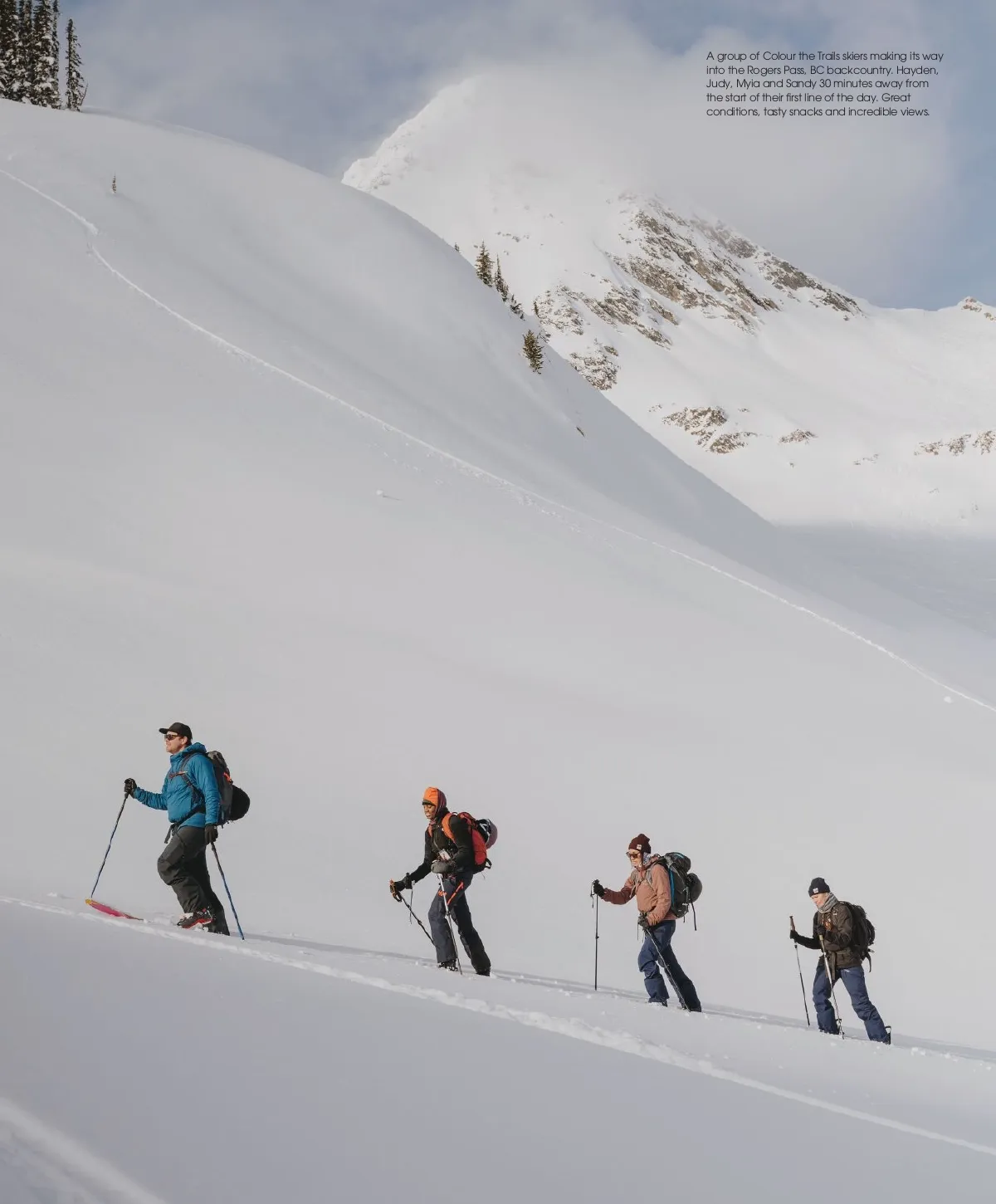
STRAIGHT LINE A NEED FOR AFFINITY Words Emily Sullivan with Judith Kasiama Photos Pavel Boiko WHEN JUDITH KASIAMA started skiing two years ago, she didn’t see any skiers who looked like her. A Congolese woman living in Vancouver, BC, she felt out of place at Whis-tler Blackcomb. “It seemed like it was a white people sport,” she recalls. “If you don’t see anyone who looks like you, it’s hard to believe you can do it.” Rather than feel discouraged, she set two personal goals: work to become a good skier and create opportunities for other Black women to try the sport. Last winter, Judith organized and participated in her first backcountry skills clinic, taught by professional skier Christina Lustenberger. Judith’s organization, an affinity group named Colour the Trails, brought six Black, Indigenous, and women of color to Rogers Pass, BC to learn terrain management, avalanche assessment and touring technique. Participants cheered one another up the skin track, taking weight from each other’s packs if someone was struggling. “It was about community,” Judith says. “We made sure that everyone made it to the top together.” The three-day, beginner-friendly course encouraged par-ticipants to build trust and be themselves without the pressure of outside judgement. “I’m still really shy about my skiing, but I felt safe in that environment,” Judith says. Designed for people who share a common identity or experience, affinity groups create welcoming environments that foster learning and break down systemic barriers. They can unite people based on gender, race, sexual orientation, disability or any combination thereof. In a homogenous sport like skiing, those spaces can be few and far between. According to the most recent data from Snowsports In-dustries America, 68.7 percent of skiers in the United States are white and 66.4 percent of frequent skiers are male. For skiers whose identities fall outside these demographics, both representation and access to mentorship are sorely lacking. “Skiing is not really encouraged within the Black community. It never crossed my mind that I, Judith, could be skiing,” Ju-dith says. “I didn’t know where to start. People say they want to help, but they don’t want to give up a good powder day to take out new skiers.” While affinity spaces are not the all-encompassing solu-tion to inequity in skiing, they have the power to advance opportunities for underrepresented skiers to become guides, instructors and industry leaders. Perhaps the best-known organization created by and for skiers of color, the National Brotherhood of Skiers, was founded in 1973. Made up of more than 50 Black ski clubs across the United States, NBS is one of the largest ski organi-zations in the country. “Joining NBS caused me to ski more than I would have otherwise,” says Todd Hood, vice president of NBS Western Region. “Participants have an opportunity to be with people who don’t just look like them, but who also live like them. That’s the joy of it.” Todd has surveyed Black skiers across several online forums and his research shows that Black skiers who ski at NBS events feel significantly more welcome at resorts than those who ski independently. Independent Black skiers, on the other hand, report feeling ignored or simply tolerated on the slopes. “We don’t want to have to code-switch when we step on the mountain, even subconsciously. That’s exhausting,” explains Deenaalee Hodgdon, a Dene-Sugpiaq skier and Coalition Snow athlete. Code-switching, or adjusting one’s style of expression to appease a dominant culture, promotes a dangerous homogenization in the winter sports space. Climbing beyond that slippery slope, Deenaalee has created an Indigenous scholarship fund, providing Native skiers with gear and opportunities to attend Indigenous snowsports clinics. Deenaalee says Native-led courses can provide heal-ing spaces for Indigenous people to connect on the land. “There’s power in shared identity because you don’t have to focus on trauma,” they add. 030 The Ski Journal
The Ski Journal Volume 15, Issue 1: Page 30