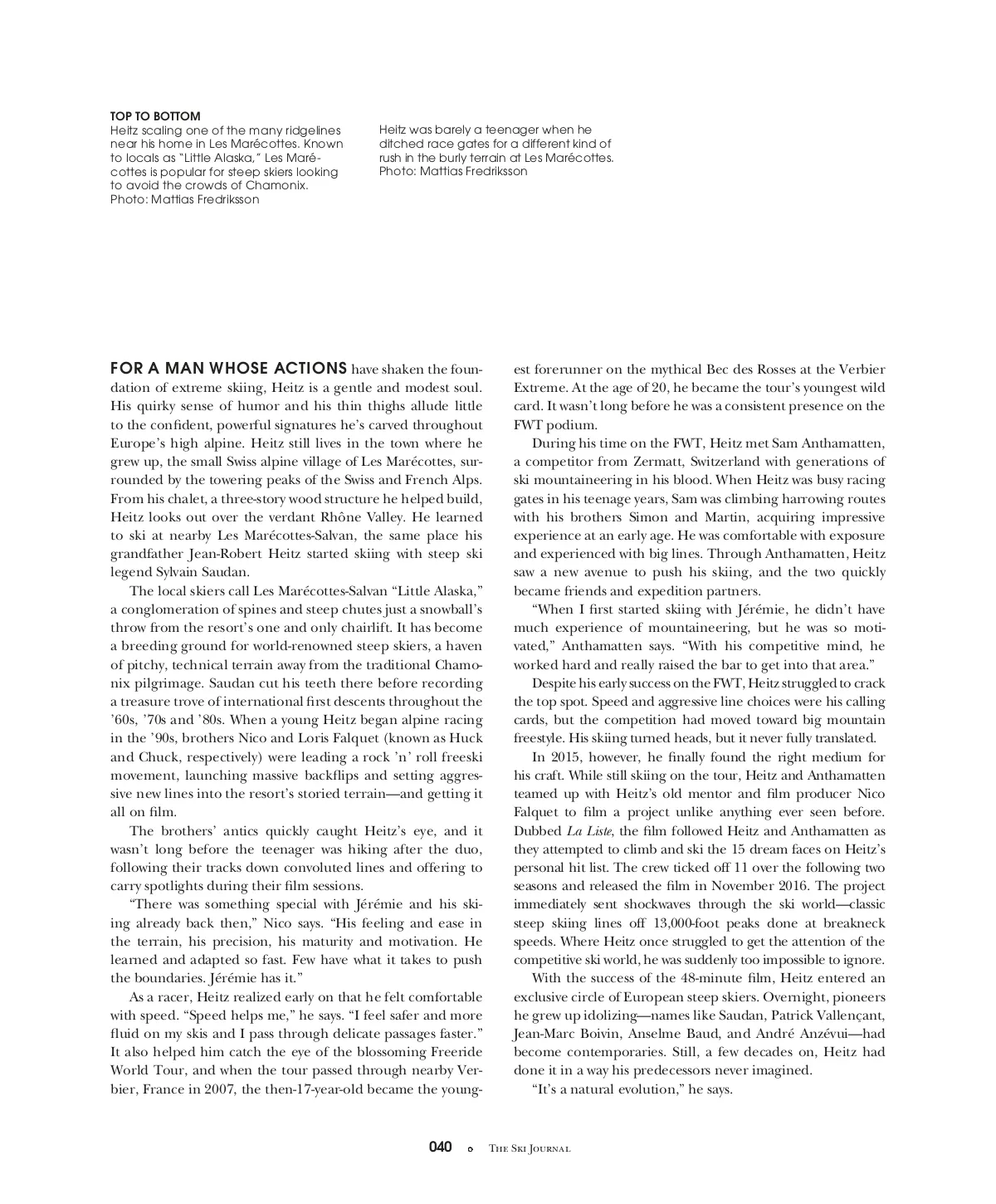
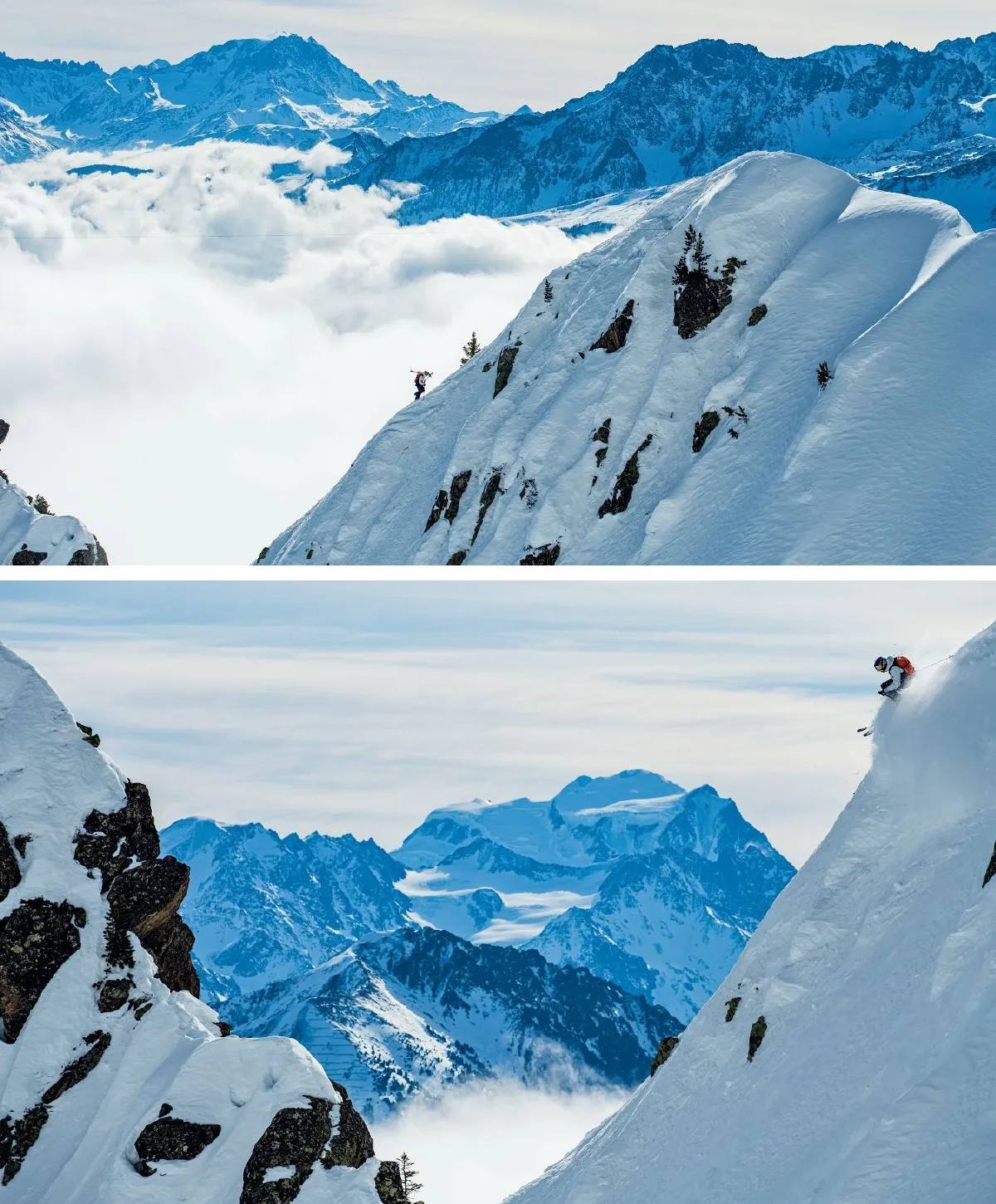
TOP TO BOTTOM Heitz scaling one of the many ridgelines near his home in Les Marécottes. Known to locals as “Little Alaska,” Les Maré-cottes is popular for steep skiers looking to avoid the crowds of Chamonix. Photo: Mattias Fredriksson Heitz was barely a teenager when he ditched race gates for a different kind of rush in the burly terrain at Les Marécottes. Photo: Mattias Fredriksson FOR A MAN WHOSE ACTIONS have shaken the foun-dation of extreme skiing, Heitz is a gentle and modest soul. His quirky sense of humor and his thin thighs allude little to the confident, powerful signatures he’s carved throughout Europe’s high alpine. Heitz still lives in the town where he grew up, the small Swiss alpine village of Les Marécottes, sur-rounded by the towering peaks of the Swiss and French Alps. From his chalet, a three-story wood structure he helped build, Heitz looks out over the verdant Rhône Valley. He learned to ski at nearby Les Marécottes-Salvan, the same place his grandfather Jean-Robert Heitz started skiing with steep ski legend Sylvain Saudan. The local skiers call Les Marécottes-Salvan “Little Alaska,” a conglomeration of spines and steep chutes just a snowball’s throw from the resort’s one and only chairlift. It has become a breeding ground for world-renowned steep skiers, a haven of pitchy, technical terrain away from the traditional Chamo-nix pilgrimage. Saudan cut his teeth there before recording a treasure trove of international first descents throughout the ’60s, ’70s and ’80s. When a young Heitz began alpine racing in the ’90s, brothers Nico and Loris Falquet (known as Huck and Chuck, respectively) were leading a rock ’n’ roll freeski movement, launching massive backflips and setting aggres-sive new lines into the resort’s storied terrain—and getting it all on film. The brothers’ antics quickly caught Heitz’s eye, and it wasn’t long before the teenager was hiking after the duo, following their tracks down convoluted lines and offering to carry spotlights during their film sessions. “There was something special with Jérémie and his ski-ing already back then,” Nico says. “His feeling and ease in the terrain, his precision, his maturity and motivation. He learned and adapted so fast. Few have what it takes to push the boundaries. Jérémie has it.” As a racer, Heitz realized early on that he felt comfortable with speed. “Speed helps me,” he says. “I feel safer and more fluid on my skis and I pass through delicate passages faster.” It also helped him catch the eye of the blossoming Freeride World Tour, and when the tour passed through nearby Ver-bier, France in 2007, the then-17-year-old became the young-est forerunner on the mythical Bec des Rosses at the Verbier Extreme. At the age of 20, he became the tour’s youngest wild card. It wasn’t long before he was a consistent presence on the FWT podium. During his time on the FWT, Heitz met Sam Anthamatten, a competitor from Zermatt, Switzerland with generations of ski mountaineering in his blood. When Heitz was busy racing gates in his teenage years, Sam was climbing harrowing routes with his brothers Simon and Martin, acquiring impressive experience at an early age. He was comfortable with exposure and experienced with big lines. Through Anthamatten, Heitz saw a new avenue to push his skiing, and the two quickly became friends and expedition partners. “When I first started skiing with Jérémie, he didn’t have much experience of mountaineering, but he was so moti-vated,” Anthamatten says. “With his competitive mind, he worked hard and really raised the bar to get into that area.” Despite his early success on the FWT, Heitz struggled to crack the top spot. Speed and aggressive line choices were his calling cards, but the competition had moved toward big mountain freestyle. His skiing turned heads, but it never fully translated. In 2015, however, he finally found the right medium for his craft. While still skiing on the tour, Heitz and Anthamatten teamed up with Heitz’s old mentor and film producer Nico Falquet to film a project unlike anything ever seen before. Dubbed La Liste , the film followed Heitz and Anthamatten as they attempted to climb and ski the 15 dream faces on Heitz’s personal hit list. The crew ticked off 11 over the following two seasons and released the film in November 2016. The project immediately sent shockwaves through the ski world—classic steep skiing lines off 13,000-foot peaks done at breakneck speeds. Where Heitz once struggled to get the attention of the competitive ski world, he was suddenly too impossible to ignore. With the success of the 48-minute film, Heitz entered an exclusive circle of European steep skiers. Overnight, pioneers he grew up idolizing—names like Saudan, Patrick Vallençant, Jean-Marc Boivin, Anselme Baud, and André Anzévui—had become contemporaries. Still, a few decades on, Heitz had done it in a way his predecessors never imagined. “It’s a natural evolution,” he says. 040 The Ski Journal
The Ski Journal Volume 15, Issue 1: Page 40