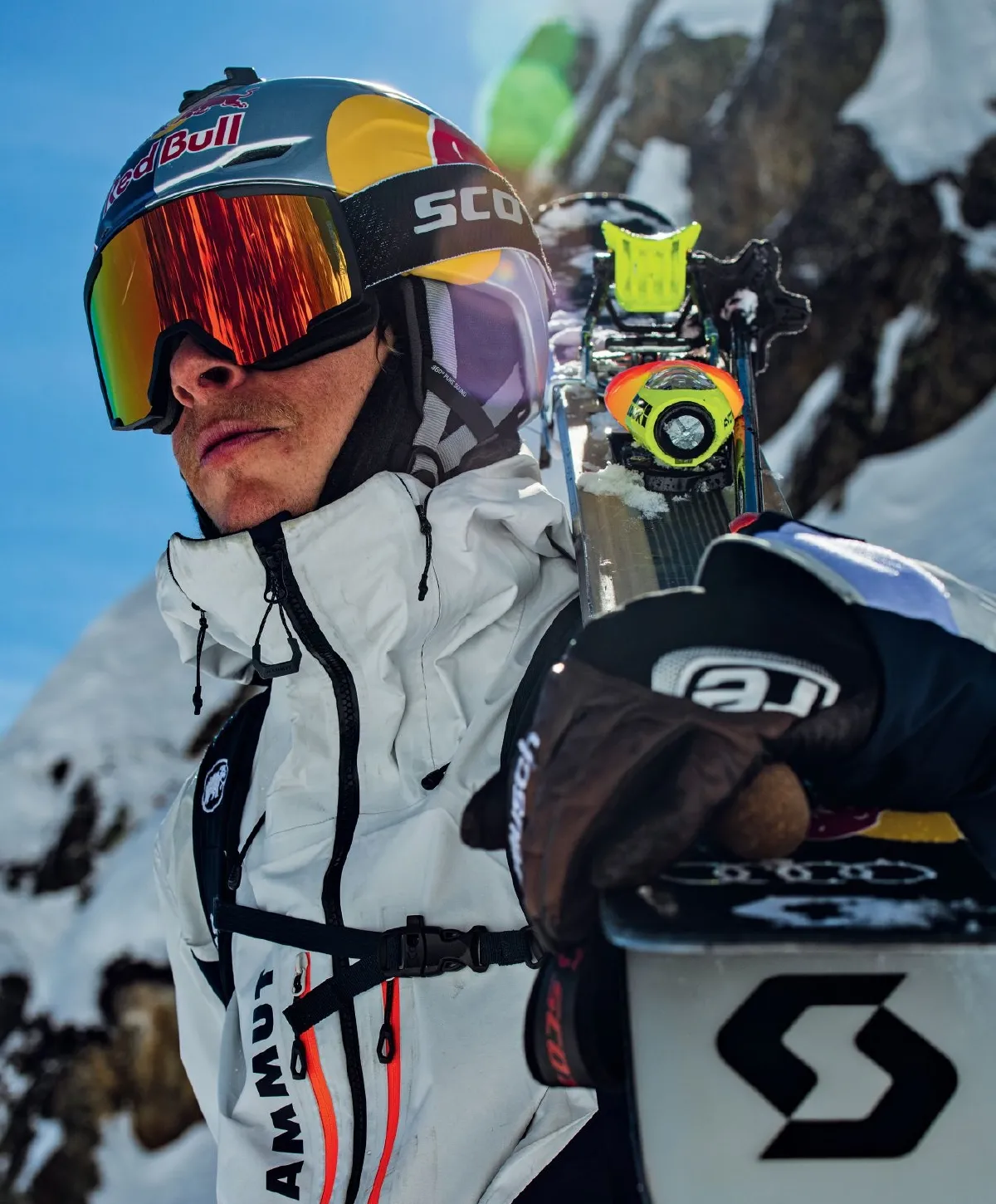
At just just 17, Heitz became the young-est ever Freeride World Tour forerun-ner on the infamous Bec des Rosses in Verbier, Switzerland. He hasn’t slowed down since. Photo: Mattias Fredriksson HEITZ NAVIGATES A RAZOR’S EDGE. He knows things can go very wrong very quickly and considers meticu-lous preparation the key to not only success, but also survival. Along with Anthamatten and Heitz’s stepfather and IMFGA mountain guide Raphaël Richard, Heitz charts and analyzes weather and temperature changes in his ski expedition zones year-round, inspecting faces via flybys and long camera lenses, and carefully tracking conditions as they align. He knows some of his lines are only skiable for a few hours every year, so every variable needs to be accounted for. It’s an attention to detail mirrored in his chalet’s gear room, where the Swiss skier spends hours organizing his expedition materials and micro-adjusting skis and bindings. For Heitz, the key lies in understanding each and every face he skis. That means climbing up—laden with nearly 50 pounds of gear, skis, skins, crampons and an ice axe—every mountain he rides down. “The ascent is an important part of the process, of my mental preparation. I get to know the snow, feel if there is any nearby ice, rock or other formations in the snow. From there, I memorize my run,” Heitz says, noting that his crew has a strict policy of not dropping in if something doesn’t feel 100 percent right. “We never stress a descent. If conditions aren’t ideal, we wait.” Yet mitigating risk doesn’t mean eliminating it—especially in the Alps. Hundreds of crosses, many bearing the names of Heitz’s heroes, stand in testament to that. In 2016, Heitz got a taste of just how close he toes that proverbial line. Hurtling down the 13,727-foot Grand Combin de Valsorey, he popped over a tongue of ice and felt his left ski binding release. In an instant, Heitz was left to battle an exposed face on a single ski or fall to an almost certain death. Focusing all of his energy on a single edge, he jammed his downhill ski into the slope and arced toward softer snow, finally slowing down and stopping—on his feet—in the middle of the harrowing run. It happened in a matter of seconds, but it would be much longer before Heitz could fully face the gravity of the moment. “Nature always has the final say,” he says. “It took me three years to process the incident. It was really tough mentally. I started to doubt. It’s that kind of experience that makes you age prematurely. It could block you forever.” Heitz’s family knows it won’t be the only time the young skier finds himself in a life-or-death situation. His mother Corinne Heitz, a former alpine racer from the valley, works to make peace with this reality on a near-daily basis. “There are a number of times that other mothers have told me they’re happy not to be Jérémie’s mother,” she says. “But I know what he’s capable of. Of course, I’m scared too. It gets worse with the years, but I have no choice [other] than to be happy for him. It’s his life and he is living it fully.” Richard echoes this sentiment, saying that while mishaps are always possible in the high-consequence terrain Heitz fre-quents, he has chosen to trust in his stepson and his abilities rather than fear for the worst. Fear is the constant black cloud looming over the world of big mountain skiing. On the one hand, fear helps us survive, preventing us from plunging off a 200-foot cliff or walking into oncoming traffic. But fear can also cripple us during de-cisive moments, inhibiting reactions and ultimately putting us in the very situation we sought to avoid. For Heitz, fear walks a middle path, helping him keep his feet on the ground—while pointing them straight. “Fear makes me alert and more focused,” he says. “If you’re too confident, it’s easier to make mistakes, but you can’t give fear too much space.” Standing atop peaks that often only have room for a single pair of skis, Heitz tries to block negative thoughts before his descent while going through a mental checklist of equipment and each turn it takes to reach the bottom safely. “There’s nothing better than reaching a peak and looking down to-ward the valley where you’ll be standing a few seconds later,” he says. “When you finish that run, feeling lighter but with the adrenaline pumping through your veins—those feelings are stronger than the fear.” 044 The Ski Journal
The Ski Journal Volume 15, Issue 1: Page 44