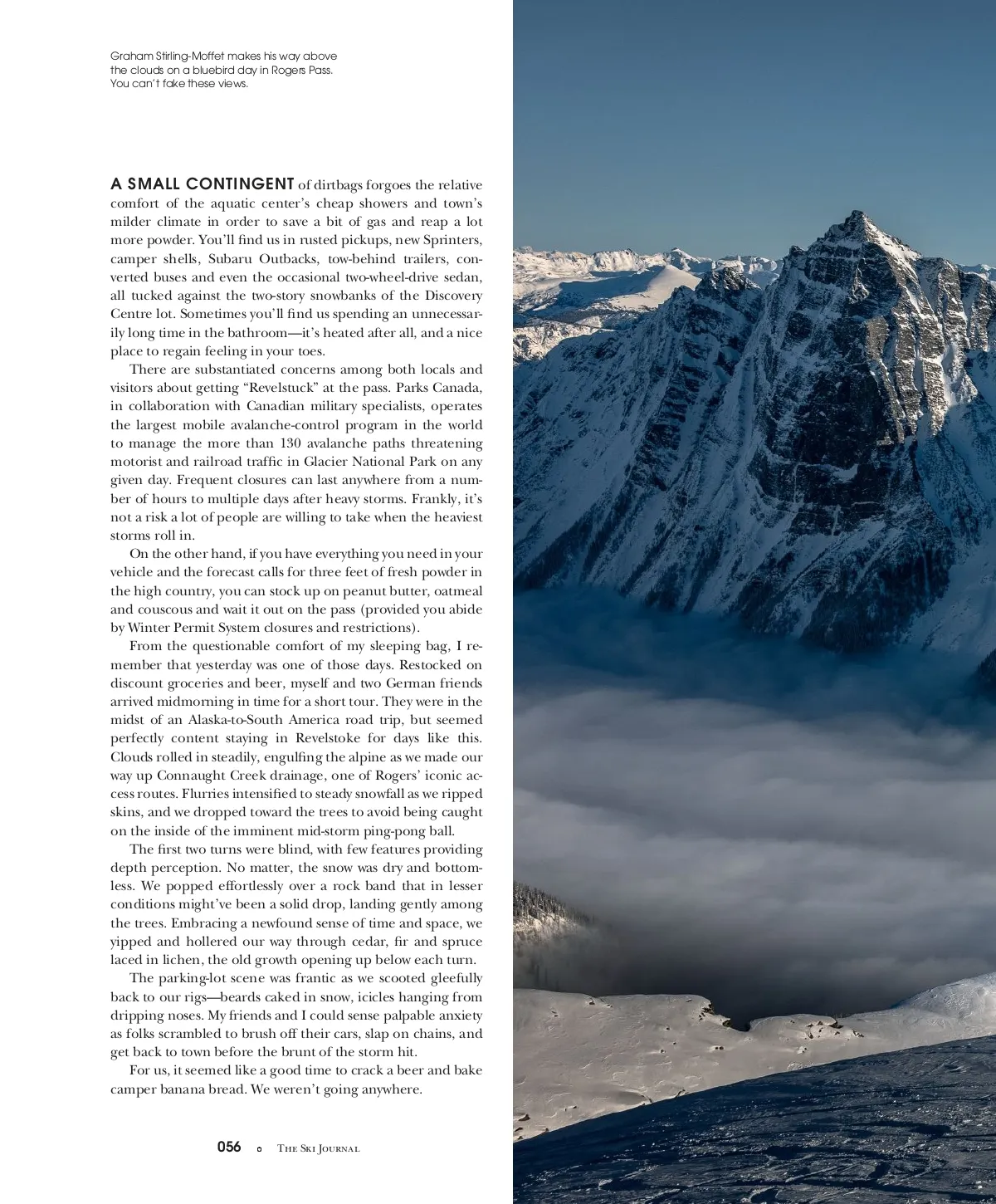
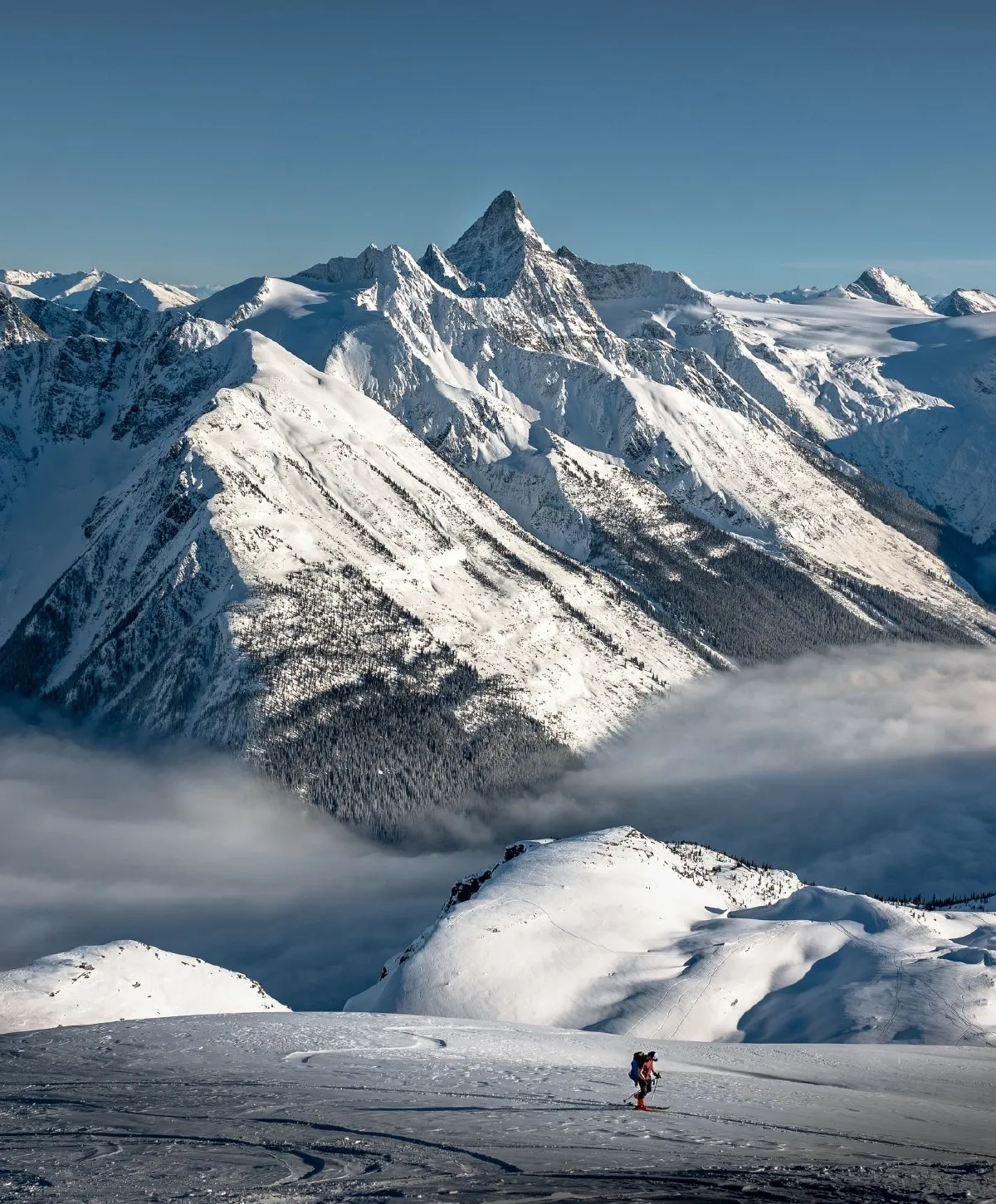
Graham Stirling-Moffet makes his way above the clouds on a bluebird day in Rogers Pass. You can’t fake these views. A SMALL CONTINGENT of dirtbags forgoes the relative comfort of the aquatic center’s cheap showers and town’s milder climate in order to save a bit of gas and reap a lot more powder. You’ll find us in rusted pickups, new Sprinters, camper shells, Subaru Outbacks, tow-behind trailers, con-verted buses and even the occasional two-wheel-drive sedan, all tucked against the two-story snowbanks of the Discovery Centre lot. Sometimes you’ll find us spending an unnecessar-ily long time in the bathroom—it’s heated after all, and a nice place to regain feeling in your toes. There are substantiated concerns among both locals and visitors about getting “Revelstuck” at the pass. Parks Canada, in collaboration with Canadian military specialists, operates the largest mobile avalanche-control program in the world to manage the more than 130 avalanche paths threatening motorist and railroad traffic in Glacier National Park on any given day. Frequent closures can last anywhere from a num-ber of hours to multiple days after heavy storms. Frankly, it’s not a risk a lot of people are willing to take when the heaviest storms roll in. On the other hand, if you have everything you need in your vehicle and the forecast calls for three feet of fresh powder in the high country, you can stock up on peanut butter, oatmeal and couscous and wait it out on the pass (provided you abide by Winter Permit System closures and restrictions). From the questionable comfort of my sleeping bag, I re-member that yesterday was one of those days. Restocked on discount groceries and beer, myself and two German friends arrived midmorning in time for a short tour. They were in the midst of an Alaska-to-South America road trip, but seemed perfectly content staying in Revelstoke for days like this. Clouds rolled in steadily, engulfing the alpine as we made our way up Connaught Creek drainage, one of Rogers’ iconic ac-cess routes. Flurries intensified to steady snowfall as we ripped skins, and we dropped toward the trees to avoid being caught on the inside of the imminent mid-storm ping-pong ball. The first two turns were blind, with few features providing depth perception. No matter, the snow was dry and bottom-less. We popped effortlessly over a rock band that in lesser conditions might’ve been a solid drop, landing gently among the trees. Embracing a newfound sense of time and space, we yipped and hollered our way through cedar, fir and spruce laced in lichen, the old growth opening up below each turn. The parking-lot scene was frantic as we scooted gleefully back to our rigs—beards caked in snow, icicles hanging from dripping noses. My friends and I could sense palpable anxiety as folks scrambled to brush off their cars, slap on chains, and get back to town before the brunt of the storm hit. For us, it seemed like a good time to crack a beer and bake camper banana bread. We weren’t going anywhere. 056 The Ski Journal
The Ski Journal Volume 15, Issue 1: Page 56