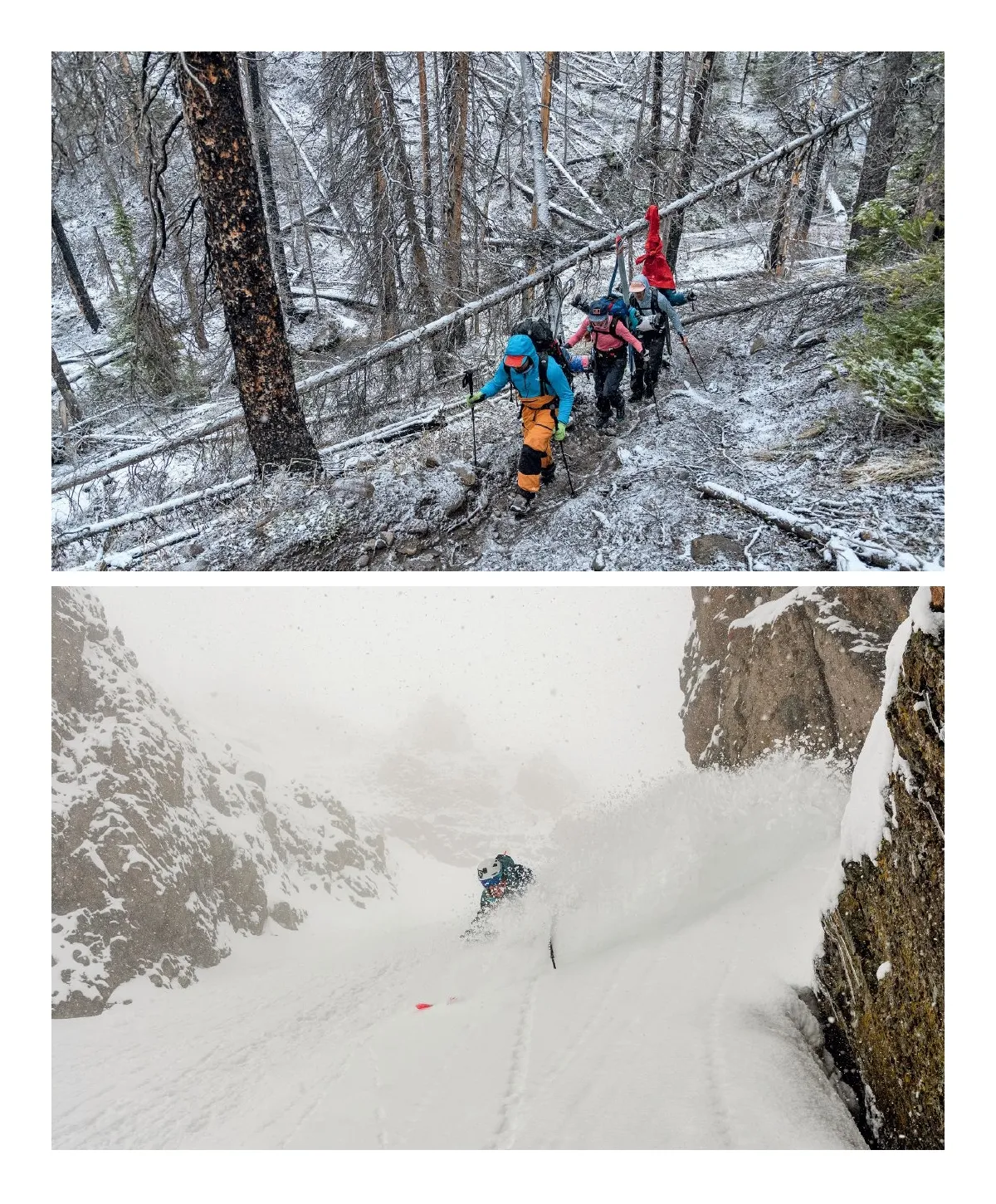
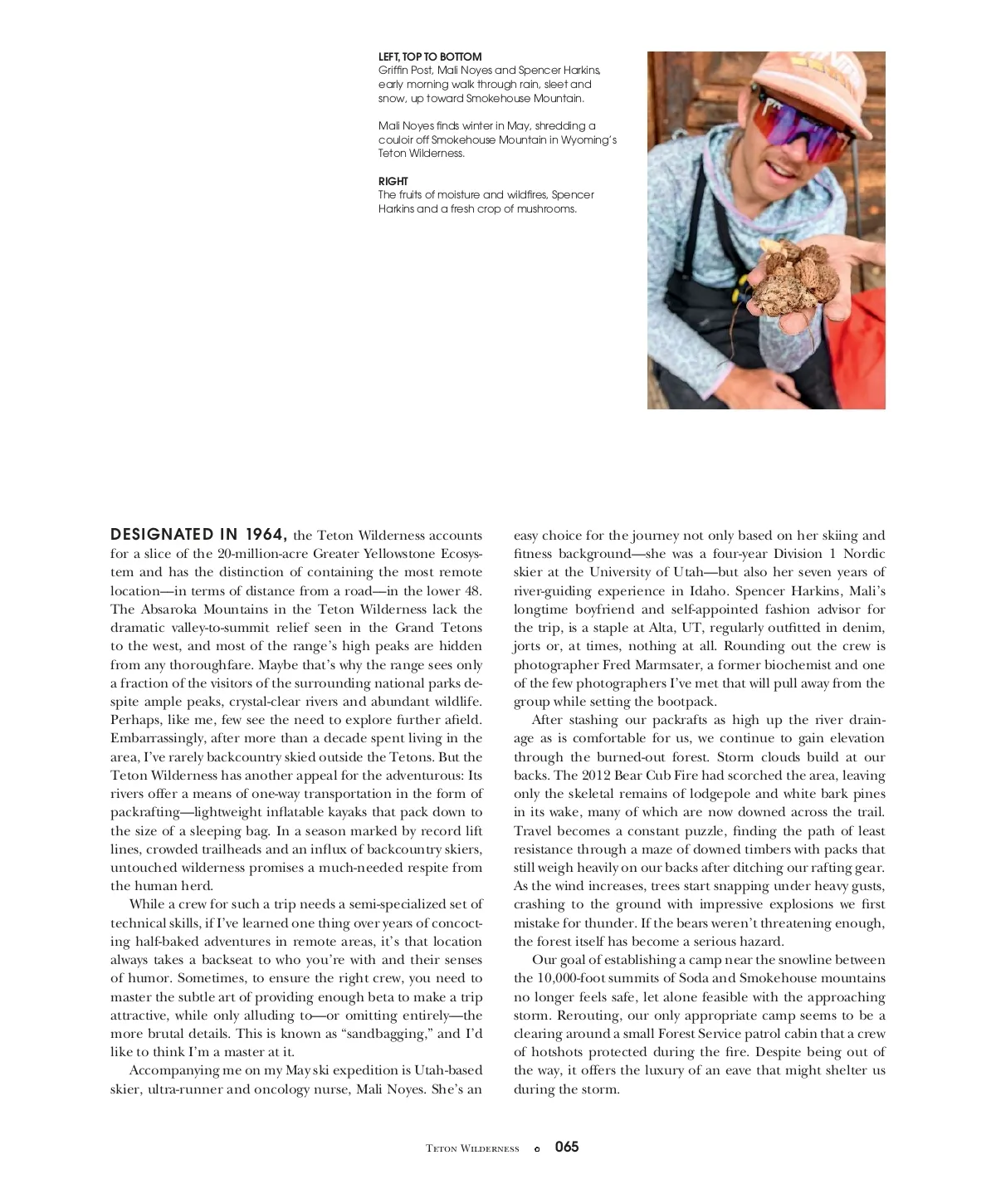
LEFT, TOP TO BOTTOM Griffin Post, Mali Noyes and Spencer Harkins, early morning walk through rain, sleet and snow, up toward Smokehouse Mountain. Mali Noyes finds winter in May, shredding a couloir off Smokehouse Mountain in Wyoming’s Teton Wilderness. RIGHT The fruits of moisture and wildfires, Spencer Harkins and a fresh crop of mushrooms. DESIGNATED IN 1964, the Teton Wilderness accounts for a slice of the 20-million-acre Greater Yellowstone Ecosys-tem and has the distinction of containing the most remote location––in terms of distance from a road––in the lower 48. The Absaroka Mountains in the Teton Wilderness lack the dramatic valley-to-summit relief seen in the Grand Tetons to the west, and most of the range’s high peaks are hidden from any thoroughfare. Maybe that’s why the range sees only a fraction of the visitors of the surrounding national parks de-spite ample peaks, crystal-clear rivers and abundant wildlife. Perhaps, like me, few see the need to explore further afield. Embarrassingly, after more than a decade spent living in the area, I’ve rarely backcountry skied outside the Tetons. But the Teton Wilderness has another appeal for the adventurous: Its rivers offer a means of one-way transportation in the form of packrafting—lightweight inflatable kayaks that pack down to the size of a sleeping bag. In a season marked by record lift lines, crowded trailheads and an influx of backcountry skiers, untouched wilderness promises a much-needed respite from the human herd. While a crew for such a trip needs a semi-specialized set of technical skills, if I’ve learned one thing over years of concoct-ing half-baked adventures in remote areas, it’s that location always takes a backseat to who you’re with and their senses of humor. Sometimes, to ensure the right crew, you need to master the subtle art of providing enough beta to make a trip attractive, while only alluding to—or omitting entirely—the more brutal details. This is known as “sandbagging,” and I’d like to think I’m a master at it. Accompanying me on my May ski expedition is Utah-based skier, ultra-runner and oncology nurse, Mali Noyes. She’s an easy choice for the journey not only based on her skiing and fitness background—she was a four-year Division 1 Nordic skier at the University of Utah—but also her seven years of river-guiding experience in Idaho. Spencer Harkins, Mali’s longtime boyfriend and self-appointed fashion advisor for the trip, is a staple at Alta, UT, regularly outfitted in denim, jorts or, at times, nothing at all. Rounding out the crew is photographer Fred Marmsater, a former biochemist and one of the few photographers I’ve met that will pull away from the group while setting the bootpack. After stashing our packrafts as high up the river drain-age as is comfortable for us, we continue to gain elevation through the burned-out forest. Storm clouds build at our backs. The 2012 Bear Cub Fire had scorched the area, leaving only the skeletal remains of lodgepole and white bark pines in its wake, many of which are now downed across the trail. Travel becomes a constant puzzle, finding the path of least resistance through a maze of downed timbers with packs that still weigh heavily on our backs after ditching our rafting gear. As the wind increases, trees start snapping under heavy gusts, crashing to the ground with impressive explosions we first mistake for thunder. If the bears weren’t threatening enough, the forest itself has become a serious hazard. Our goal of establishing a camp near the snowline between the 10,000-foot summits of Soda and Smokehouse mountains no longer feels safe, let alone feasible with the approaching storm. Rerouting, our only appropriate camp seems to be a clearing around a small Forest Service patrol cabin that a crew of hotshots protected during the fire. Despite being out of the way, it offers the luxury of an eave that might shelter us during the storm. Teton Wilderness 065
The Ski Journal Volume 15, Issue 1: Page 65