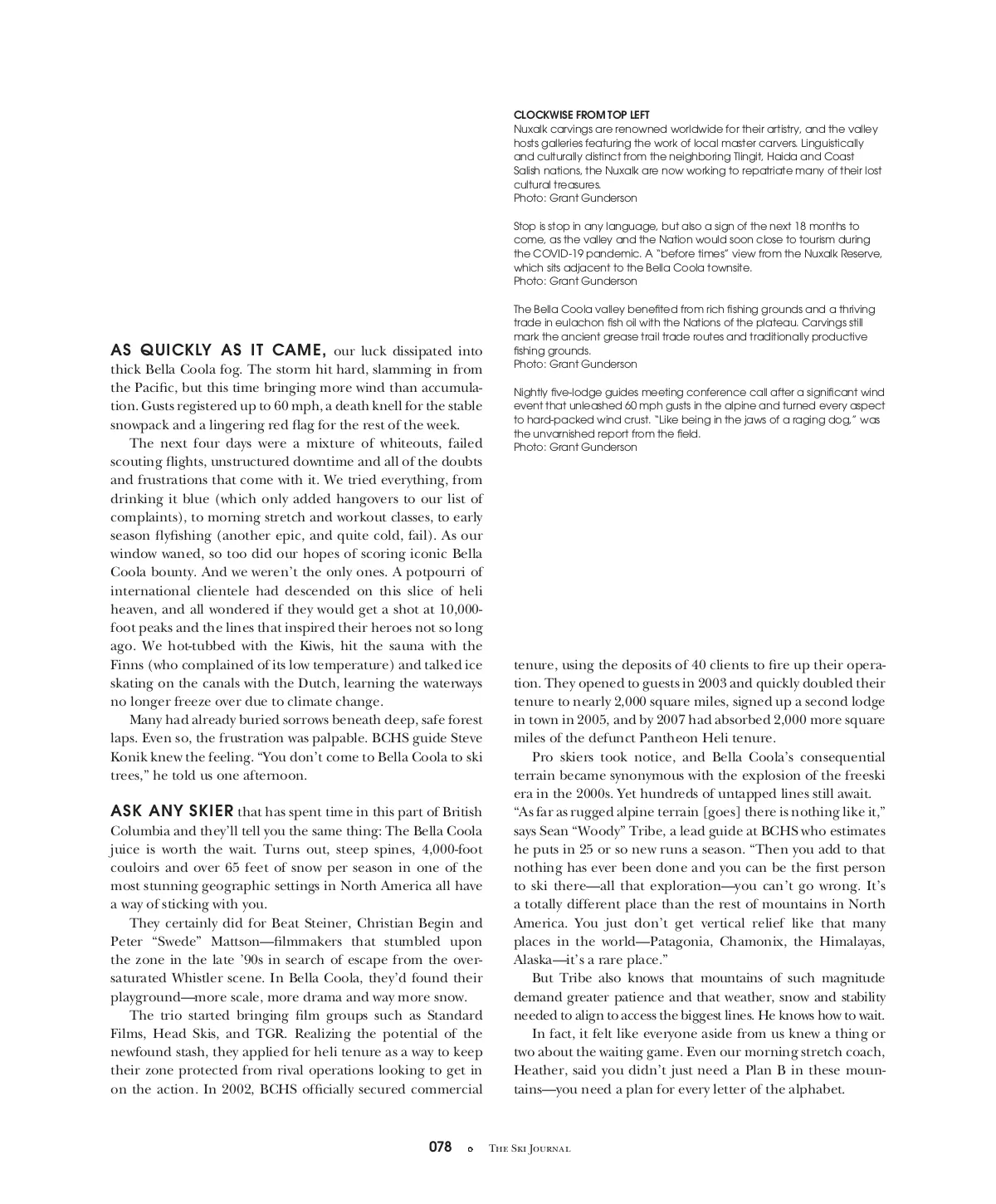
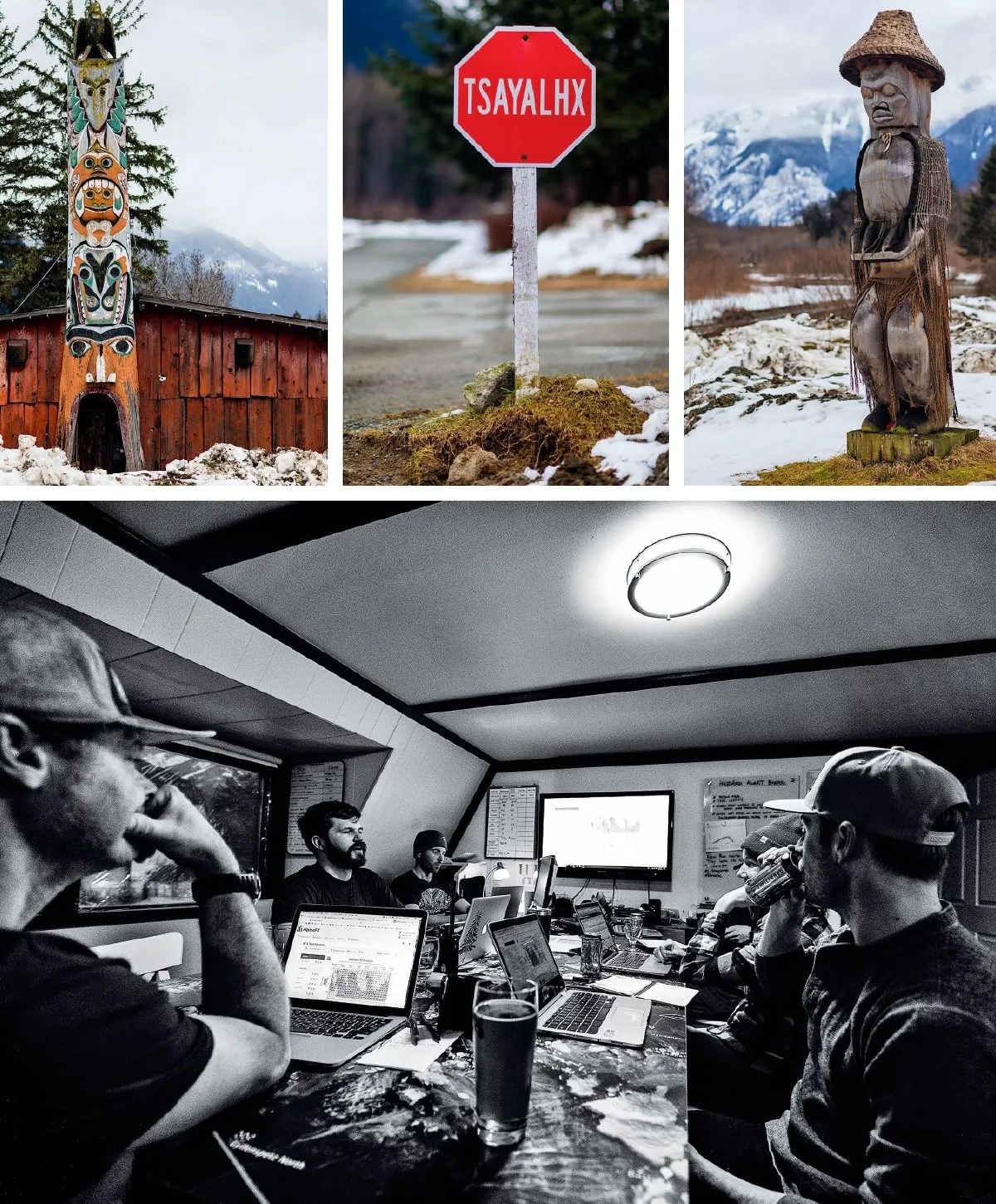
CLOCKWISE FROM TOP LEFT Nuxalk carvings are renowned worldwide for their artistry, and the valley hosts galleries featuring the work of local master carvers. Linguistically and culturally distinct from the neighboring Tlingit, Haida and Coast Salish nations, the Nuxalk are now working to repatriate many of their lost cultural treasures. Photo: Grant Gunderson Stop is stop in any language, but also a sign of the next 18 months to come, as the valley and the Nation would soon close to tourism during the COVID-19 pandemic. A “before times” view from the Nuxalk Reserve, which sits adjacent to the Bella Coola townsite. Photo: Grant Gunderson The Bella Coola valley benefited from rich fishing grounds and a thriving trade in eulachon fish oil with the Nations of the plateau. Carvings still mark the ancient grease trail trade routes and traditionally productive fishing grounds. Photo: Grant Gunderson Nightly five-lodge guides meeting conference call after a significant wind event that unleashed 60 mph gusts in the alpine and turned every aspect to hard-packed wind crust. “Like being in the jaws of a raging dog,” was the unvarnished report from the field. Photo: Grant Gunderson AS QUICKLY AS IT CAME, our luck dissipated into thick Bella Coola fog. The storm hit hard, slamming in from the Pacific, but this time bringing more wind than accumula-tion. Gusts registered up to 60 mph, a death knell for the stable snowpack and a lingering red flag for the rest of the week. The next four days were a mixture of whiteouts, failed scouting flights, unstructured downtime and all of the doubts and frustrations that come with it. We tried everything, from drinking it blue (which only added hangovers to our list of complaints), to morning stretch and workout classes, to early season flyfishing (another epic, and quite cold, fail). As our window waned, so too did our hopes of scoring iconic Bella Coola bounty. And we weren’t the only ones. A potpourri of international clientele had descended on this slice of heli heaven, and all wondered if they would get a shot at 10,000-foot peaks and the lines that inspired their heroes not so long ago. We hot-tubbed with the Kiwis, hit the sauna with the Finns (who complained of its low temperature) and talked ice skating on the canals with the Dutch, learning the waterways no longer freeze over due to climate change. Many had already buried sorrows beneath deep, safe forest laps. Even so, the frustration was palpable. BCHS guide Steve Konik knew the feeling. “You don’t come to Bella Coola to ski trees,” he told us one afternoon. ASK ANY SKIER that has spent time in this part of British Columbia and they’ll tell you the same thing: The Bella Coola juice is worth the wait. Turns out, steep spines, 4,000-foot couloirs and over 65 feet of snow per season in one of the most stunning geographic settings in North America all have a way of sticking with you. They certainly did for Beat Steiner, Christian Begin and Peter “Swede” Mattson—filmmakers that stumbled upon the zone in the late ’90s in search of escape from the over-saturated Whistler scene. In Bella Coola, they’d found their playground—more scale, more drama and way more snow. The trio started bringing film groups such as Standard Films, Head Skis, and TGR. Realizing the potential of the newfound stash, they applied for heli tenure as a way to keep their zone protected from rival operations looking to get in on the action. In 2002, BCHS officially secured commercial tenure, using the deposits of 40 clients to fire up their opera-tion. They opened to guests in 2003 and quickly doubled their tenure to nearly 2,000 square miles, signed up a second lodge in town in 2005, and by 2007 had absorbed 2,000 more square miles of the defunct Pantheon Heli tenure. Pro skiers took notice, and Bella Coola’s consequential terrain became synonymous with the explosion of the freeski era in the 2000s. Yet hundreds of untapped lines still await. “As far as rugged alpine terrain [goes] there is nothing like it,” says Sean “Woody” Tribe, a lead guide at BCHS who estimates he puts in 25 or so new runs a season. “Then you add to that nothing has ever been done and you can be the first person to ski there—all that exploration—you can’t go wrong. It’s a totally different place than the rest of mountains in North America. You just don’t get vertical relief like that many places in the world—Patagonia, Chamonix, the Himalayas, Alaska—it’s a rare place.” But Tribe also knows that mountains of such magnitude demand greater patience and that weather, snow and stability needed to align to access the biggest lines. He knows how to wait. In fact, it felt like everyone aside from us knew a thing or two about the waiting game. Even our morning stretch coach, Heather, said you didn’t just need a Plan B in these moun-tains—you need a plan for every letter of the alphabet. 078 The Ski Journal
The Ski Journal Volume 15, Issue 1: Page 78