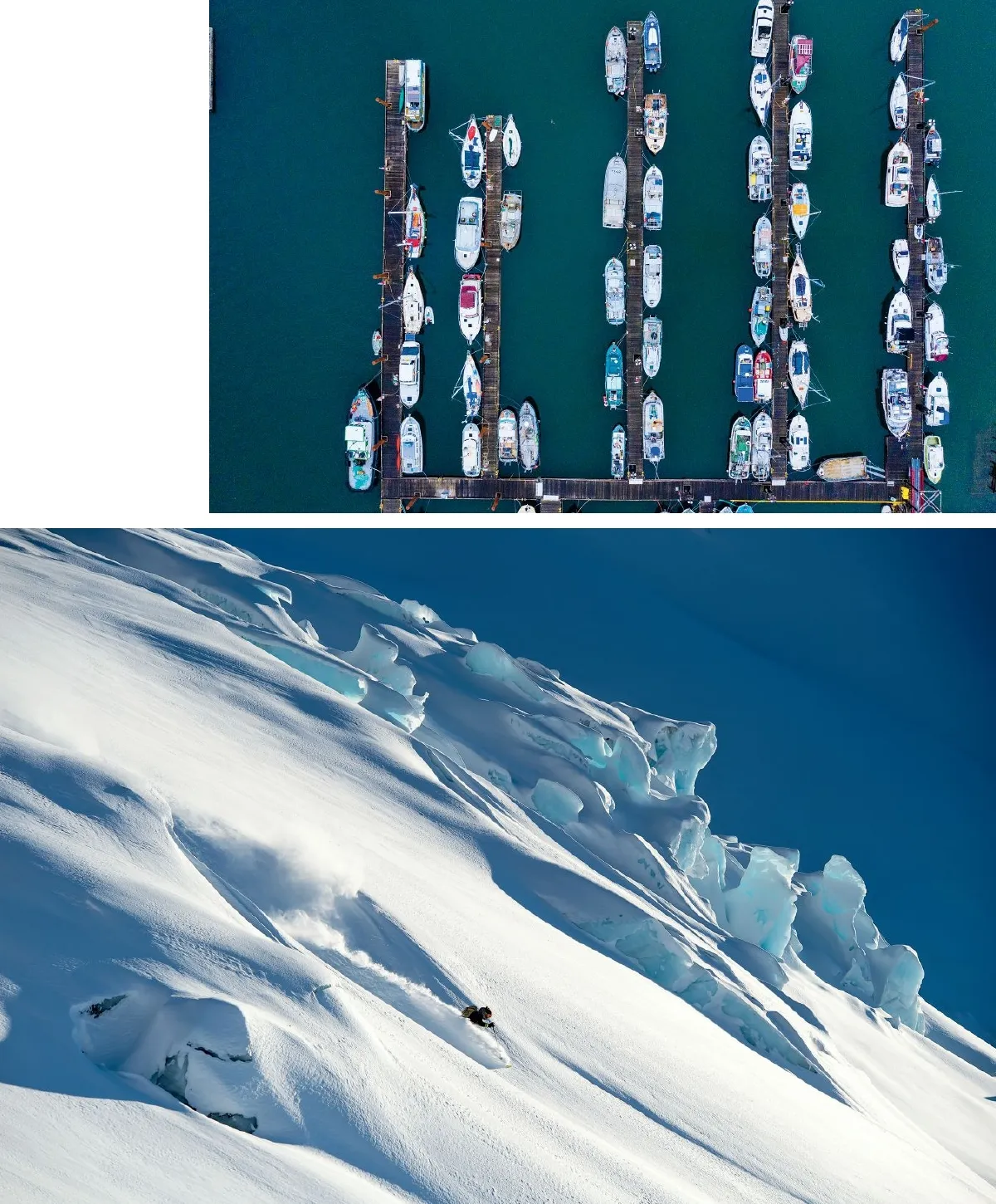
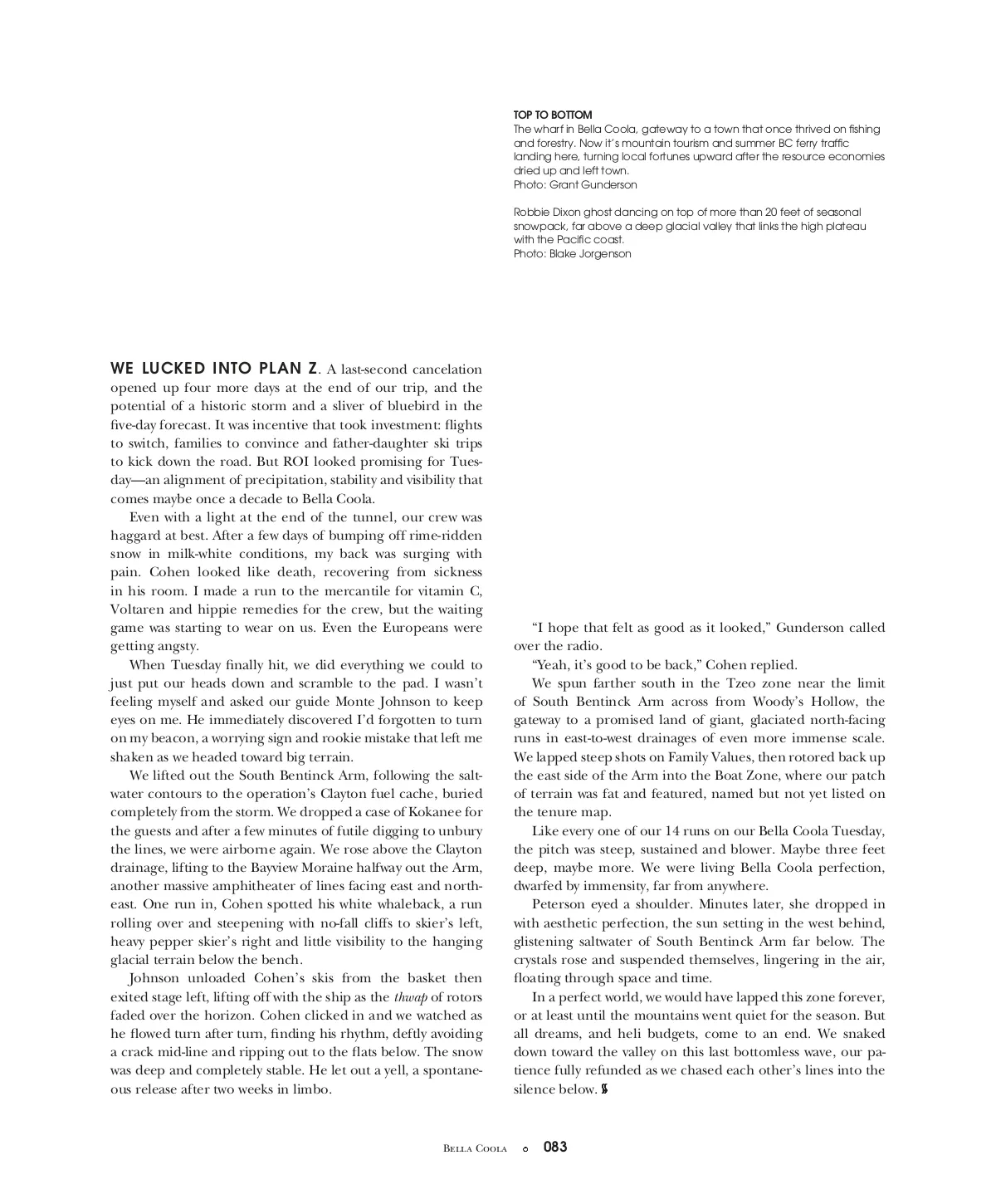
TOP TO BOTTOM The wharf in Bella Coola, gateway to a town that once thrived on fishing and forestry. Now it’s mountain tourism and summer BC ferry traffic landing here, turning local fortunes upward after the resource economies dried up and left town. Photo: Grant Gunderson Robbie Dixon ghost dancing on top of more than 20 feet of seasonal snowpack, far above a deep glacial valley that links the high plateau with the Pacific coast. Photo: Blake Jorgenson WE LUCKED INTO PLAN Z . A last-second cancelation opened up four more days at the end of our trip, and the potential of a historic storm and a sliver of bluebird in the five-day forecast. It was incentive that took investment: flights to switch, families to convince and father-daughter ski trips to kick down the road. But ROI looked promising for Tues-day—an alignment of precipitation, stability and visibility that comes maybe once a decade to Bella Coola. Even with a light at the end of the tunnel, our crew was haggard at best. After a few days of bumping off rime-ridden snow in milk-white conditions, my back was surging with pain. Cohen looked like death, recovering from sickness in his room. I made a run to the mercantile for vitamin C, Voltaren and hippie remedies for the crew, but the waiting game was starting to wear on us. Even the Europeans were getting angsty. When Tuesday finally hit, we did everything we could to just put our heads down and scramble to the pad. I wasn’t feeling myself and asked our guide Monte Johnson to keep eyes on me. He immediately discovered I’d forgotten to turn on my beacon, a worrying sign and rookie mistake that left me shaken as we headed toward big terrain. We lifted out the South Bentinck Arm, following the salt-water contours to the operation’s Clayton fuel cache, buried completely from the storm. We dropped a case of Kokanee for the guests and after a few minutes of futile digging to unbury the lines, we were airborne again. We rose above the Clayton drainage, lifting to the Bayview Moraine halfway out the Arm, another massive amphitheater of lines facing east and north-east. One run in, Cohen spotted his white whaleback, a run rolling over and steepening with no-fall cliffs to skier’s left, heavy pepper skier’s right and little visibility to the hanging glacial terrain below the bench. Johnson unloaded Cohen’s skis from the basket then exited stage left, lifting off with the ship as the thwap of rotors faded over the horizon. Cohen clicked in and we watched as he flowed turn after turn, finding his rhythm, deftly avoiding a crack mid-line and ripping out to the flats below. The snow was deep and completely stable. He let out a yell, a spontane-ous release after two weeks in limbo. “I hope that felt as good as it looked,” Gunderson called over the radio. “Yeah, it’s good to be back,” Cohen replied. We spun farther south in the Tzeo zone near the limit of South Bentinck Arm across from Woody’s Hollow, the gateway to a promised land of giant, glaciated north-facing runs in east-to-west drainages of even more immense scale. We lapped steep shots on Family Values, then rotored back up the east side of the Arm into the Boat Zone, where our patch of terrain was fat and featured, named but not yet listed on the tenure map. Like every one of our 14 runs on our Bella Coola Tuesday, the pitch was steep, sustained and blower. Maybe three feet deep, maybe more. We were living Bella Coola perfection, dwarfed by immensity, far from anywhere. Peterson eyed a shoulder. Minutes later, she dropped in with aesthetic perfection, the sun setting in the west behind, glistening saltwater of South Bentinck Arm far below. The crystals rose and suspended themselves, lingering in the air, floating through space and time. In a perfect world, we would have lapped this zone forever, or at least until the mountains went quiet for the season. But all dreams, and heli budgets, come to an end. We snaked down toward the valley on this last bottomless wave, our pa-tience fully refunded as we chased each other’s lines into the silence below. Bella Coola 083
The Ski Journal Volume 15, Issue 1: Page 83