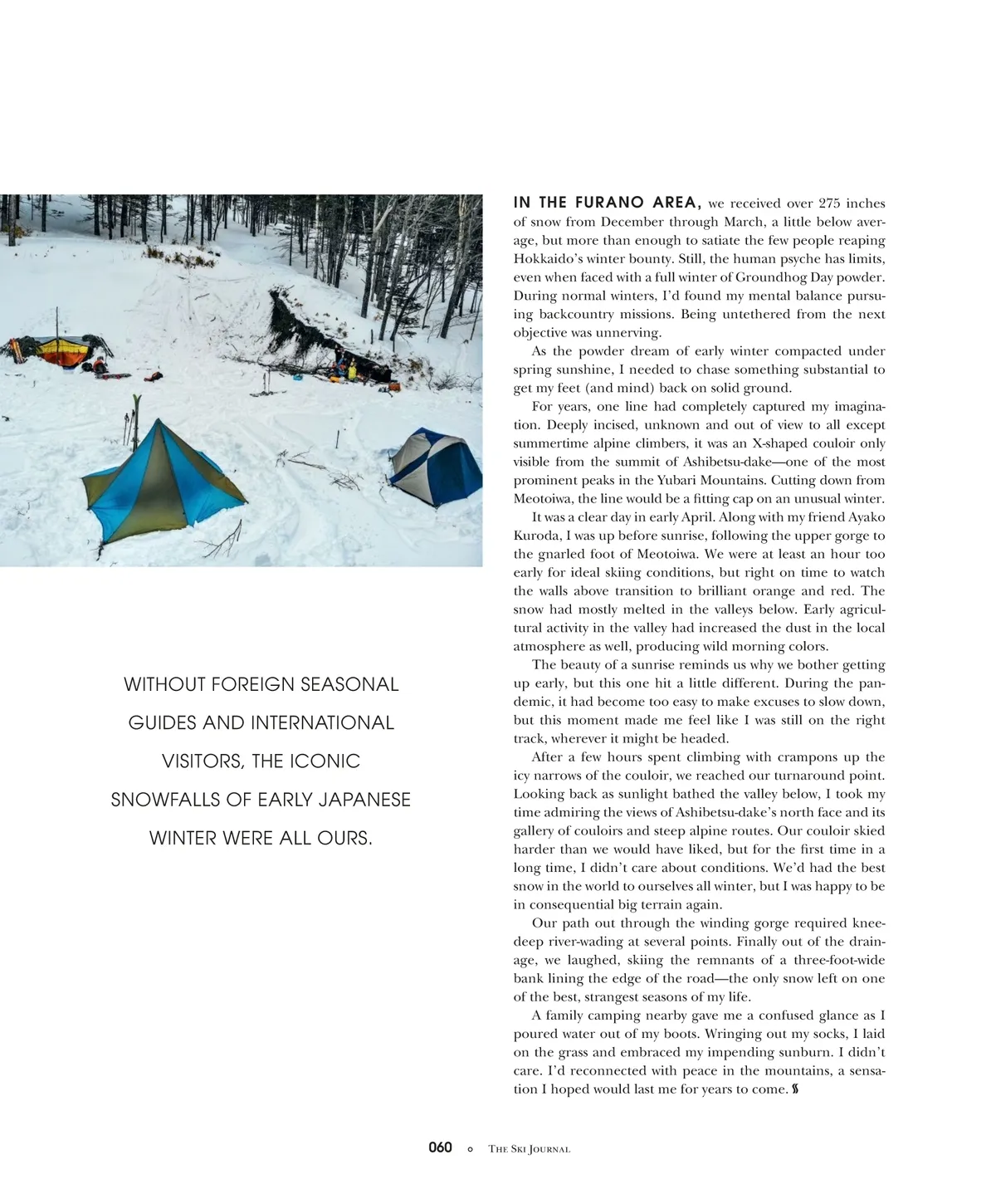
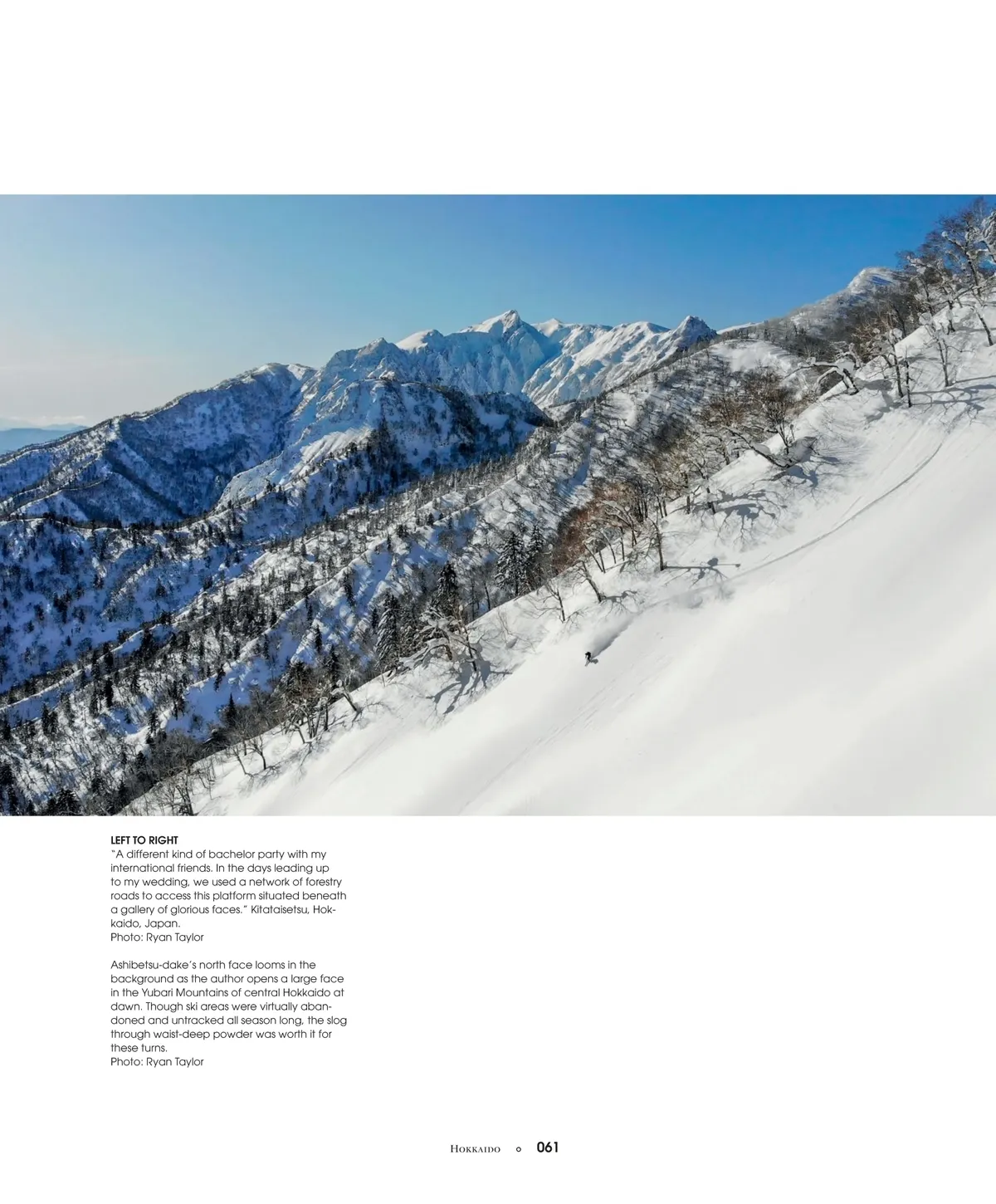
IN THE FURANO AREA, we received over 275 inches of snow from December through March, a little below aver-age, but more than enough to satiate the few people reaping Hokkaido’s winter bounty. Still, the human psyche has limits, even when faced with a full winter of Groundhog Day powder. During normal winters, I’d found my mental balance pursu-ing backcountry missions. Being untethered from the next objective was unnerving. As the powder dream of early winter compacted under spring sunshine, I needed to chase something substantial to get my feet (and mind) back on solid ground. For years, one line had completely captured my imagina-tion. Deeply incised, unknown and out of view to all except summertime alpine climbers, it was an X-shaped couloir only visible from the summit of Ashibetsu-dake—one of the most prominent peaks in the Yubari Mountains. Cutting down from Meotoiwa, the line would be a fitting cap on an unusual winter. It was a clear day in early April. Along with my friend Ayako Kuroda, I was up before sunrise, following the upper gorge to the gnarled foot of Meotoiwa. We were at least an hour too early for ideal skiing conditions, but right on time to watch the walls above transition to brilliant orange and red. The snow had mostly melted in the valleys below. Early agricul-tural activity in the valley had increased the dust in the local atmosphere as well, producing wild morning colors. The beauty of a sunrise reminds us why we bother getting up early, but this one hit a little different. During the pan-demic, it had become too easy to make excuses to slow down, but this moment made me feel like I was still on the right track, wherever it might be headed. After a few hours spent climbing with crampons up the icy narrows of the couloir, we reached our turnaround point. Looking back as sunlight bathed the valley below, I took my time admiring the views of Ashibetsu-dake’s north face and its gallery of couloirs and steep alpine routes. Our couloir skied harder than we would have liked, but for the first time in a long time, I didn’t care about conditions. We’d had the best snow in the world to ourselves all winter, but I was happy to be in consequential big terrain again. Our path out through the winding gorge required knee-deep river-wading at several points. Finally out of the drain-age, we laughed, skiing the remnants of a three-foot-wide bank lining the edge of the road—the only snow left on one of the best, strangest seasons of my life. A family camping nearby gave me a confused glance as I poured water out of my boots. Wringing out my socks, I laid on the grass and embraced my impending sunburn. I didn’t care. I’d reconnected with peace in the mountains, a sensa-tion I hoped would last me for years to come. WITHOUT FOREIGN SEASONAL GUIDES AND INTERNATIONAL VISITORS, THE ICONIC SNOWFALLS OF EARLY JAPANESE WINTER WERE ALL OURS. 060 The Ski Journal
The Ski Journal Volume 15, Issue 2: Page 60