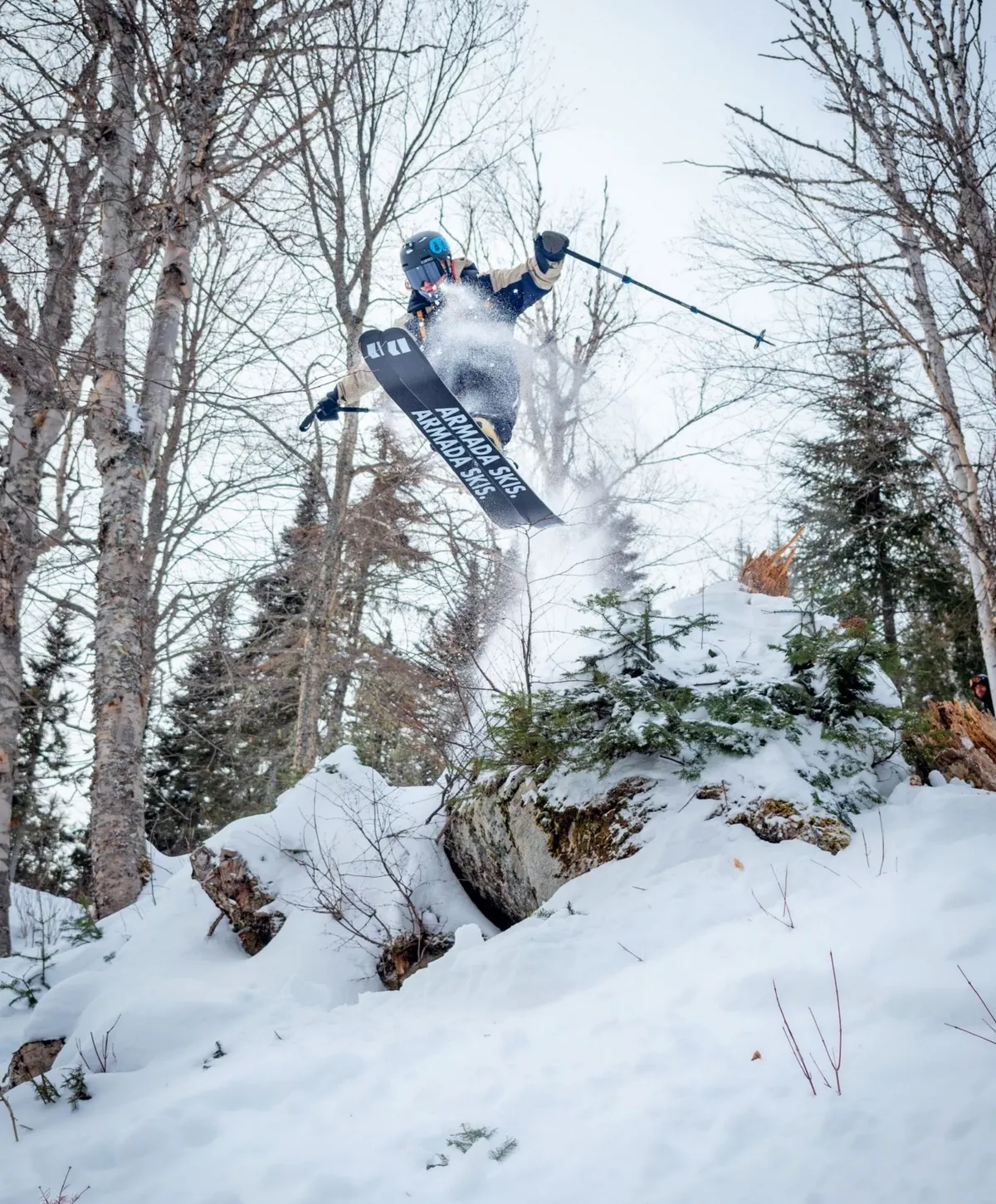
Émile Bergeron airing one out through the ultra-tight trees in the Secteur des Géants area near Mont Édouard, QC. Words and Photos Jean-Sébastien Chartier-Plante “THIS is the fourth or fifth time I’ve ever put on climbing skins,’’ 35-year-old JF Houle said as he tried to attach the back clip to the tail of his fat twin-tip. to ski in their own backyard, discovering the oft-overlooked backcountry of frigid northeast Canada. It was a quest that, like so many during the 2020 winter, was born from travel restrictions. With Quebec under strict COVID quarantine, Casabon and film director Raph Sevigny wanted to put their downtime to use and began plotting missions around Mauricie, QC. Their local towns of Shawinigan and Trois-Rivières, about one hour west from Quebec City, already grace many classic street-skiing segments, but Bourgeois and Melancon held a wild card. The snowboarders had spent their summer cutting lines and digging landings all over the region, and now they were hoping to make good on their sweat equity. They’d also set sights on the Saguenay region to the northeast and the deep offerings of the Chic-Chocs—all missions within the confines of tightly drawn pandemic borders. From what seemed like a winter of cancelled connections, a project was born. The search for “la Creuse,” Quebec’s deep powder, was on. His crew laughed. It was another cold February day at Mont Édouard, a community hill turned quasi-backcountry gold mine in L’Anse-Saint-Jean, four hours north of Quebec City, QC. The laughter was more out of surprise than in jest. Houle had been a pro skier for nearly 20 years and is a legend in the world of street skiing. Now he was admittedly flailing with his backcountry setup. This was new territory for Houle, and for the whole crew. Phil Casabon, Émile Bergeron, and snowboarders Frank Bourgeois and David “Meloche” Melançon—all top urban riders—have never been known for bushwhacking on tech bindings. Still, the skintrack was well-packed, and as the morning light softened the icy route, the team awkwardly cut upward through dense spruce forest. Calling themselves the Prospecteurs—French for “pros-pector”—the group was seeking something outside their comfort zone. After years of metal, concrete and icy transi-tions, they’d turned their attention to the trees and a new way 064 The Ski Journal
The Ski Journal Volume 15, Issue 2: Page 64