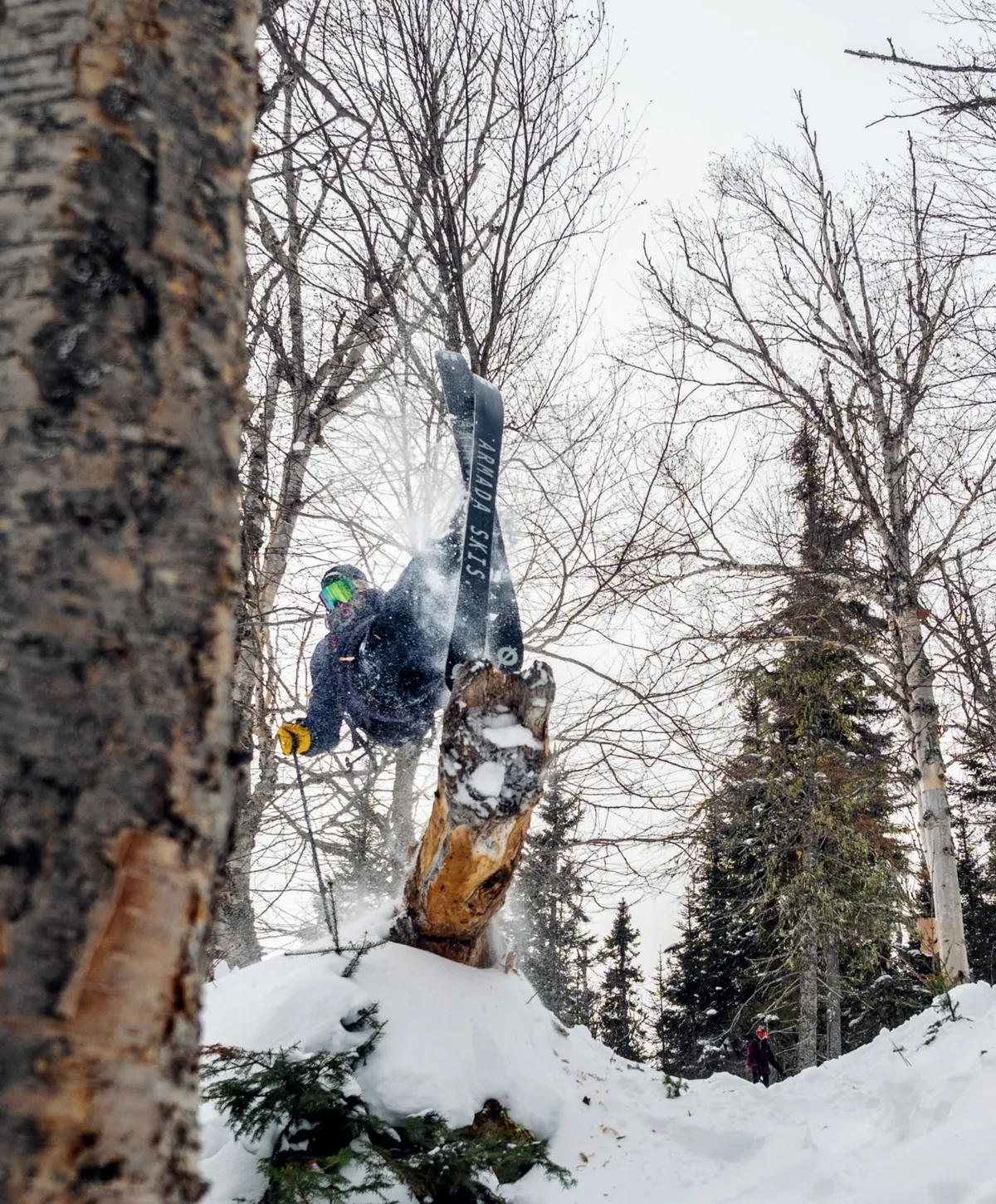
The Quebec forests are full of possibility, espe-cially for the ever-creative Phil Casabon. Tail taps on fallen timber offer a nice change of pace from life in the streets. Mont Édouard, QC. “THERE’S ALWAYS SECRET LINES. BUT FOR THOSE, YOU NEED TO BE WITH THE LUMBERJACK WHO DESIGNS IT.” — GAB LEVESQUE THE CHIC-CHOC MOUNTAINS stand in the middle of the Gaspésie Peninsula in southeastern Quebec. With sum-mits rising higher than 4,100 feet directly from the sea, the range is a ridge of rock advancing toward the Atlantic Ocean, giving the mountains an unusually dramatic alpine relief by East Coast standards. Along the north shore of the peninsula, a two-lane road connects small villages that sit between the tumultuous mouth of the Saint Lawrence River and the rising mountains. It’s a harrowing drive come wintertime, but gives access to some of the East Coast’s biggest lines. In the heart of the range, and at the end of the bumpy and winding road, Murdochville was a virtual ghost town as late as the year 2000. Built in 1950 to service copper mines in these hills, the town rose to economic prominence, but dwindled when mining slowed about the turn of the century. Although the population fell from a high of 3,300 folks to approximately 500, Guillame Molaison recognized a new natural resource when he moved to town in 2006. He saw an endless array of terrain and, after buying up lodging on the cheap, he began expanding glades and launched the ski project he called Chic-Chac. Molaison started small with snowmobile shuttles up the surrounding peaks, then brought a snowcat to Gaspésie in 2012, offering something new for East Coast skiers. The catskiing operation became Chic-Chac, and put Murdochville back on the map. In 2016, he helped reopen the decaying town ski hill, Mont Miller, giving new energy to the previously deteriorating community. But Molaison‘s last acquisition might speak the loudest: the abandoned town church that serves as his new company headquarters—a temple now dedicated to a different kind of deity. In place of the picture of Saint Paul in the nave, a portrait of the late JP Auclair stands in this temple of snow. The powder pilgrims have followed. The Chic-Chac experi-ence has turned heads on the East Coast and worldwide. Accommodations are often booked a year in advance, and Chic-Chac’s stable of three snowcats motor all winter long. After an up-and-down winter, Casabon and Bergeron jumped at the opportunity to explore the holy depths of the Chic-Chacs. In late March, snow peppered the range and, making good on a short weather window, the duo jumped in one of Molaison’s cats on the way up to nearby Mount York. There they sought the promise of clean lines accentuated by deadfall sculpted into kickers, wooden rails and butter pads by Molaison’s team—a natural terrain park perfected at 35 degrees. The weather was iffy and there was little snow down low. But as the group slowly gained elevation, the snowbase thick-ened. Rime-riddled white birch clung to steep hillsides as the range spread out before them—it was an expansive winter wonderland. When Bergeron exited the cat, he sunk to his knees. After a winter of hard yards in the backyard, they had found final salvation at 2,700 feet. Pushing into the fall line in that moment, la Creuse was worth the squeeze. 068 The Ski Journal
The Ski Journal Volume 15, Issue 2: Page 68