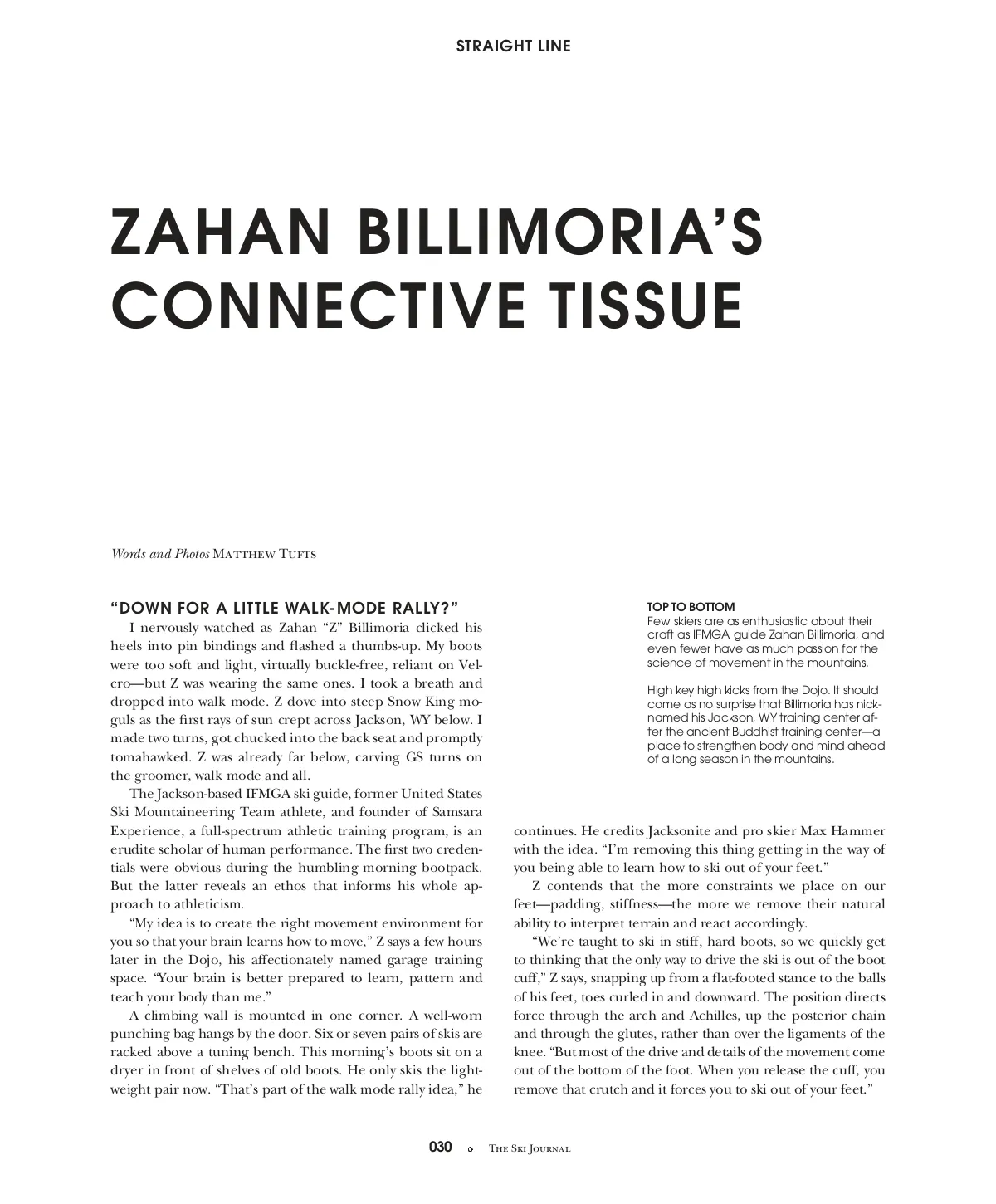
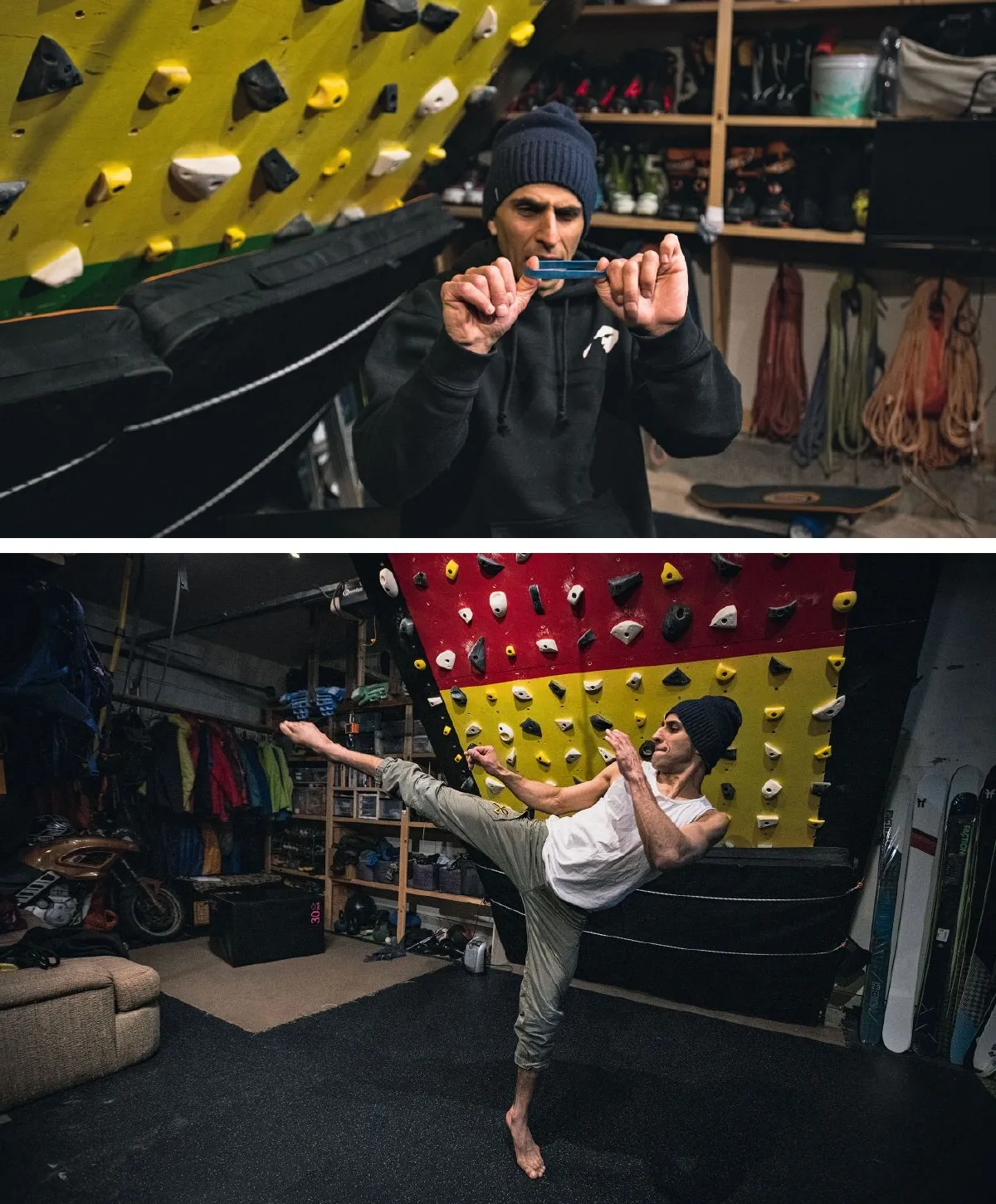
STRAIGHT LINE ZAHAN BILLIMORIA’S CONNECTIVE TISSUE Words and Photos Matthew Tufts “DOWN FOR A LITTLE WALK-MODE RALLY?” I nervously watched as Zahan “Z” Billimoria clicked his heels into pin bindings and flashed a thumbs-up. My boots were too soft and light, virtually buckle-free, reliant on Vel-cro—but Z was wearing the same ones. I took a breath and dropped into walk mode. Z dove into steep Snow King mo-guls as the first rays of sun crept across Jackson, WY below. I made two turns, got chucked into the back seat and promptly tomahawked. Z was already far below, carving GS turns on the groomer, walk mode and all. The Jackson-based IFMGA ski guide, former United States Ski Mountaineering Team athlete, and founder of Samsara Experience, a full-spectrum athletic training program, is an erudite scholar of human performance. The first two creden-tials were obvious during the humbling morning bootpack. But the latter reveals an ethos that informs his whole ap-proach to athleticism. “My idea is to create the right movement environment for you so that your brain learns how to move,” Z says a few hours later in the Dojo, his affectionately named garage training space. “Your brain is better prepared to learn, pattern and teach your body than me.” A climbing wall is mounted in one corner. A well-worn punching bag hangs by the door. Six or seven pairs of skis are racked above a tuning bench. This morning’s boots sit on a dryer in front of shelves of old boots. He only skis the light-weight pair now. “That’s part of the walk mode rally idea,” he TOP TO BOTTOM Few skiers are as enthusiastic about their craft as IFMGA guide Zahan Billimoria, and even fewer have as much passion for the science of movement in the mountains. High key high kicks from the Dojo. It should come as no surprise that Billimoria has nick-named his Jackson, WY training center af-ter the ancient Buddhist training center—a place to strengthen body and mind ahead of a long season in the mountains. continues. He credits Jacksonite and pro skier Max Hammer with the idea. “I’m removing this thing getting in the way of you being able to learn how to ski out of your feet.” Z contends that the more constraints we place on our feet—padding, stiffness—the more we remove their natural ability to interpret terrain and react accordingly. “We’re taught to ski in stiff, hard boots, so we quickly get to thinking that the only way to drive the ski is out of the boot cuff,” Z says, snapping up from a flat-footed stance to the balls of his feet, toes curled in and downward. The position directs force through the arch and Achilles, up the posterior chain and through the glutes, rather than over the ligaments of the knee. “But most of the drive and details of the movement come out of the bottom of the foot. When you release the cuff, you remove that crutch and it forces you to ski out of your feet.” 030 The Ski Journal
The Ski Journal Volume 15, Issue 3: Page 30