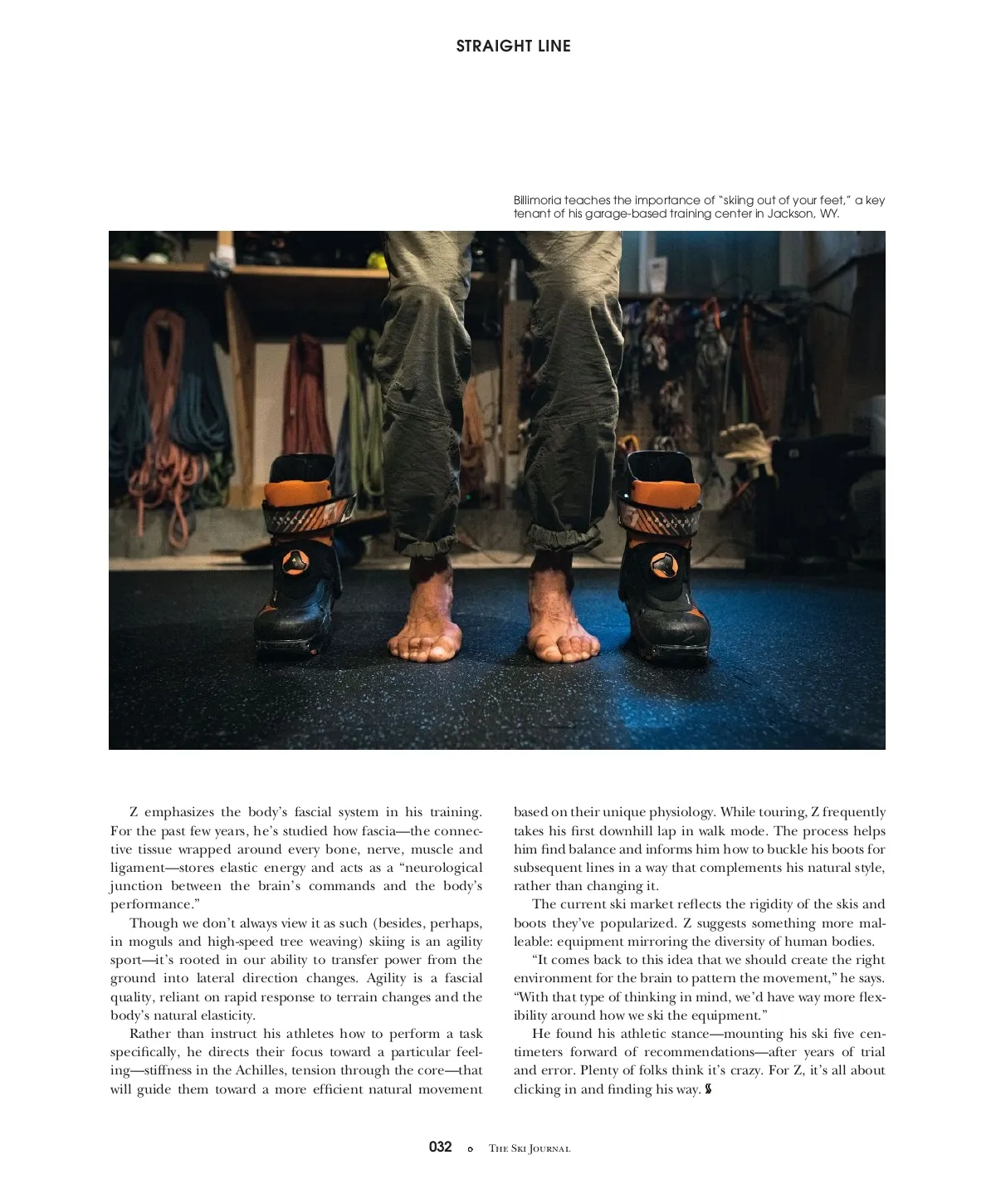
STRAIGHT LINE Billimoria teaches the importance of “skiing out of your feet,” a key tenant of his garage-based training center in Jackson, WY. Z emphasizes the body’s fascial system in his training. For the past few years, he’s studied how fascia—the connec-tive tissue wrapped around every bone, nerve, muscle and ligament—stores elastic energy and acts as a “neurological junction between the brain’s commands and the body’s performance.” Though we don’t always view it as such (besides, perhaps, in moguls and high-speed tree weaving) skiing is an agility sport—it’s rooted in our ability to transfer power from the ground into lateral direction changes. Agility is a fascial quality, reliant on rapid response to terrain changes and the body’s natural elasticity. Rather than instruct his athletes how to perform a task specifically, he directs their focus toward a particular feel-ing—stiffness in the Achilles, tension through the core—that will guide them toward a more efficient natural movement based on their unique physiology. While touring, Z frequently takes his first downhill lap in walk mode. The process helps him find balance and informs him how to buckle his boots for subsequent lines in a way that complements his natural style, rather than changing it. The current ski market reflects the rigidity of the skis and boots they’ve popularized. Z suggests something more mal-leable: equipment mirroring the diversity of human bodies. “It comes back to this idea that we should create the right environment for the brain to pattern the movement,” he says. “With that type of thinking in mind, we’d have way more flex-ibility around how we ski the equipment.” He found his athletic stance—mounting his ski five cen-timeters forward of recommendations—after years of trial and error. Plenty of folks think it’s crazy. For Z, it’s all about clicking in and finding his way. 032 The Ski Journal
The Ski Journal Volume 15, Issue 3: Page 32