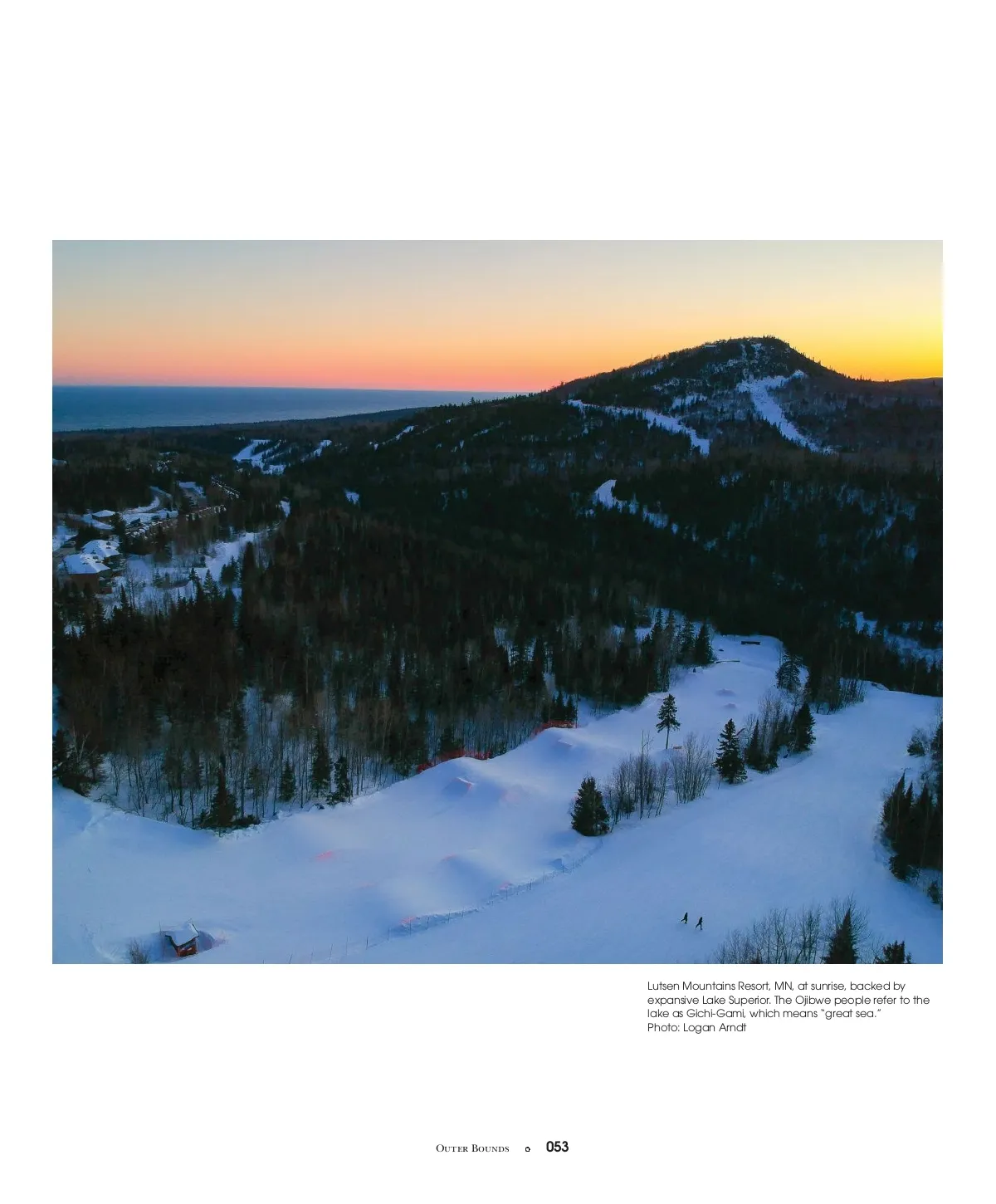
Words Heather Hansman of Duluth, MN, near Lake Superior, a group of ob-sessive backcountry skiers has been planning the Midwest’s first backcountry ski area and a hut-to-hut ski-touring route along the North Shore. Rory Scoles, the founder of Superior Highlands Backcountry, a local nonprofit, says hacking around outside in the winter is core to the culture there. They’re working to get people excited about ski-touring, and to bring Midwesterners into the mountains. The Great Lakes region might not seem like an ideal backcoun-try zone, but the dense hardwood forests of those northern mountains pitch and dip into perfect mini-golf ski lines. The snow stays deep and cold. And to make that terrain even bet-ter, the organization hosted its first glading parties for the hut system this fall. The centerpiece of the plan is Moose Mountain, which holds arguably the best backcountry skiing in the Mid-west—1,000 vertical feet of sugar maple and rolling terrain. But the backcountry skiing on Moose Mountain, and the hut-to-hut traverse plans, are at risk because of another ski project in the works. In 2017, Lutsen Mountain, the biggest ski resort in the Midwest and owner of the eastern third of Moose Mountain, proposed an expansion into 496 acres of Forest Service land. The project is currently under environmental review and would include seven chairlifts, a “mountaintop chalet,” two new snowmaking reservoirs and 1,260 parking spaces to aug-ment the 200 they have currently. “What they’re proposing is basically quadrupling the area. It’s huge,” Scoles says. “One of the many questions that arises just from the facts: Are they fully utilizing the terrain they have? In my estimation they have not. I own the pro shop; of course I want the ski area to succeed—but not like this.” Jim Vick, Director of Operations, Marketing and Guest Services at Lutsen, says the mountain’s on-hill skier density is usually pretty low, but expanding will allow the resort to offer more beginner-friendly terrain and appeal to a broader audi-ence. “We’re adding a mix of terrain, and the expansion allows for additional services like rental and parking lots,” he says. “It’s what we need to stay competitive with the big [resorts].” In many ways, the debate centers on differing definitions of a single word: access. For resorts with expansion plans such as Lutsen, increasing access involves designating more lift-accessed terrain and amenities—essentially whatever it takes to get more people on the ski hill. For recreationists that frequent public land under their own power, preserving access means keeping development—resort or otherwise—off of National Forest land and keeping that terrain available for public use. With more and more resort expansion plans arising over the last decade, it’s a tug-of-war that has been amplified in mountain towns across North America. Historically, policy has given resorts priority in how the Forest Service manages ski area permits. That’s because For-est Service policy was initially established in the 1940s during a time when the government was trying to encourage growth on public land. According to the National Forest Ski Area Per-mit Act (1986), resorts are able to request the expansion and outline the viable alternatives in the Environmental Impact Statement. For instance, at Lutsen, Vick says they went back and forth with the Forest Service to develop the EIS before it became public. Now backcountry skiers and other users, like hikers and seasonal hunters, are asking to have a voice in how the lands they use for recreation are managed. They’re urging the Forest Service to amend its policy to include other options from when expansion plans are first proposed and to consider all kinds of use—not just lift-accessed skiing. NORTH 052 The Ski Journal
The Ski Journal Volume 15, Issue 3: Page 52