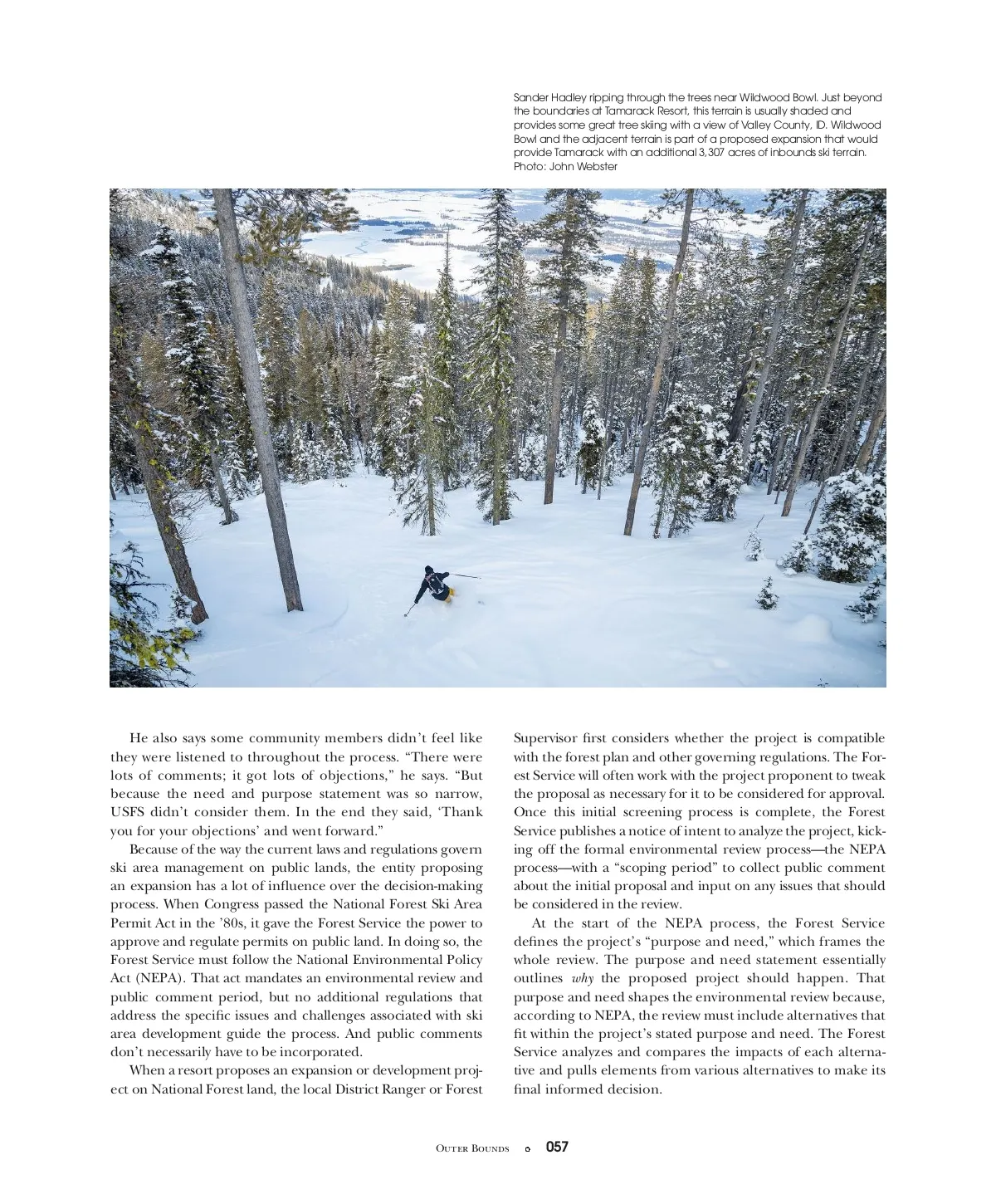
Sander Hadley ripping through the trees near Wildwood Bowl. Just beyond the boundaries at Tamarack Resort, this terrain is usually shaded and provides some great tree skiing with a view of Valley County, ID. Wildwood Bowl and the adjacent terrain is part of a proposed expansion that would provide Tamarack with an additional 3,307 acres of inbounds ski terrain. Photo: John Webster He also says some community members didn’t feel like they were listened to throughout the process. “There were lots of comments; it got lots of objections,” he says. “But because the need and purpose statement was so narrow, USFS didn’t consider them. In the end they said, ‘Thank you for your objections’ and went forward.” Because of the way the current laws and regulations govern ski area management on public lands, the entity proposing an expansion has a lot of influence over the decision-making process. When Congress passed the National Forest Ski Area Permit Act in the ’80s, it gave the Forest Service the power to approve and regulate permits on public land. In doing so, the Forest Service must follow the National Environmental Policy Act (NEPA). That act mandates an environmental review and public comment period, but no additional regulations that address the specific issues and challenges associated with ski area development guide the process. And public comments don’t necessarily have to be incorporated. When a resort proposes an expansion or development proj-ect on National Forest land, the local District Ranger or Forest Supervisor first considers whether the project is compatible with the forest plan and other governing regulations. The For-est Service will often work with the project proponent to tweak the proposal as necessary for it to be considered for approval. Once this initial screening process is complete, the Forest Service publishes a notice of intent to analyze the project, kick-ing off the formal environmental review process—the NEPA process—with a “scoping period” to collect public comment about the initial proposal and input on any issues that should be considered in the review. At the start of the NEPA process, the Forest Service defines the project’s “purpose and need,” which frames the whole review. The purpose and need statement essentially outlines why the proposed project should happen. That purpose and need shapes the environmental review because, according to NEPA, the review must include alternatives that fit within the project’s stated purpose and need. The Forest Service analyzes and compares the impacts of each alterna-tive and pulls elements from various alternatives to make its final informed decision. Outer Bounds 057
The Ski Journal Volume 15, Issue 3: Page 57