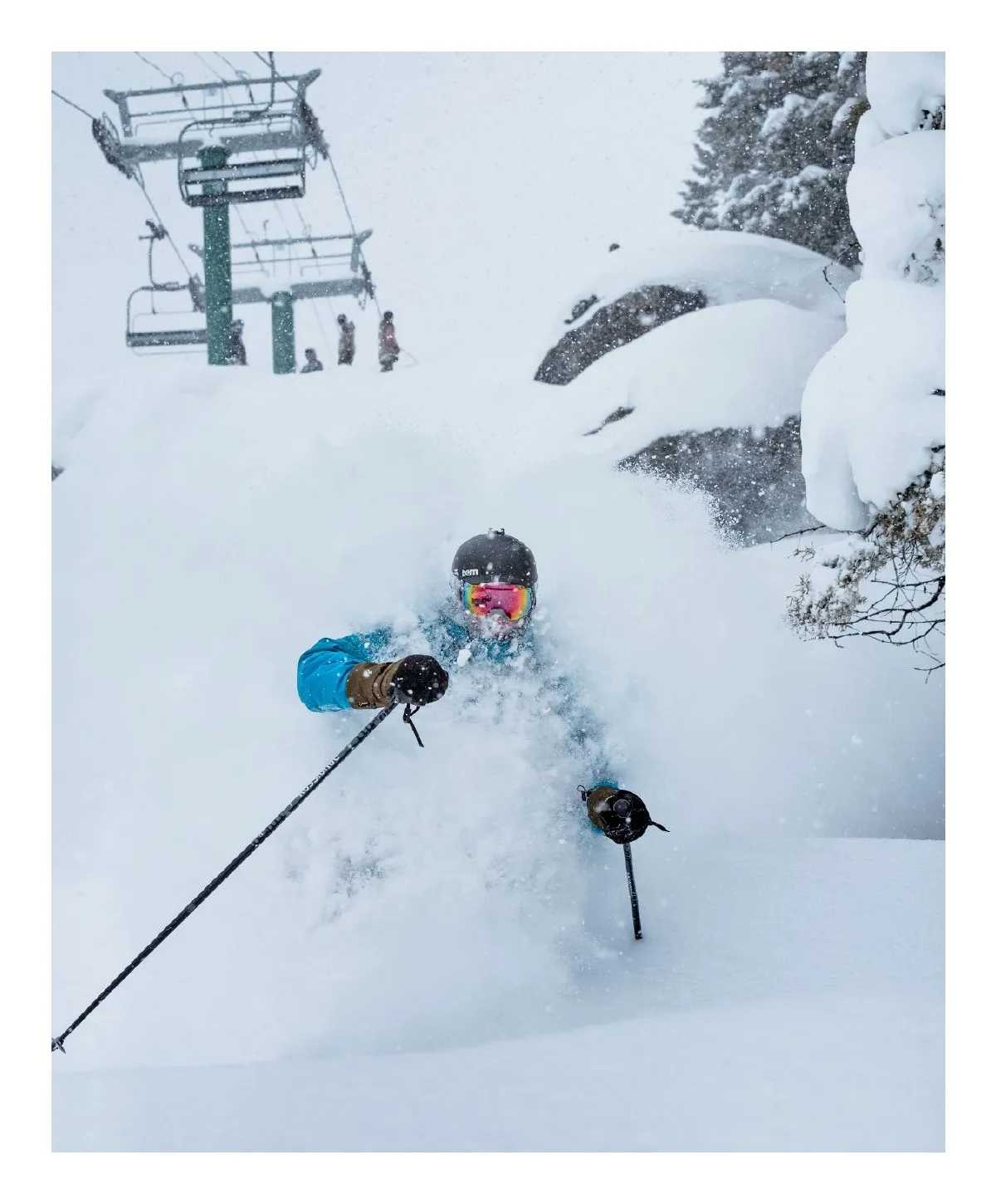
Alec Voorhees getting in some deep powder turns below Tamarack Resort’s main lift, the Tamarack Express. Photo: John Webster Kofinas says the Snow King NEPA review was too narrow and all the alternatives were slight variations on the original plan rather than a comprehensive compromise. He says his group lost the battle on that project, but now they’re asking the Forest Service to hold off another proposed expansion on the other side of Teton Pass, where Grand Targhee wants to expand farther into the Caribou-Targhee National Forest, potentially doubling the number of skiers in critical wildlife habitat. The project has already been scaled back. After listening to local concerns, Grand Targhee general manager Geordie Gillett pulled a proposed cat-skiing zone from the original proposal in January 2021. It was an important step, reaching a sought-after middle ground in the fight over ski resort expansion, but advocacy groups such as the Teton Backcountry Alliance are hoping to have a more official seat at the table earlier in the process rather than relying on last-minute intervention. Like so many access and equity issues in ski towns, it’s not just about the skiing. In addition to wildlife and skiing impacts, there will also be social and economic impacts if more resort skiers flood into Driggs and Victor, ID. Expansion helps to bring more people to the hill and provide an economic boost to local lodging and hospitality industries, but it also puts additional strain on infrastructure and public works projects that were designed with local populations—not necessarily a massive influx of visitors—in mind. Because the Targhee access road is in Idaho, but the ski area is in Wyoming, all of the revenue from lift tickets or food sales goes to Wyoming, while Idaho shoulders the bulk of the costs of emergency services and traffic using the resort’s ac-cess road as well as employee housing, which is also located in Idaho. While the Idaho side may benefit from a trickle down of increased ski area revenue into towns such as Driggs and Victor, county commissioners and advocacy groups are wor-ried about increased infrastructure bills. With what they’ve learned from—and lost—at Snow King, community groups such as Teton Backcountry Alliance are putting pressure on the Forest Service to assess a wider range of alternatives ad-dressing these realities, and to look at the bigger-picture im-pacts—both positive and negative—of expansion. While the USFS isn’t required by law to take those growth consequences into account, county commissioners on both the Idaho and Wyoming sides of the pass are looking to do their own research, with both sides recently pledging close to $25,000 for a study to assess how the expansion might impact roads, traffic, waste management, labor and housing in the area. “All of those things will…impact the county and city,” Cindy Regel, a commissioner from Teton County, ID, told Jackson Hole News and Guide in October. “That’s the crux of why I wanted to see a more in-depth socioeconomic impact analysis: to figure out what the impacts are going to be and what it’s going to cost.” Expanding ski resorts is about far more than just skiing, and the scenario taking place in the Tetons is a microcosm of what’s happening in many rural mountain areas. In Wenatchee, they talk about fire danger and water access. At Tamarack, O’Brien says they’re worried about housing short-ages. Advocates and activists are working to open up conversa-tions with the resorts, to find the balance between economic growth, habitat protection, non-resort recreation and more. That’s why backcountry advocates in all those places feel strongly about also having a voice in the expansion and per-mitting process. The Winter Wildlands Alliance is attempting to consolidate the battles and encourage the Forest Service to put more checks on its decision-making process to ensure the broader interests of the community are considered from the get-go. They understand expansion can mean economic growth and stability for an area, but know such growth comes with costs not reflected on a balance sheet, and they’re push-ing to make sure the full picture is understood before plans move forward. “Ski area development can have many effects…but the cur-rent way in which the Forest Service analyzes these projects fails to capture the full range of [it],” Regel says. “We’re not trying to ban expansion unilaterally, just change the process so that all stakeholders can have a voice.” She, along with the skiers whose backcountry zones are currently incorporated within expansion plans, want to be heard in the debate over public lands. Scoles is trying to show something similar at Moose Mountain and Lutsen—how dif-ferent ways of backcountry recreating can benefit the commu-nity and the ecosystem, while still working in conjunction with local resorts. When he’s not asking skiers to sign petitions in his shop, he’s trying to get the ski community to think outside of the current framework of expanding, to be open to the re-sorts’ desire to stay competitive—which Vick says is crucial to the health of the ski industry—while still considering popular backcountry zones. Collaboration holds the key to a sustainable future for both ski areas and public land users, but what exactly that looks like is a debate that is widening cracks in mountain towns across the United States. Though that collaboration may begin with an amendment to a nearly century-old USFS policy, back-country advocacy groups, resorts and the communities they represent realize they need to find common ground quickly before the wedge is driven too deep. Outer Bounds 059
The Ski Journal Volume 15, Issue 3: Page 59