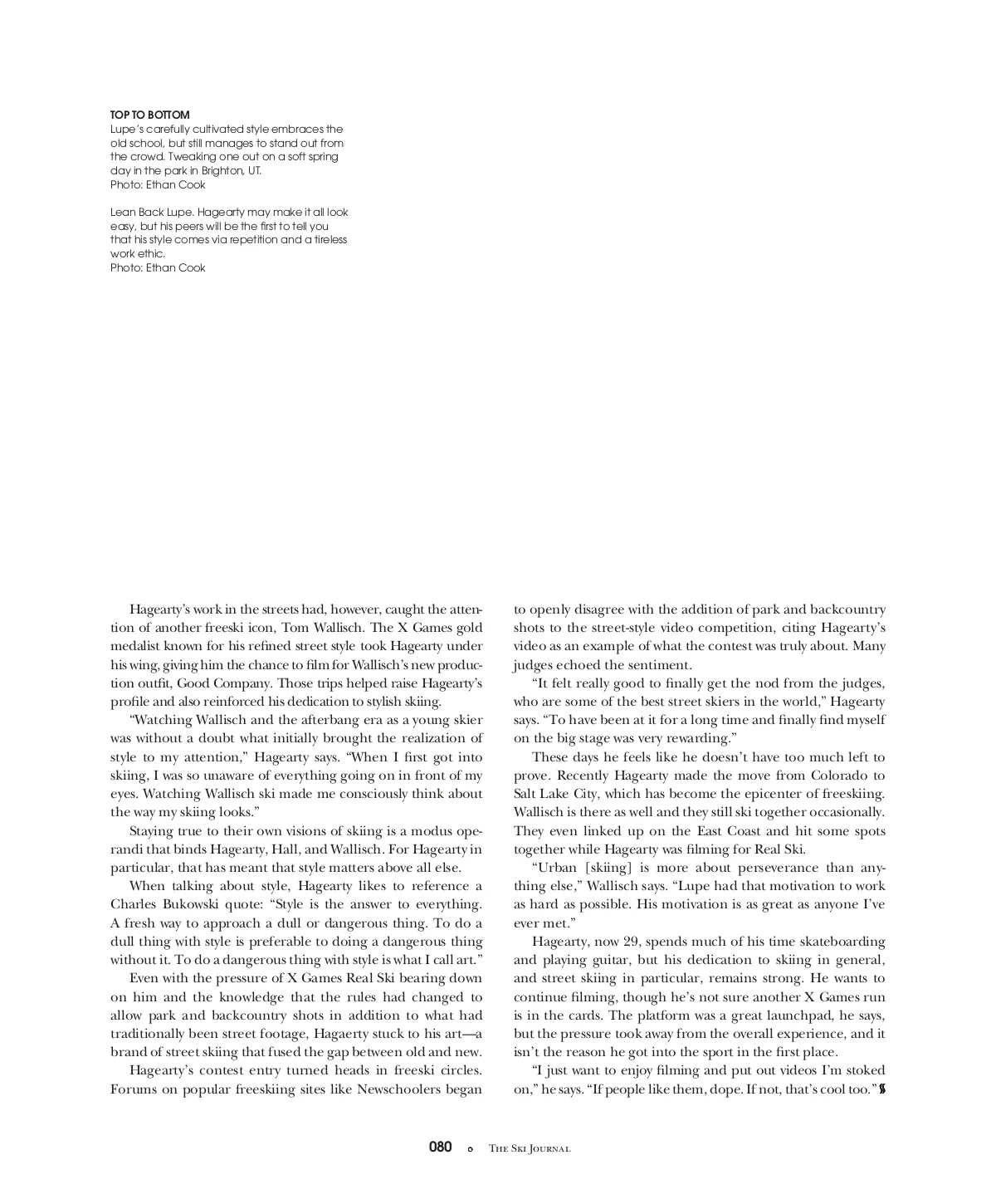
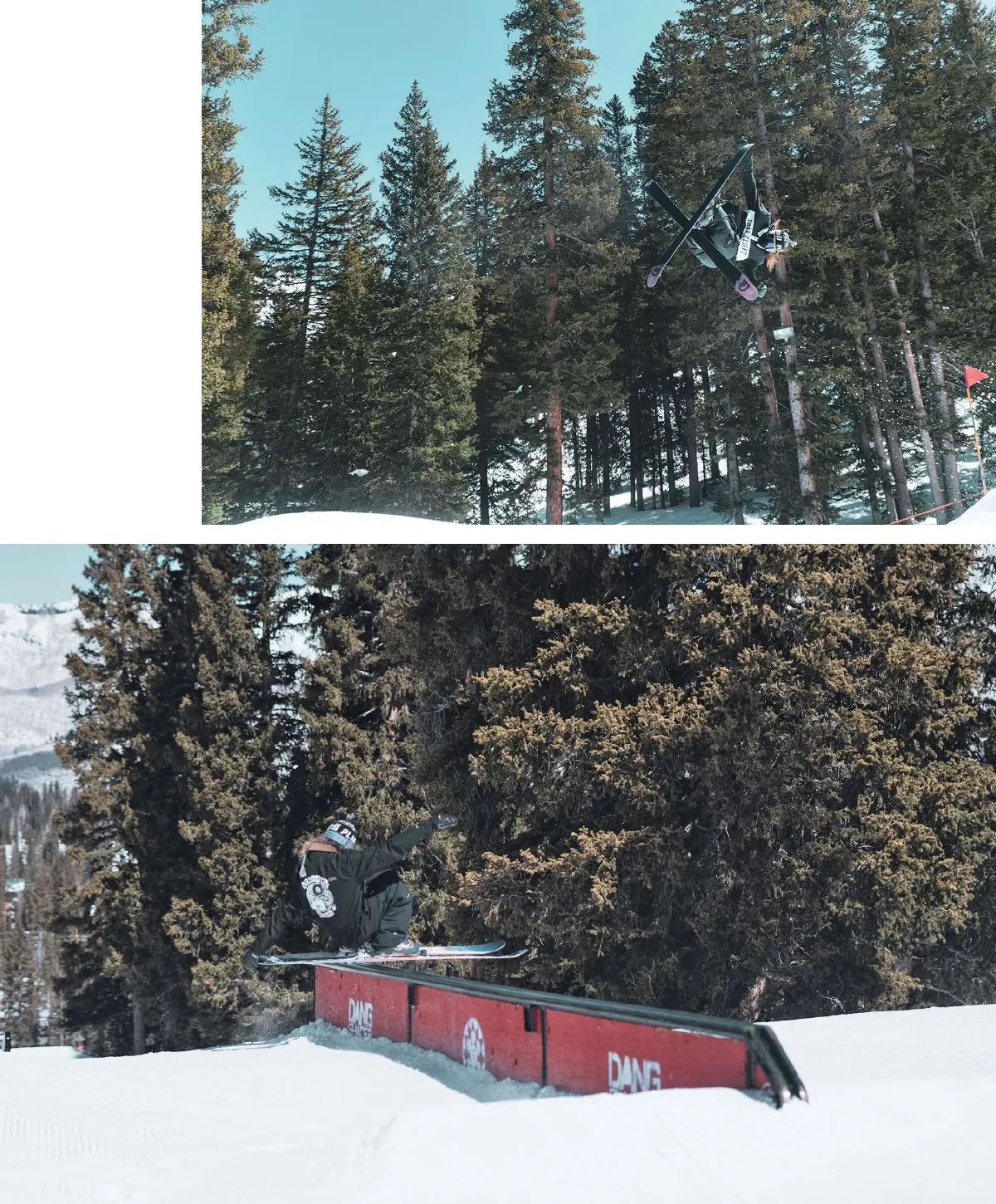
TOP TO BOTTOM Lupe’s carefully cultivated style embraces the old school, but still manages to stand out from the crowd. Tweaking one out on a soft spring day in the park in Brighton, UT. Photo: Ethan Cook Lean Back Lupe. Hagearty may make it all look easy, but his peers will be the first to tell you that his style comes via repetition and a tireless work ethic. Photo: Ethan Cook Hagearty’s work in the streets had, however, caught the atten-tion of another freeski icon, Tom Wallisch. The X Games gold medalist known for his refined street style took Hagearty under his wing, giving him the chance to film for Wallisch’s new produc-tion outfit, Good Company. Those trips helped raise Hagearty’s profile and also reinforced his dedication to stylish skiing. “Watching Wallisch and the afterbang era as a young skier was without a doubt what initially brought the realization of style to my attention,” Hagearty says. “When I first got into skiing, I was so unaware of everything going on in front of my eyes. Watching Wallisch ski made me consciously think about the way my skiing looks.” Staying true to their own visions of skiing is a modus ope-randi that binds Hagearty, Hall, and Wallisch. For Hagearty in particular, that has meant that style matters above all else. When talking about style, Hagearty likes to reference a Charles Bukowski quote: “Style is the answer to everything. A fresh way to approach a dull or dangerous thing. To do a dull thing with style is preferable to doing a dangerous thing without it. To do a dangerous thing with style is what I call art.” Even with the pressure of X Games Real Ski bearing down on him and the knowledge that the rules had changed to allow park and backcountry shots in addition to what had traditionally been street footage, Hagaerty stuck to his art—a brand of street skiing that fused the gap between old and new. Hagearty’s contest entry turned heads in freeski circles. Forums on popular freeskiing sites like Newschoolers began to openly disagree with the addition of park and backcountry shots to the street-style video competition, citing Hagearty’s video as an example of what the contest was truly about. Many judges echoed the sentiment. “It felt really good to finally get the nod from the judges, who are some of the best street skiers in the world,” Hagearty says. “To have been at it for a long time and finally find myself on the big stage was very rewarding.” These days he feels like he doesn’t have too much left to prove. Recently Hagearty made the move from Colorado to Salt Lake City, which has become the epicenter of freeskiing. Wallisch is there as well and they still ski together occasionally. They even linked up on the East Coast and hit some spots together while Hagearty was filming for Real Ski. “Urban [skiing] is more about perseverance than any-thing else,” Wallisch says. “Lupe had that motivation to work as hard as possible. His motivation is as great as anyone I’ve ever met.” Hagearty, now 29, spends much of his time skateboarding and playing guitar, but his dedication to skiing in general‚ and street skiing in particular, remains strong. He wants to continue filming, though he’s not sure another X Games run is in the cards. The platform was a great launchpad, he says, but the pressure took away from the overall experience, and it isn’t the reason he got into the sport in the first place. “I just want to enjoy filming and put out videos I’m stoked on,” he says. “If people like them, dope. If not, that’s cool too.” 080 The Ski Journal
The Ski Journal Volume 15, Issue 3: Page 80