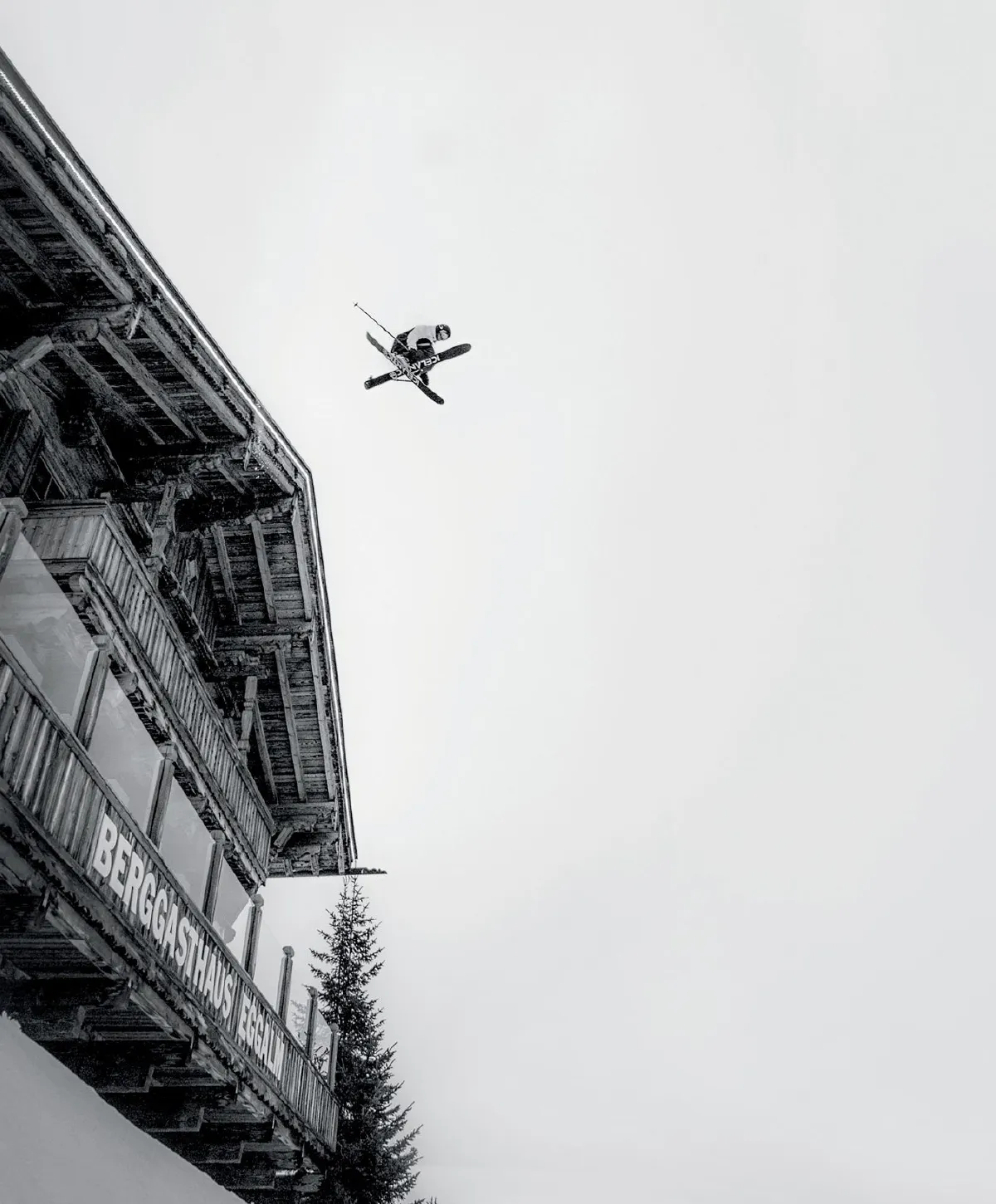
High in Austria’s Zillertal Alps, we hunkered in the dimly lit bar. After the last schnapps was empty, the conversation shifted to the angle of the roof. With a warm laugh, and no concern for liability, the bar owner pulled open the staircase to the roof and gestured upward. Amie Engerbretson and I stood watch, and in the last light I caught this shot of Mark Morris exiting the bar to a broken rib. After getting pushed thousands of feet and flying over a rocky cliff band, Rogers miraculously stopped moving with her airways clear—alive but with spinal damage that would keep her away from skiing for the next year. After months of physical therapy, Rogers moved to Utah’s Wasatch Range and cautiously approached the mountains again through a different lens—both literally and figuratively. “There was a lot of trauma I had to deal with after the accident and I eased back into skiing really slowly, so I just spent a lot more time shooting,” she says. “It became this grounding force, like a meditative art. It slowed me down, helped me notice things I hadn’t seen before, and really pulled me into the moment.” The Wasatch is home to some of skiing’s top photographers, and Rogers got to learn from pros such as Adam Barker, Lee Cohen, and Will Wissman. “All those guys were really encour-aging,” she says. “Adam was really supportive of getting more women psyched on photography, and he was always there to answer questions when I had them.” Barker, who was born and raised in the Wasatch, recalls Rogers’ maturation as a photog-rapher, “It’s as if all the dots are being connected. Tack sharp, well-composed, accurately exposed—her work looks polished. You can tell she’s worked hard in honing her skills.” Rogers’ journey has taken its own unique turn, however, one facilitated by her fascination with the sheer magnitude of the natural world. Today her eye searches for contrast, for light and the movement of shadows across the mountains. Shots of tiny humans etching paper-thin turns into untouched slopes focus more on the mountains themselves. The humans, on the other hand, become secondary. It didn’t take long for her work to get noticed, leading to commercial projects with Icelantic and Spyder. Soon she was travelling Europe; Zermatt one week, Engelberg the next. But it was there, shooting dreamy powder photos in Zil-lertal for a ski catalog, that Rogers knew she needed to make a change. “I felt out of alignment. My work lacked a larger purpose,” she says. “Standing there, feeling that awe and con-nection of being in these mountains, I knew I had to realign to work in ways that foster conservation of places like this. We’re making money off these places, but what are we doing to conserve them?” She thought back to those summers in the Tetons, of conservation projects on her grandfather’s farm. She thought about her grandfather’s words: “If you love a place, you have to do something to give back to it.” Alpine photography sits close to Rogers’ heart, a way to blend her childhood roots in natural spaces and her love for skiing and action sports. She’s one of few people who get to weave these landscapes into her everyday life, and her lens has given her a unique look into these environments. But as remote and wild spaces see more and more traffic in summer and winter, the fast pace of ski and outdoor photography doesn’t always keep up with the growing impact that humans have on these delicate environments. “Recreation in itself is not a conservation act,” she says. “We want access. We want to use public land. We want to pursue sports that enrich our lives. We want to travel and see new places. We want to share the imagery and build careers. But the question becomes how is big rec, and those of us that promote it, participating in conservation?” She knows that film crews are often big, and the high stress of nailing deliverables in a short period of time can leave things like carrying out waste as a lesser concern. As she came to terms with the environmental impact of her profession, Rogers had a realization: “The best shot isn’t always the most responsible one.” Instead of focusing on the doom and gloom of overcrowd-ing in the backcountry, Rogers saw opportunity in photogra-phy. When used properly, a camera is a powerful tool to stir up change, a chance to educate. She took a step back, reevaluated, and sought out brands and partners working to protect the land and use visuals as a way to encourage proper land stewardship. Through a mutual friend, Rogers connected with world-renowned Canadian conservation photographer Paul Nicklen, whose work com-bining photos and environmental narratives had a dramatic impact on her. Rogers worked with Nicklen on his branding, and saw the power and depth imagery could create in protect-ing the world around her. He showed her that wild spaces and wildlife depend on education and action, something that resonated deeply with her as she sought out future projects. Jana Rogers Gallerie 087
The Ski Journal Volume 15, Issue 3: Page 87