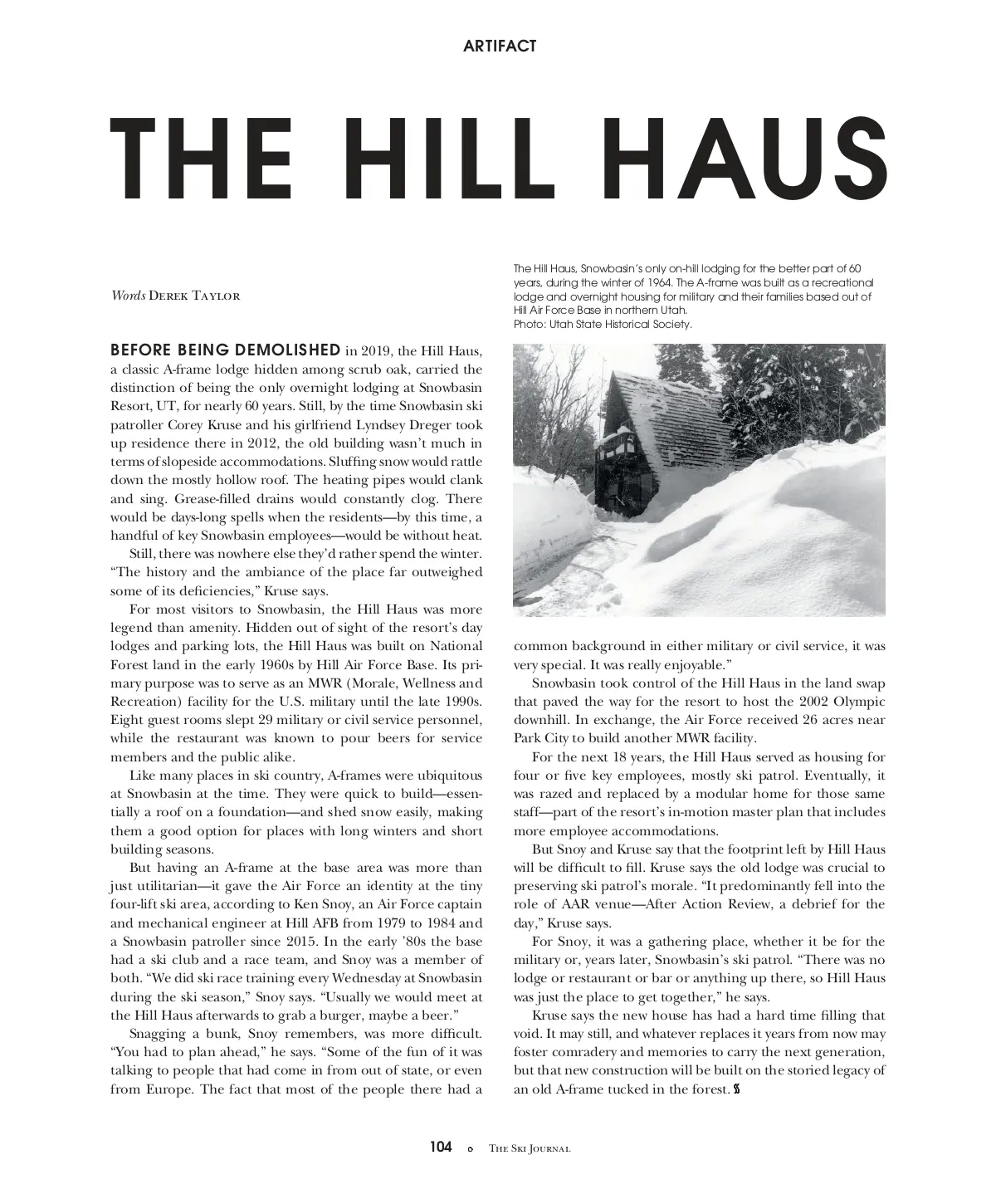
ARTIFACT THE HILL HAUS Words Derek Taylor The Hill Haus, Snowbasin’s only on-hill lodging for the better part of 60 years, during the winter of 1964. The A-frame was built as a recreational lodge and overnight housing for military and their families based out of Hill Air Force Base in northern Utah. Photo: Utah State Historical Society. BEFORE BEING DEMOLISHED in 2019, the Hill Haus, a classic A-frame lodge hidden among scrub oak, carried the distinction of being the only overnight lodging at Snowbasin Resort, UT, for nearly 60 years. Still, by the time Snowbasin ski patroller Corey Kruse and his girlfriend Lyndsey Dreger took up residence there in 2012, the old building wasn’t much in terms of slopeside accommodations. Sluffing snow would rattle down the mostly hollow roof. The heating pipes would clank and sing. Grease-filled drains would constantly clog. There would be days-long spells when the residents—by this time, a handful of key Snowbasin employees—would be without heat. Still, there was nowhere else they’d rather spend the winter. “The history and the ambiance of the place far outweighed some of its deficiencies,” Kruse says. For most visitors to Snowbasin, the Hill Haus was more legend than amenity. Hidden out of sight of the resort’s day lodges and parking lots, the Hill Haus was built on National Forest land in the early 1960s by Hill Air Force Base. Its pri-mary purpose was to serve as an MWR (Morale, Wellness and Recreation) facility for the U.S. military until the late 1990s. Eight guest rooms slept 29 military or civil service personnel, while the restaurant was known to pour beers for service members and the public alike. Like many places in ski country, A-frames were ubiquitous at Snowbasin at the time. They were quick to build—essen-tially a roof on a foundation—and shed snow easily, making them a good option for places with long winters and short building seasons. But having an A-frame at the base area was more than just utilitarian—it gave the Air Force an identity at the tiny four-lift ski area, according to Ken Snoy, an Air Force captain and mechanical engineer at Hill AFB from 1979 to 1984 and a Snowbasin patroller since 2015. In the early ’80s the base had a ski club and a race team, and Snoy was a member of both. “We did ski race training every Wednesday at Snowbasin during the ski season,” Snoy says. “Usually we would meet at the Hill Haus afterwards to grab a burger, maybe a beer.” Snagging a bunk, Snoy remembers, was more difficult. “You had to plan ahead,” he says. “Some of the fun of it was talking to people that had come in from out of state, or even from Europe. The fact that most of the people there had a common background in either military or civil service, it was very special. It was really enjoyable.” Snowbasin took control of the Hill Haus in the land swap that paved the way for the resort to host the 2002 Olympic downhill. In exchange, the Air Force received 26 acres near Park City to build another MWR facility. For the next 18 years, the Hill Haus served as housing for four or five key employees, mostly ski patrol. Eventually, it was razed and replaced by a modular home for those same staff—part of the resort’s in-motion master plan that includes more employee accommodations. But Snoy and Kruse say that the footprint left by Hill Haus will be difficult to fill. Kruse says the old lodge was crucial to preserving ski patrol’s morale. “It predominantly fell into the role of AAR venue—After Action Review, a debrief for the day,” Kruse says. For Snoy, it was a gathering place, whether it be for the military or, years later, Snowbasin’s ski patrol. “There was no lodge or restaurant or bar or anything up there, so Hill Haus was just the place to get together,” he says. Kruse says the new house has had a hard time filling that void. It may still, and whatever replaces it years from now may foster comradery and memories to carry the next generation, but that new construction will be built on the storied legacy of an old A-frame tucked in the forest. 104 The Ski Journal
The Ski Journal Volume 15, Issue 4: Page 104