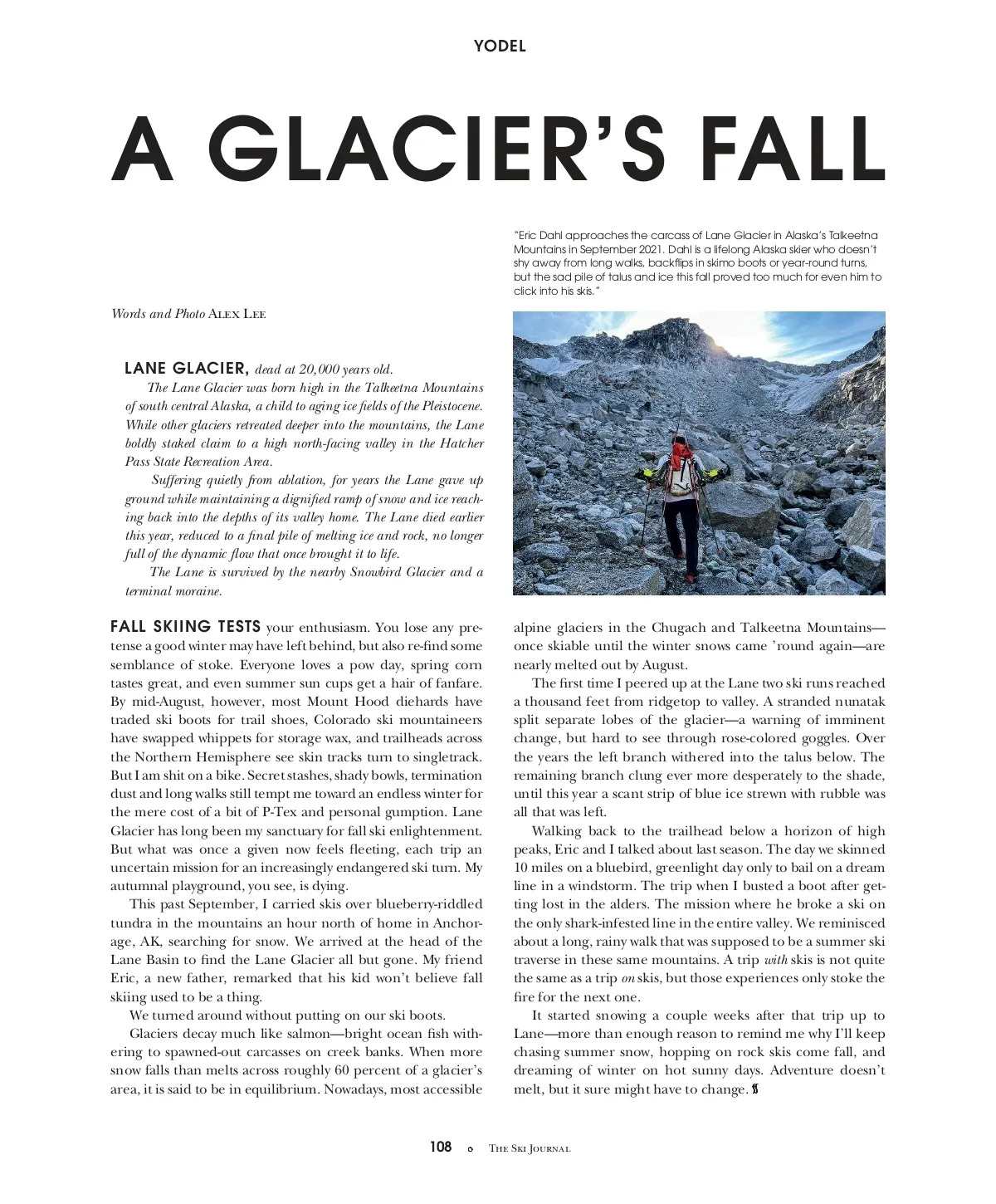
YODEL A GLACIER’S FALL “Eric Dahl approaches the carcass of Lane Glacier in Alaska’s Talkeetna Mountains in September 2021. Dahl is a lifelong Alaska skier who doesn’t shy away from long walks, backflips in skimo boots or year-round turns, but the sad pile of talus and ice this fall proved too much for even him to click into his skis.” Words and Photo Alex Lee LANE GLACIER, dead at 20,000 years old. The Lane Glacier was born high in the Talkeetna Mountains of south central Alaska, a child to aging ice fields of the Pleistocene. While other glaciers retreated deeper into the mountains, the Lane boldly staked claim to a high north-facing valley in the Hatcher Pass State Recreation Area. Suffering quietly from ablation, for years the Lane gave up ground while maintaining a dignified ramp of snow and ice reach-ing back into the depths of its valley home. The Lane died earlier this year, reduced to a final pile of melting ice and rock, no longer full of the dynamic flow that once brought it to life. The Lane is survived by the nearby Snowbird Glacier and a terminal moraine. FALL SKIING TESTS your enthusiasm. You lose any pre-tense a good winter may have left behind, but also re-find some semblance of stoke. Everyone loves a pow day, spring corn tastes great, and even summer sun cups get a hair of fanfare. By mid-August, however, most Mount Hood diehards have traded ski boots for trail shoes, Colorado ski mountaineers have swapped whippets for storage wax, and trailheads across the Northern Hemisphere see skin tracks turn to singletrack. But I am shit on a bike. Secret stashes, shady bowls, termination dust and long walks still tempt me toward an endless winter for the mere cost of a bit of P-Tex and personal gumption. Lane Glacier has long been my sanctuary for fall ski enlightenment. But what was once a given now feels fleeting, each trip an uncertain mission for an increasingly endangered ski turn. My autumnal playground, you see, is dying. This past September, I carried skis over blueberry-riddled tundra in the mountains an hour north of home in Anchor-age, AK, searching for snow. We arrived at the head of the Lane Basin to find the Lane Glacier all but gone. My friend Eric, a new father, remarked that his kid won’t believe fall skiing used to be a thing. We turned around without putting on our ski boots. Glaciers decay much like salmon—bright ocean fish with-ering to spawned-out carcasses on creek banks. When more snow falls than melts across roughly 60 percent of a glacier’s area, it is said to be in equilibrium. Nowadays, most accessible alpine glaciers in the Chugach and Talkeetna Mountains— once skiable until the winter snows came ’round again—are nearly melted out by August. The first time I peered up at the Lane two ski runs reached a thousand feet from ridgetop to valley. A stranded nunatak split separate lobes of the glacier—a warning of imminent change, but hard to see through rose-colored goggles. Over the years the left branch withered into the talus below. The remaining branch clung ever more desperately to the shade, until this year a scant strip of blue ice strewn with rubble was all that was left. Walking back to the trailhead below a horizon of high peaks, Eric and I talked about last season. The day we skinned 10 miles on a bluebird, greenlight day only to bail on a dream line in a windstorm. The trip when I busted a boot after get-ting lost in the alders. The mission where he broke a ski on the only shark-infested line in the entire valley. We reminisced about a long, rainy walk that was supposed to be a summer ski traverse in these same mountains. A trip with skis is not quite the same as a trip on skis, but those experiences only stoke the fire for the next one. It started snowing a couple weeks after that trip up to Lane—more than enough reason to remind me why I’ll keep chasing summer snow, hopping on rock skis come fall, and dreaming of winter on hot sunny days. Adventure doesn’t melt, but it sure might have to change. 108 The Ski Journal
The Ski Journal Volume 15, Issue 4: Page 108