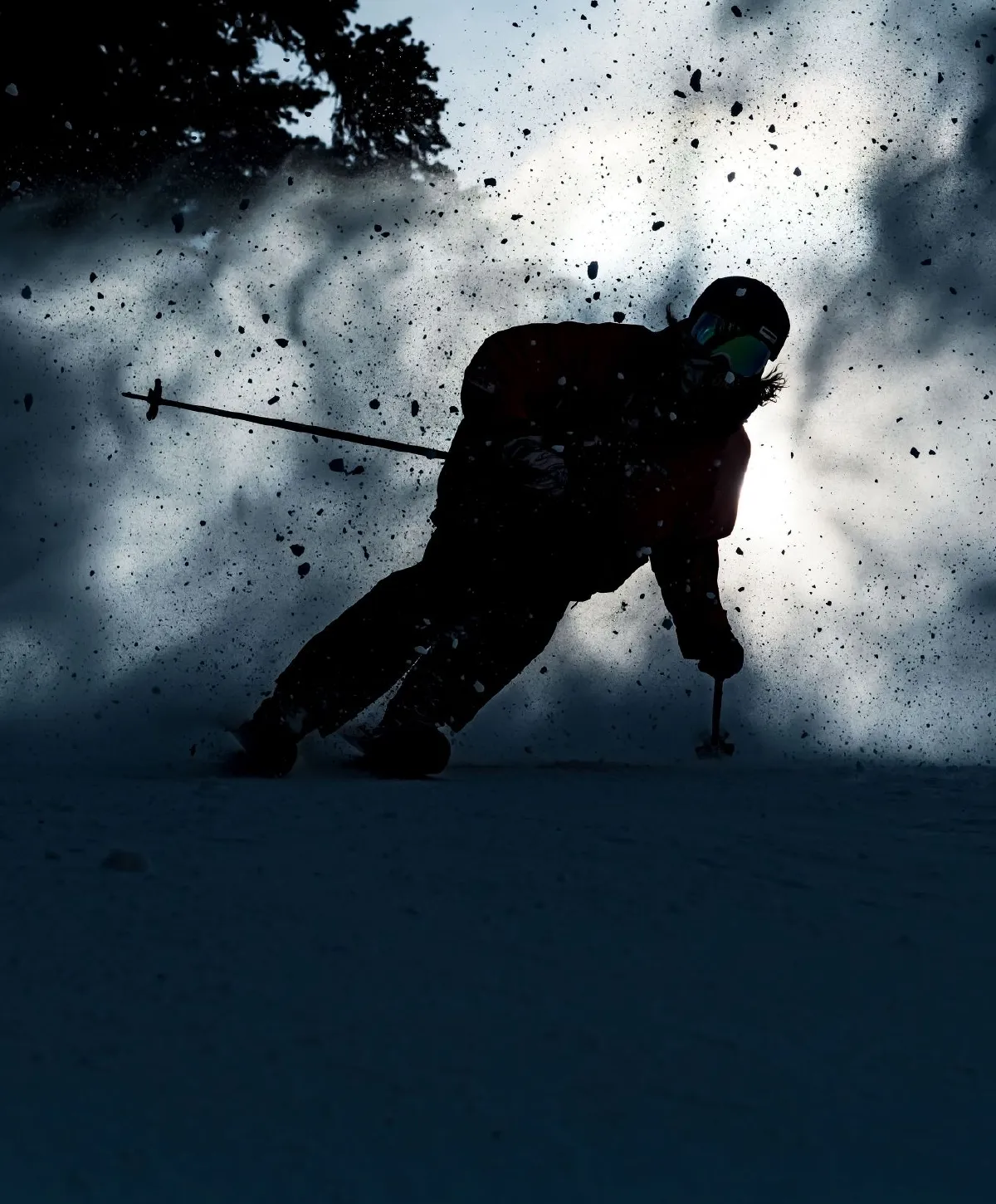
“Shred with the locals and you’ll eventually get shown the light—even on piste.” Fernie Alpine Resort, BC. Photo: Bruno Long “HE’S A REVERSE MULLET: party in the front, busi-ness in the back,” says Josh Malczyk, the former global brand director at LINE, who signed Siggers back in 2006. “He seems to have 48 hours in a day, he just does so much stuff. His output was just next level; every week he had a new edit that was totally different than the one he gave us the week before. And his skill progressed at the same rate as his filmmaking.” Though he likes to project an appearance of acting with reckless abandon as part of his youthful, carefree brand, Sig-gers’ actual life is far more calculated. He got married when he was 25, owns a home, and runs a successful freelance film-making business making tourism and music videos. He’s also a pro mountain biker, plays the drums in three bands and is an and is exuberantly talkative—something his parents say comes from being an only child and having to reach out a lot for companionship. As a kid, that meant Siggers was always the one rallying his friends to the ski hill. His father, Robin, remembers that Dylan would get really upset because he always wanted to catch the first lift, but sometimes his friends wanted to start at 10 or 11 a.m. It’s not that different today. Dylan remains the glue of his friend group, according to his wife, Sophie Perrault. With no media gatekeepers in Fernie, Siggers picked up a camera as a preteen and herded his pals in front of it, passing it off to them when it was his turn to ski. He taught himself to edit on a home computer and began releasing a series of erratic edits online under the moniker of Burrrlapz. It was a portmanteau of “Bear laps,” a nod to the Bear Chairlift he and his crew would ride all day, making Fernie Alpine Resort’s natural features into their aerial jungle gym. Those edits, which Siggers continues to create to this day and now include a feature film called Football , have helped skiers like Josh McSkimming, Liam Morgan and Garret Capel carve out a little corner of the internet for themselves, and become a cult influence for a huge sect of the sport. They harness the guerilla ethos of skate films and the visual treatment of street snowboard films, but package it all in dreamy winter scenes where human movement seems like it belongs in nature—as though freewheeling play on skis is an intrinsic part of the landscape. The crux of that, of course, is getting talented people into that landscape. He continues to populate his films with little-known locals who have ex-plosive skills, and in that regard Siggers is Fernie’s resident shepherd. Sometimes, though, he’s more like a border collie. “He’s super vocal about everything; you know exactly what he’s feeling when he’s feeling it,” Perrault says, admitting Dylan’s constant energy can be trying at times. For her part, Perrault has been a focusing force in Siggers’ life, injecting the pragmatism of a medical professional (she works as a licensed practical nurse at the local hospital). But she’s also become his partner in other respects. Since they began dating in 2012, Perrault’s ski and backcountry skills have progressed greatly, and she goes on every trip she can with her husband (even during the summer, when they switch to mountain bikes). She’s also become one of his principal videographers—a potentially contentious proposition if ever there was one. “He’s up there doing the hardest thing he can do, and the shot would be perfect if he took it,” she says. “But, he’s got me doing it, so it can be stressful.” Calling Siggers a stickler for detail is an understatement. For years he’s covered his face with a neck gaiter while skiing because he doesn’t want anyone to see his weird facial expressions and wants to direct attention to his skiing. Last year a photographer snuck a shot of his uncovered face, and it drove him mad. It’s this need for control that makes him feel that he wouldn’t do well in a traditional filming scenario in which someone else is making the video. Despite that, Siggers never touches the camera himself anymore. Early in his career, someone from a film company tried to convince him to give up skiing in front of the camera and just be a filmer. It angered him so much that it motivated him to ski even harder. Since then, he’s carefully directed all shooting via his friends, wife, or even his dad, to make sure he’s always an athlete and not solely a filmmaker. After the shoot, regardless of who was behind the camera, Siggers finds the story—the vibe—in the editing room. Everything is shot at 60 frames per second, giv-ing him the option to slow the footage down and do much of the creative lifting during post-production—where he tweaks and revises until he gets exactly what he wants. 042 The Ski Journal
The Ski Journal Volume 15, Issue 4: Page 42