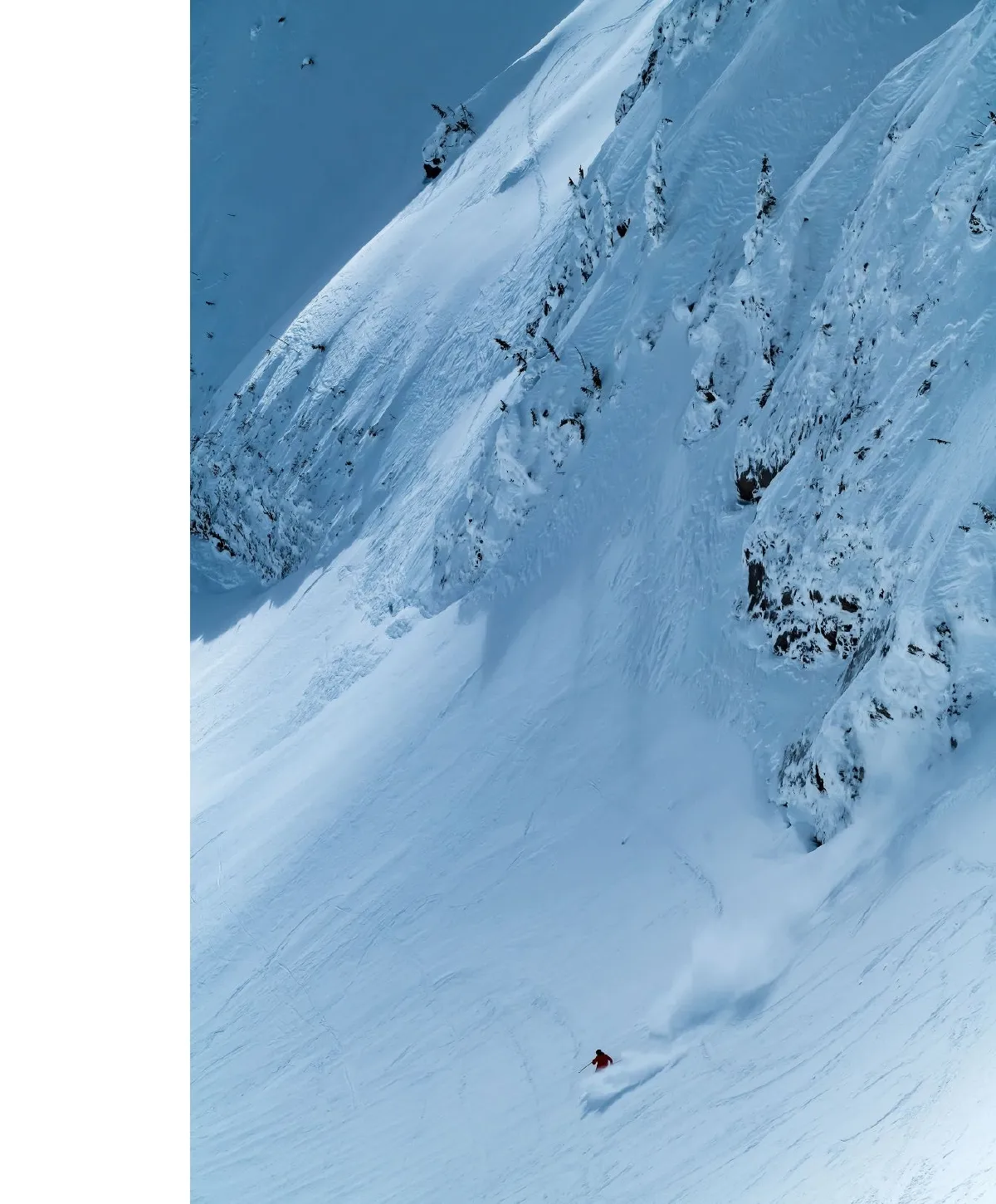
“In a world full of lemons, Siggers knows how to make lemonade. Even on a day when 99 per-cent of the mountain had turned into an ice cap—kids were literally sliding on their sides for fun in some places—Siggers managed to find where all the snow had blown in. These were probably the best two turns of the day.” Photo: Bruno Long WHILE DYLAN may be the more noteworthy Siggers these days, he comes from a family steeped in Canadian ski history. Three decades before Dylan rose to prominence, elevating the profile of his town among skiers across the world, his father opened Fernie up for an entire generation of ski bums and is still part of local ski lore. Growing up in Vancouver, BC, Robin migrated to Whistler during the mid-1970s, where he built and lived in a squat in the woods in order to ski every day. But when big money found Whistler, that first generation of hardcore ski bums was flushed out of the woods and sent packing. A friend of Robin’s told him about a tiny, two-T-bar com-munity ski hill in southern British Columbia that had epic amounts of snow (close to 30 feet a year), five expansive bowls and no crowds. The rub was having to post up in a backwater mining town without much going on. Robin took the tradeoff, and in 1977 split a $100-per-month rental house with three friends and found work at the Fernie Snow Valley ski school. There was no avalanche control back then, so the ski hill simply closed for a few days whenever it snowed. When the owner decided to build up Fernie Alpine Resort by putting in chairlifts, the first one was taken out by a big slide from an imposing headwall. That’s when they decided to institute an avalanche control program, creating the patrol team. Robin was one of the first on the job. As Fernie Alpine Resort grew during the next 30 years, eventually being purchased by Resorts of the Canadian Rockies, Robin advanced to operations manager, a title he still holds. He and his wife, Helen, raised their son on the ski hill, which acted as Dylan’s de facto day care. The couple intentionally sheltered their child from the pressures and expectations of the outside world, and he grew up believing skiing was life. And a good life, it has been. “The generation gap that I had with my parents in the ’70s was more of a titanic gulf because there was such a cultural difference between my parents and our generation,” Robin recalls. “Things were happening really fast. The generation gap between Dylan and I is a technological gap, but not a cultural one. You know, we even like the same music.” That organic approach to parenting has allowed a lasting friendship to flourish. Robin still skis frequently in the back-country, and often accompanying Dylan on his film shoots (now mostly in the backcountry). Although Helen doesn’t ski as much, she also remains close with her son, in her role as his main creative influence. She’s a seamstress and, accord-ing to everyone who knows the family, she’s where he got most of his precision and style from. “Ever since he was a baby, I was sewing,” Helen says. “Dylan’s crib was set up in my sewing room, and he’d be my sounding board. I always asked him how my work looked.” 046 The Ski Journal
The Ski Journal Volume 15, Issue 4: Page 46