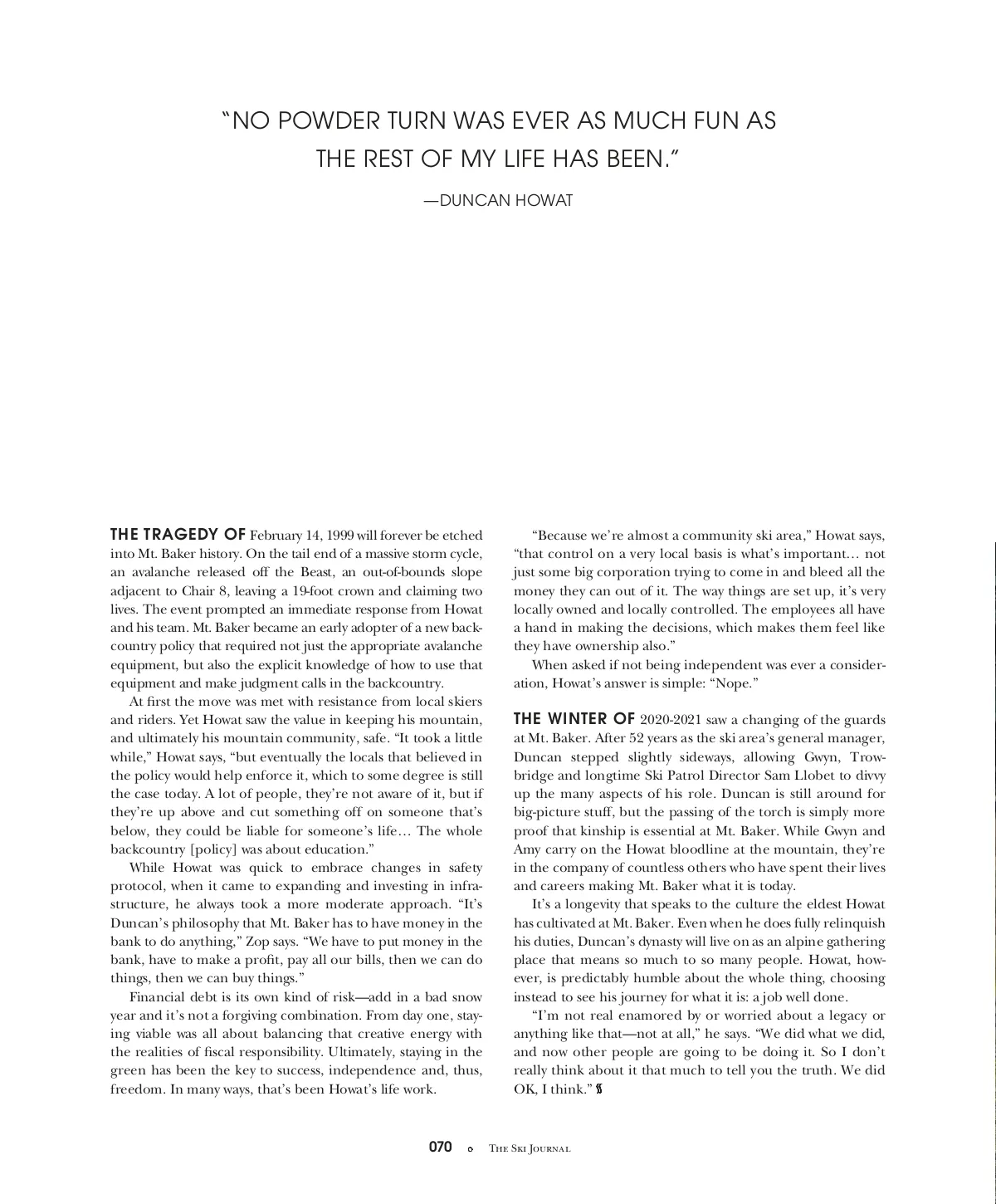
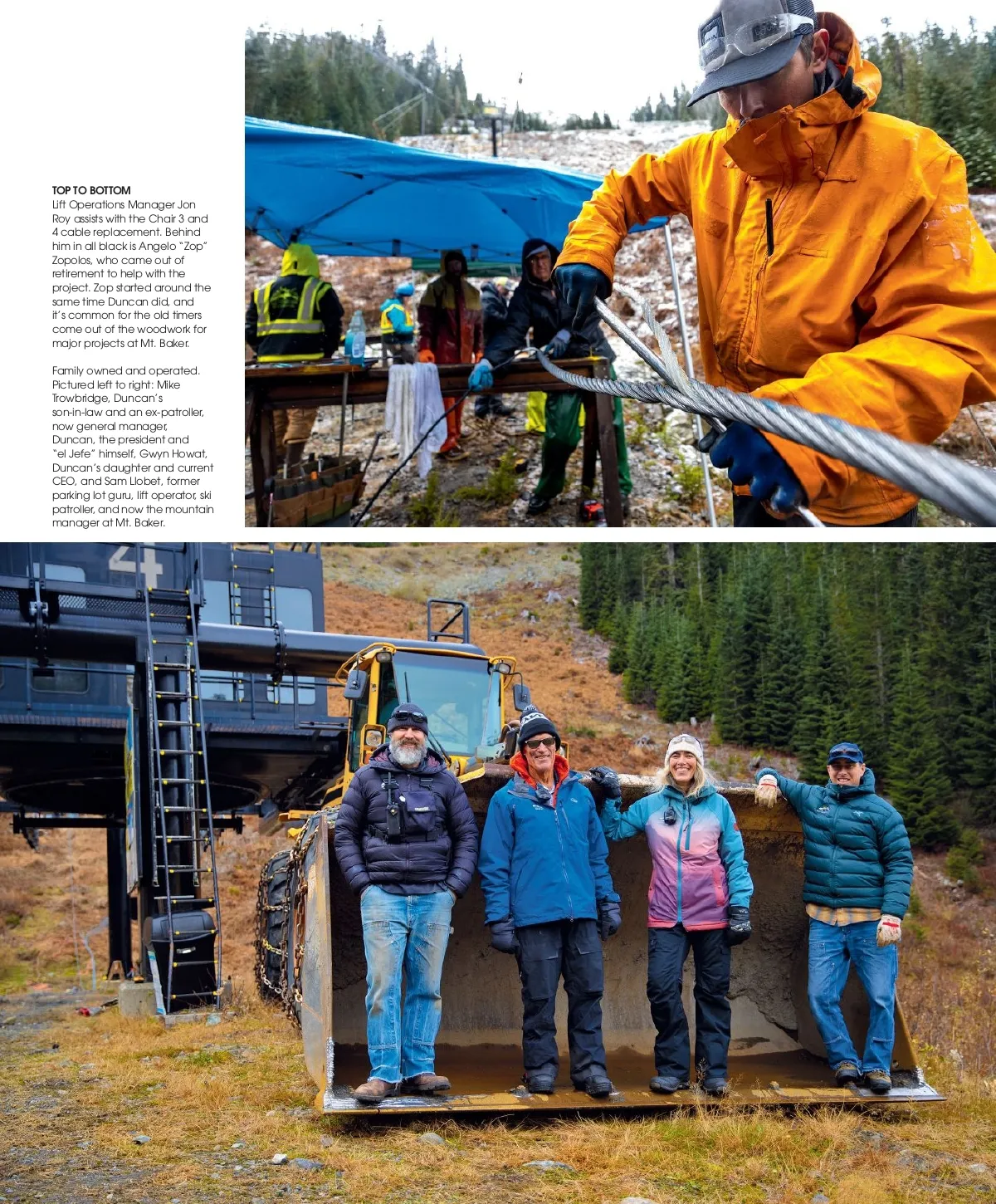
“NO POWDER TURN WAS EVER AS MUCH FUN AS THE REST OF MY LIFE HAS BEEN.” —DUNCAN HOWAT THE TRAGEDY OF February 14, 1999 will forever be etched into Mt. Baker history. On the tail end of a massive storm cycle, an avalanche released off the Beast, an out-of-bounds slope adjacent to Chair 8, leaving a 19-foot crown and claiming two lives. The event prompted an immediate response from Howat and his team. Mt. Baker became an early adopter of a new back-country policy that required not just the appropriate avalanche equipment, but also the explicit knowledge of how to use that equipment and make judgment calls in the backcountry. At first the move was met with resistance from local skiers and riders. Yet Howat saw the value in keeping his mountain, and ultimately his mountain community, safe. “It took a little while,” Howat says, “but eventually the locals that believed in the policy would help enforce it, which to some degree is still the case today. A lot of people, they’re not aware of it, but if they’re up above and cut something off on someone that’s below, they could be liable for someone’s life… The whole backcountry [policy] was about education.” While Howat was quick to embrace changes in safety protocol, when it came to expanding and investing in infra-structure, he always took a more moderate approach. “It’s Duncan’s philosophy that Mt. Baker has to have money in the bank to do anything,” Zop says. “We have to put money in the bank, have to make a profit, pay all our bills, then we can do things, then we can buy things.” Financial debt is its own kind of risk—add in a bad snow year and it’s not a forgiving combination. From day one, stay-ing viable was all about balancing that creative energy with the realities of fiscal responsibility. Ultimately, staying in the green has been the key to success, independence and, thus, freedom. In many ways, that’s been Howat’s life work. “Because we’re almost a community ski area,” Howat says, “that control on a very local basis is what’s important… not just some big corporation trying to come in and bleed all the money they can out of it. The way things are set up, it’s very locally owned and locally controlled. The employees all have a hand in making the decisions, which makes them feel like they have ownership also.” When asked if not being independent was ever a consider-ation, Howat’s answer is simple: “Nope.” THE WINTER OF 2020-2021 saw a changing of the guards at Mt. Baker. After 52 years as the ski area’s general manager, Duncan stepped slightly sideways, allowing Gwyn, Trow-bridge and longtime Ski Patrol Director Sam Llobet to divvy up the many aspects of his role. Duncan is still around for big-picture stuff, but the passing of the torch is simply more proof that kinship is essential at Mt. Baker. While Gwyn and Amy carry on the Howat bloodline at the mountain, they’re in the company of countless others who have spent their lives and careers making Mt. Baker what it is today. It’s a longevity that speaks to the culture the eldest Howat has cultivated at Mt. Baker. Even when he does fully relinquish his duties, Duncan’s dynasty will live on as an alpine gathering place that means so much to so many people. Howat, how-ever, is predictably humble about the whole thing, choosing instead to see his journey for what it is: a job well done. “I’m not real enamored by or worried about a legacy or anything like that—not at all,” he says. “We did what we did, and now other people are going to be doing it. So I don’t really think about it that much to tell you the truth. We did OK, I think.” 070 The Ski Journal
The Ski Journal Volume 15, Issue 4: Page 70