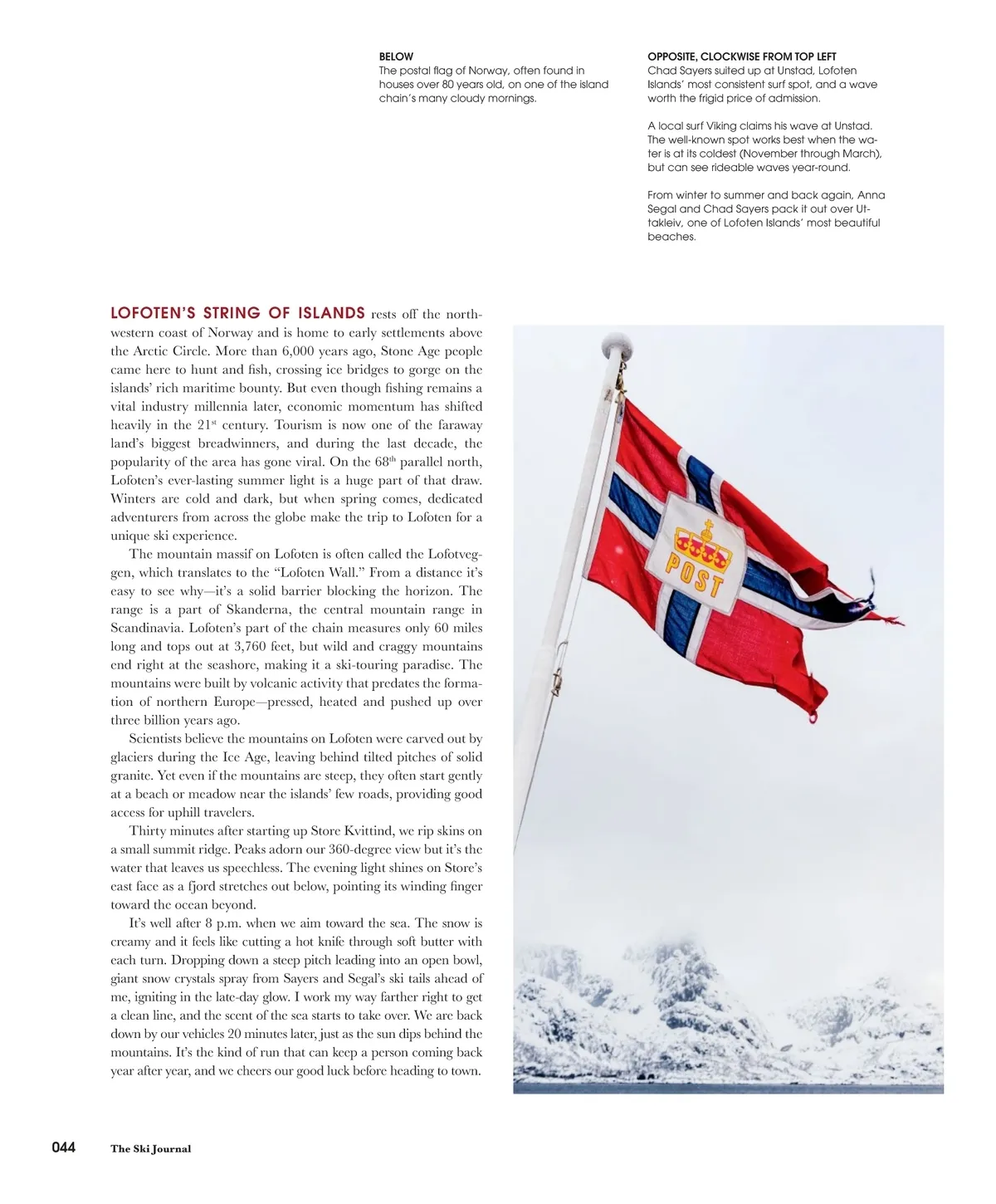
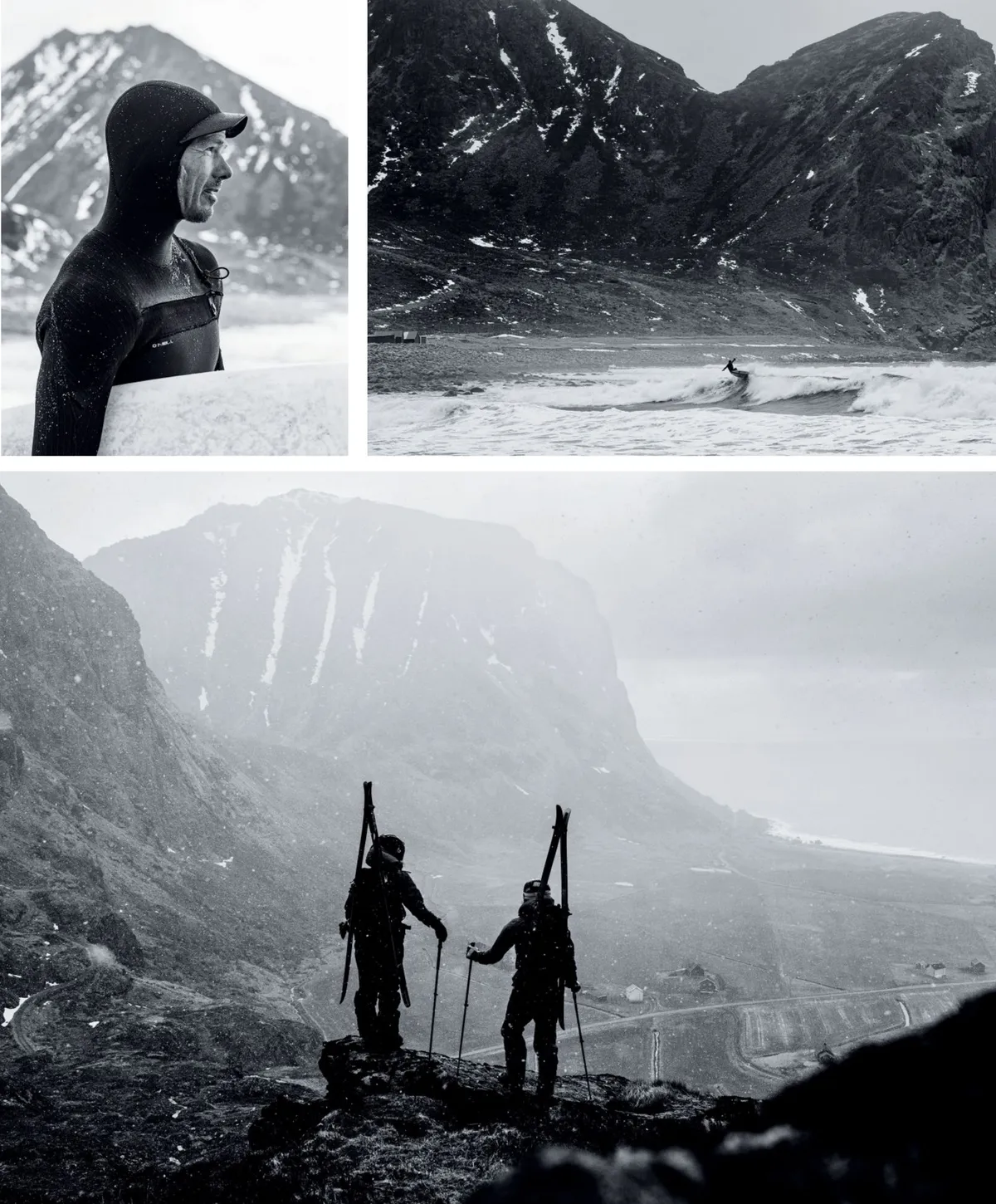
BELOW The postal flag of Norway, often found in houses over 80 years old, on one of the island chain’s many cloudy mornings. OPPOSITE, CLOCKWISE FROM TOP LEFT Chad Sayers suited up at Unstad, Lofoten Islands’ most consistent surf spot, and a wave worth the frigid price of admission. A local surf Viking claims his wave at Unstad. The well-known spot works best when the wa-ter is at its coldest (November through March), but can see rideable waves year-round. From winter to summer and back again, Anna Segal and Chad Sayers pack it out over Ut-takleiv, one of Lofoten Islands’ most beautiful beaches. LOFOTEN’S STRING OF ISLANDS rests off the north-western coast of Norway and is home to early settlements above the Arctic Circle. More than 6,000 years ago, Stone Age people came here to hunt and fish, crossing ice bridges to gorge on the islands’ rich maritime bounty. But even though fishing remains a vital industry millennia later, economic momentum has shifted heavily in the 21 st century. Tourism is now one of the faraway land’s biggest breadwinners, and during the last decade, the popularity of the area has gone viral. On the 68 th parallel north, Lofoten’s ever-lasting summer light is a huge part of that draw. Winters are cold and dark, but when spring comes, dedicated adventurers from across the globe make the trip to Lofoten for a unique ski experience. The mountain massif on Lofoten is often called the Lofotveg-gen, which translates to the “Lofoten Wall.” From a distance it’s easy to see why—it’s a solid barrier blocking the horizon. The range is a part of Skanderna, the central mountain range in Scandinavia. Lofoten’s part of the chain measures only 60 miles long and tops out at 3,760 feet, but wild and craggy mountains end right at the seashore, making it a ski-touring paradise. The mountains were built by volcanic activity that predates the forma-tion of northern Europe—pressed, heated and pushed up over three billion years ago. Scientists believe the mountains on Lofoten were carved out by glaciers during the Ice Age, leaving behind tilted pitches of solid granite. Yet even if the mountains are steep, they often start gently at a beach or meadow near the islands’ few roads, providing good access for uphill travelers. Thirty minutes after starting up Store Kvittind, we rip skins on a small summit ridge. Peaks adorn our 360-degree view but it’s the water that leaves us speechless. The evening light shines on Store’s east face as a fjord stretches out below, pointing its winding finger toward the ocean beyond. It’s well after 8 p.m. when we aim toward the sea. The snow is creamy and it feels like cutting a hot knife through soft butter with each turn. Dropping down a steep pitch leading into an open bowl, giant snow crystals spray from Sayers and Segal’s ski tails ahead of me, igniting in the late-day glow. I work my way farther right to get a clean line, and the scent of the sea starts to take over. We are back down by our vehicles 20 minutes later, just as the sun dips behind the mountains. It’s the kind of run that can keep a person coming back year after year, and we cheers our good luck before heading to town. 044 The Ski Journal
The Ski Journal Volume 16, Issue 1: Page 44