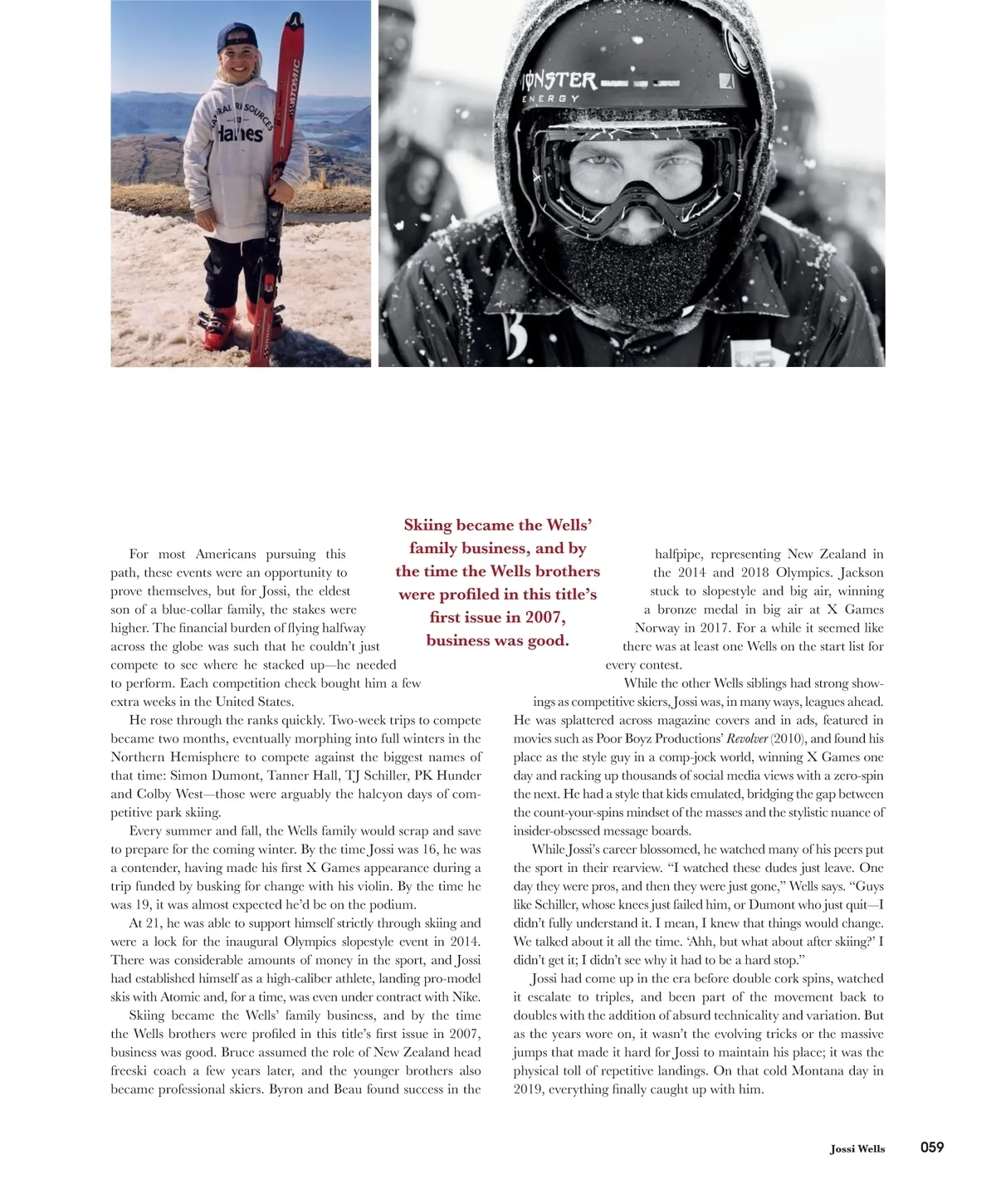
Skiing became the Wells’ family business, and by For most Americans pursuing this the time the Wells brothers path, these events were an opportunity to prove themselves, but for Jossi, the eldest were profiled in this title’s son of a blue-collar family, the stakes were first issue in 2007, higher. The financial burden of flying halfway business was good. across the globe was such that he couldn’t just compete to see where he stacked up—he needed to perform. Each competition check bought him a few extra weeks in the United States. He rose through the ranks quickly. Two-week trips to compete became two months, eventually morphing into full winters in the Northern Hemisphere to compete against the biggest names of that time: Simon Dumont, Tanner Hall, TJ Schiller, PK Hunder and Colby West—those were arguably the halcyon days of com-petitive park skiing. Every summer and fall, the Wells family would scrap and save to prepare for the coming winter. By the time Jossi was 16, he was a contender, having made his first X Games appearance during a trip funded by busking for change with his violin. By the time he was 19, it was almost expected he’d be on the podium. At 21, he was able to support himself strictly through skiing and were a lock for the inaugural Olympics slopestyle event in 2014. There was considerable amounts of money in the sport, and Jossi had established himself as a high-caliber athlete, landing pro-model skis with Atomic and, for a time, was even under contract with Nike. Skiing became the Wells’ family business, and by the time the Wells brothers were profiled in this title’s first issue in 2007, business was good. Bruce assumed the role of New Zealand head freeski coach a few years later, and the younger brothers also became professional skiers. Byron and Beau found success in the halfpipe, representing New Zealand in the 2014 and 2018 Olympics. Jackson stuck to slopestyle and big air, winning a bronze medal in big air at X Games Norway in 2017. For a while it seemed like there was at least one Wells on the start list for every contest. While the other Wells siblings had strong show-ings as competitive skiers, Jossi was, in many ways, leagues ahead. He was splattered across magazine covers and in ads, featured in movies such as Poor Boyz Productions’ Revolver (2010), and found his place as the style guy in a comp-jock world, winning X Games one day and racking up thousands of social media views with a zero-spin the next. He had a style that kids emulated, bridging the gap between the count-your-spins mindset of the masses and the stylistic nuance of insider-obsessed message boards. While Jossi’s career blossomed, he watched many of his peers put the sport in their rearview. “I watched these dudes just leave. One day they were pros, and then they were just gone,” Wells says. “Guys like Schiller, whose knees just failed him, or Dumont who just quit—I didn’t fully understand it. I mean, I knew that things would change. We talked about it all the time. ‘Ahh, but what about after skiing?’ I didn’t get it; I didn’t see why it had to be a hard stop.” Jossi had come up in the era before double cork spins, watched it escalate to triples, and been part of the movement back to doubles with the addition of absurd technicality and variation. But as the years wore on, it wasn’t the evolving tricks or the massive jumps that made it hard for Jossi to maintain his place; it was the physical toll of repetitive landings. On that cold Montana day in 2019, everything finally caught up with him. Jossi Wells 059
The Ski Journal Volume 16, Issue 1: Page 59