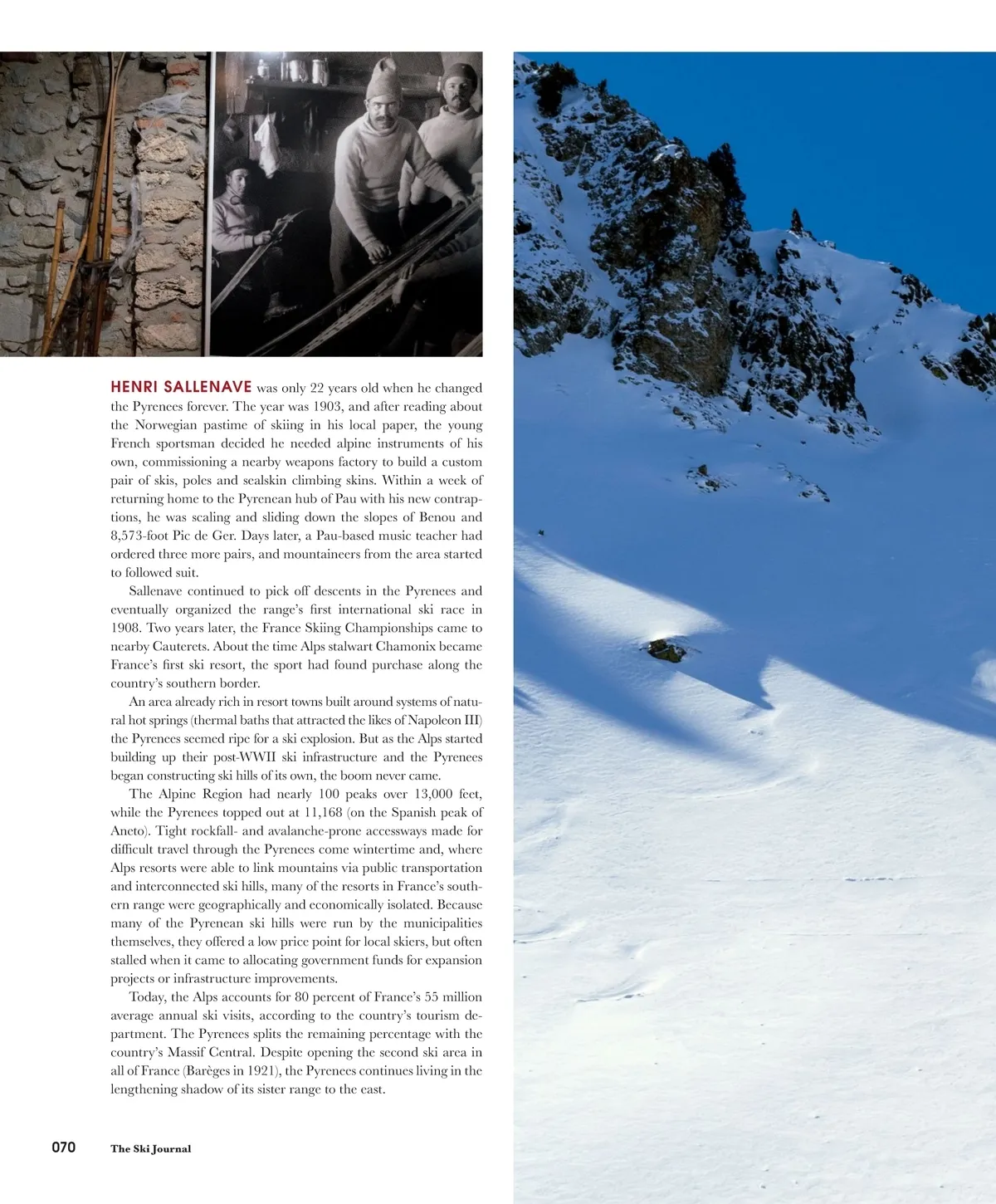
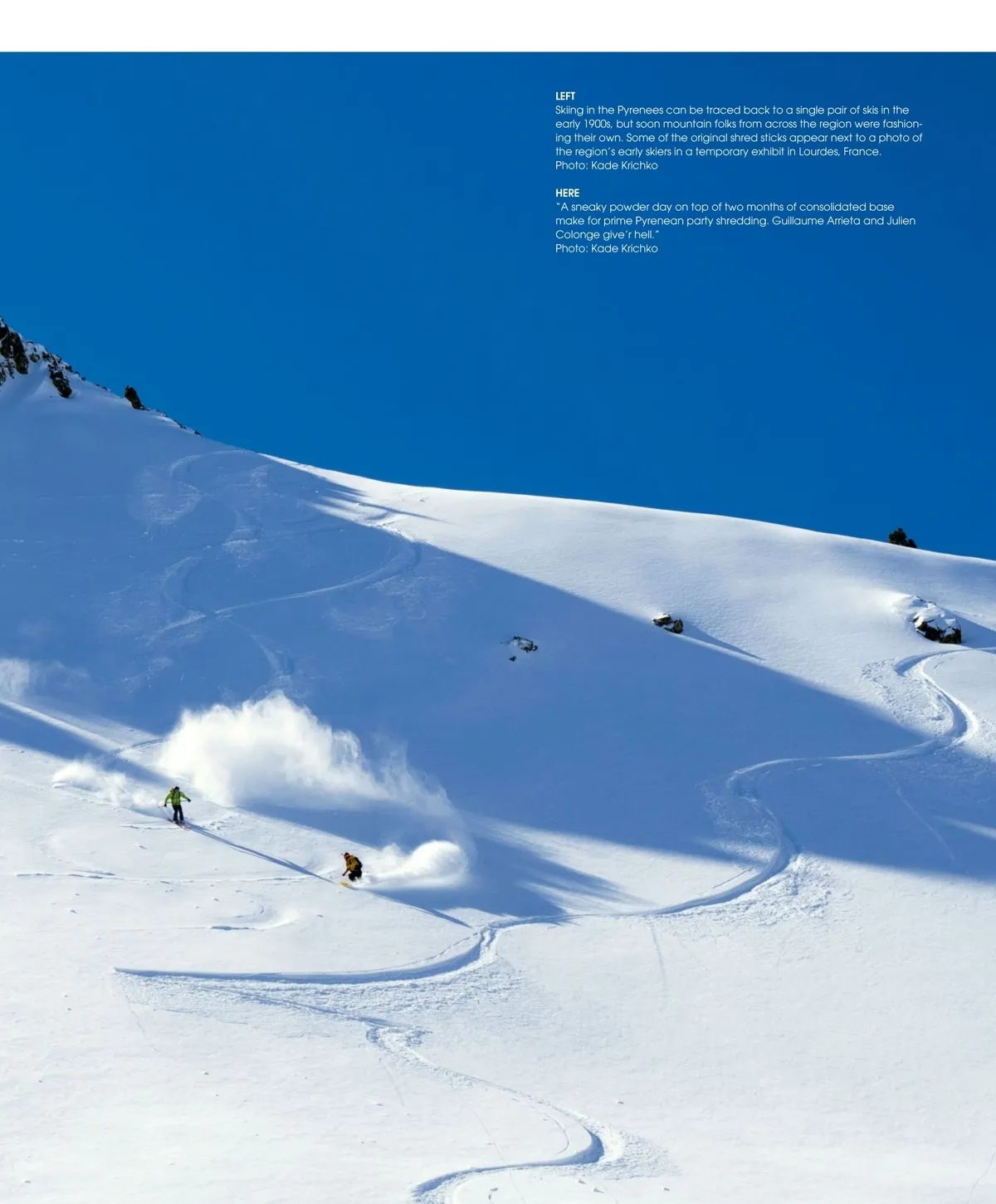
HENRI SALLENAVE was only 22 years old when he changed the Pyrenees forever. The year was 1903, and after reading about the Norwegian pastime of skiing in his local paper, the young French sportsman decided he needed alpine instruments of his own, commissioning a nearby weapons factory to build a custom pair of skis, poles and sealskin climbing skins. Within a week of returning home to the Pyrenean hub of Pau with his new contrap-tions, he was scaling and sliding down the slopes of Benou and 8,573-foot Pic de Ger. Days later, a Pau-based music teacher had ordered three more pairs, and mountaineers from the area started to followed suit. Sallenave continued to pick off descents in the Pyrenees and eventually organized the range’s first international ski race in 1908. Two years later, the France Skiing Championships came to nearby Cauterets. About the time Alps stalwart Chamonix became France’s first ski resort, the sport had found purchase along the country’s southern border. An area already rich in resort towns built around systems of natu-ral hot springs (thermal baths that attracted the likes of Napoleon III) the Pyrenees seemed ripe for a ski explosion. But as the Alps started building up their post-WWII ski infrastructure and the Pyrenees began constructing ski hills of its own, the boom never came. The Alpine Region had nearly 100 peaks over 13,000 feet, while the Pyrenees topped out at 11,168 (on the Spanish peak of Aneto). Tight rockfall-and avalanche-prone accessways made for difficult travel through the Pyrenees come wintertime and, where Alps resorts were able to link mountains via public transportation and interconnected ski hills, many of the resorts in France’s south-ern range were geographically and economically isolated. Because many of the Pyrenean ski hills were run by the municipalities themselves, they offered a low price point for local skiers, but often stalled when it came to allocating government funds for expansion projects or infrastructure improvements. Today, the Alps accounts for 80 percent of France’s 55 million average annual ski visits, according to the country’s tourism de-partment. The Pyrenees splits the remaining percentage with the country’s Massif Central. Despite opening the second ski area in all of France (Barèges in 1921), the Pyrenees continues living in the lengthening shadow of its sister range to the east. 070 The Ski Journal
The Ski Journal Volume 16, Issue 1: Page 70