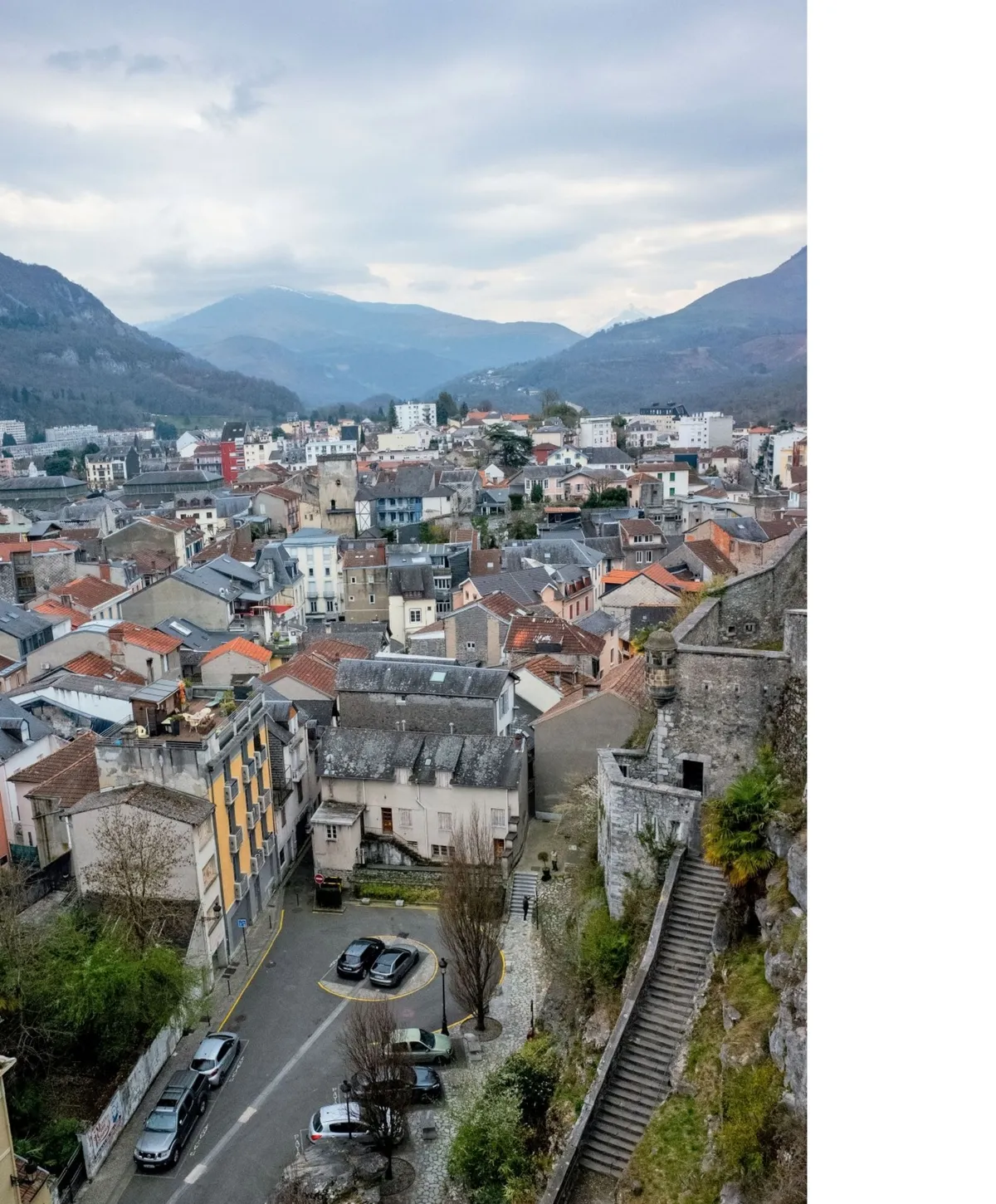
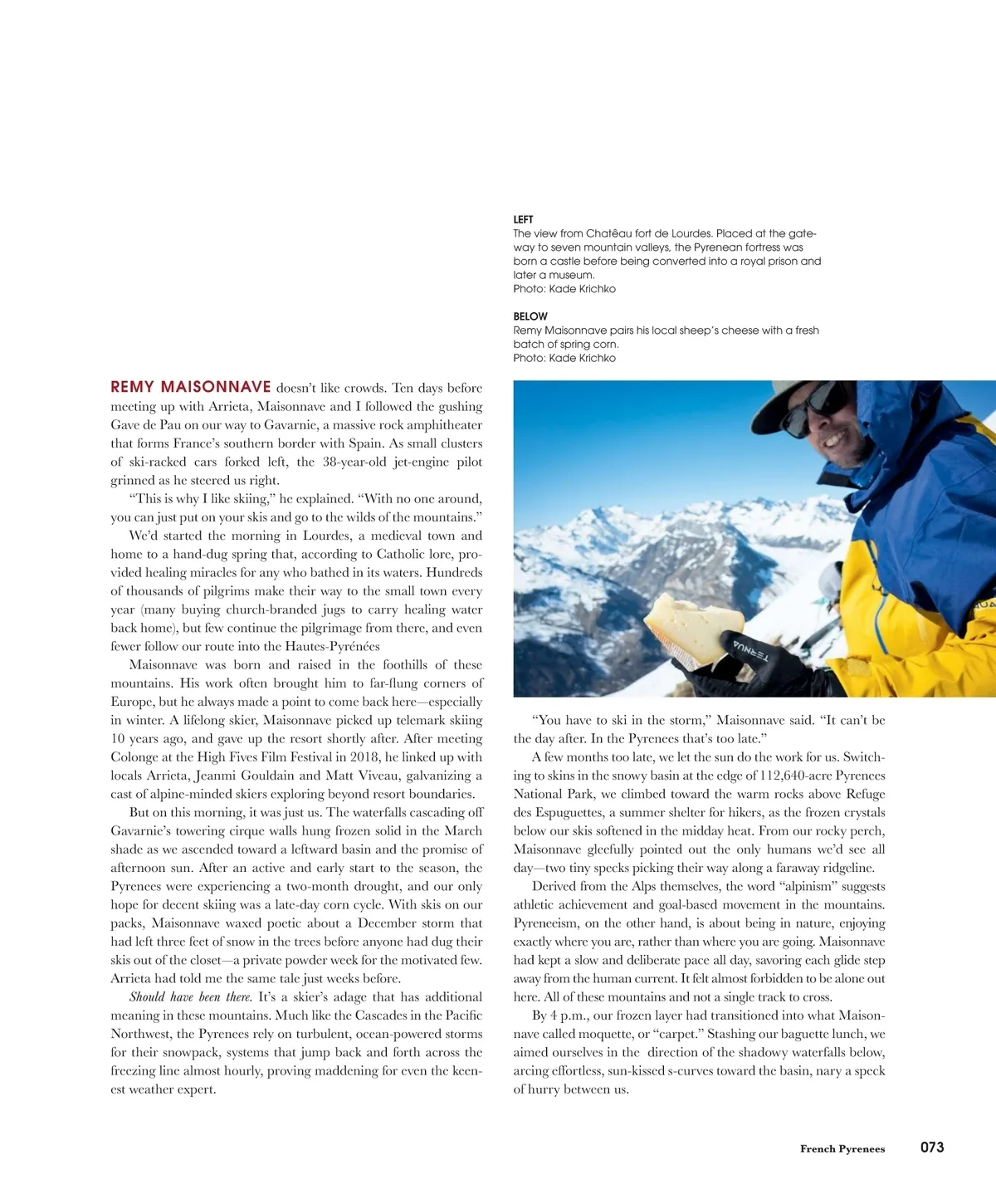
LEFT The view from Chatêau fort de Lourdes. Placed at the gate-way to seven mountain valleys, the Pyrenean fortress was born a castle before being converted into a royal prison and later a museum. Photo: Kade Krichko BELOW Remy Maisonnave pairs his local sheep’s cheese with a fresh batch of spring corn. Photo: Kade Krichko REMY MAISONNAVE doesn’t like crowds. Ten days before meeting up with Arrieta, Maisonnave and I followed the gushing Gave de Pau on our way to Gavarnie, a massive rock amphitheater that forms France’s southern border with Spain. As small clusters of ski-racked cars forked left, the 38-year-old jet-engine pilot grinned as he steered us right. “This is why I like skiing,” he explained. “With no one around, you can just put on your skis and go to the wilds of the mountains.” We’d started the morning in Lourdes, a medieval town and home to a hand-dug spring that, according to Catholic lore, pro-vided healing miracles for any who bathed in its waters. Hundreds of thousands of pilgrims make their way to the small town every year (many buying church-branded jugs to carry healing water back home), but few continue the pilgrimage from there, and even fewer follow our route into the Hautes-Pyrénées Maisonnave was born and raised in the foothills of these mountains. His work often brought him to far-flung corners of Europe, but he always made a point to come back here—especially in winter. A lifelong skier, Maisonnave picked up telemark skiing 10 years ago, and gave up the resort shortly after. After meeting Colonge at the High Fives Film Festival in 2018, he linked up with locals Arrieta, Jeanmi Gouldain and Matt Viveau, galvanizing a cast of alpine-minded skiers exploring beyond resort boundaries. But on this morning, it was just us. The waterfalls cascading off Gavarnie’s towering cirque walls hung frozen solid in the March shade as we ascended toward a leftward basin and the promise of afternoon sun. After an active and early start to the season, the Pyrenees were experiencing a two-month drought, and our only hope for decent skiing was a late-day corn cycle. With skis on our packs, Maisonnave waxed poetic about a December storm that had left three feet of snow in the trees before anyone had dug their skis out of the closet—a private powder week for the motivated few. Arrieta had told me the same tale just weeks before. Should have been there. It’s a skier’s adage that has additional meaning in these mountains. Much like the Cascades in the Pacific Northwest, the Pyrenees rely on turbulent, ocean-powered storms for their snowpack, systems that jump back and forth across the freezing line almost hourly, proving maddening for even the keen-est weather expert. “You have to ski in the storm,” Maisonnave said. “It can’t be the day after. In the Pyrenees that’s too late.” A few months too late, we let the sun do the work for us. Switch-ing to skins in the snowy basin at the edge of 112,640-acre Pyrenees National Park, we climbed toward the warm rocks above Refuge des Espuguettes, a summer shelter for hikers, as the frozen crystals below our skis softened in the midday heat. From our rocky perch, Maisonnave gleefully pointed out the only humans we’d see all day—two tiny specks picking their way along a faraway ridgeline. Derived from the Alps themselves, the word “alpinism” suggests athletic achievement and goal-based movement in the mountains. Pyreneeism, on the other hand, is about being in nature, enjoying exactly where you are, rather than where you are going. Maisonnave had kept a slow and deliberate pace all day, savoring each glide step away from the human current. It felt almost forbidden to be alone out here. All of these mountains and not a single track to cross. By 4 p.m., our frozen layer had transitioned into what Maison-nave called moquette, or “carpet.” Stashing our baguette lunch, we aimed ourselves in the direction of the shadowy waterfalls below, arcing effortless, sun-kissed s-curves toward the basin, nary a speck of hurry between us. French Pyrenees 073
The Ski Journal Volume 16, Issue 1: Page 73