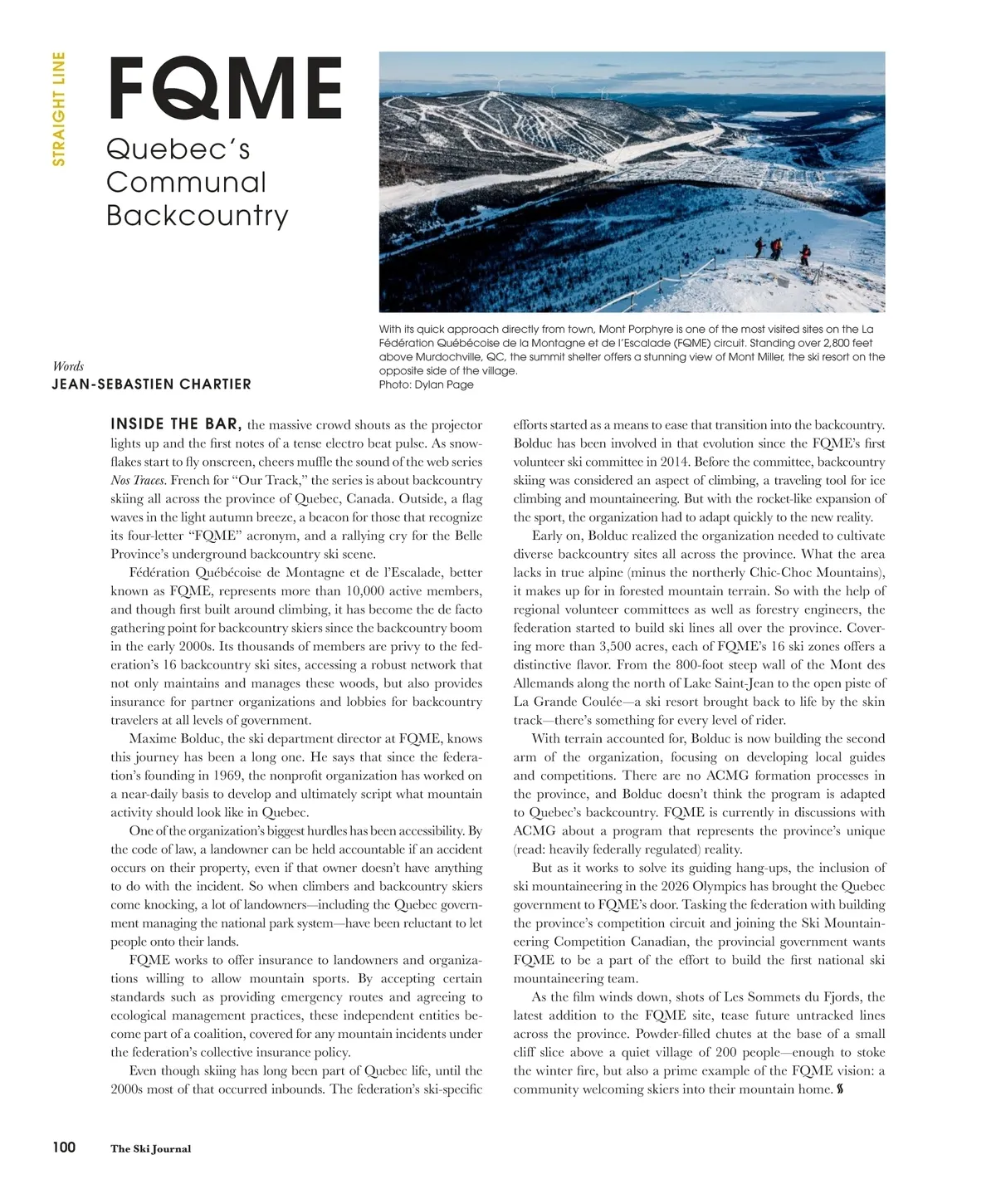
STRAIGHT LINE Quebec’s Communal Backcountry FQME With its quick approach directly from town, Mont Porphyre is one of the most visited sites on the La Fédération Québécoise de la Montagne et de l’Escalade (FQME) circuit. Standing over 2,800 feet above Murdochville, QC, the summit shelter offers a stunning view of Mont Miller, the ski resort on the opposite side of the village. Photo: Dylan Page Words JEAN-SEBASTIEN CHARTIER INSIDE THE BAR, the massive crowd shouts as the projector lights up and the first notes of a tense electro beat pulse. As snow-flakes start to fly onscreen, cheers muffle the sound of the web series Nos Traces . French for “Our Track,” the series is about backcountry skiing all across the province of Quebec, Canada. Outside, a flag waves in the light autumn breeze, a beacon for those that recognize its four-letter “FQME” acronym, and a rallying cry for the Belle Province’s underground backcountry ski scene. Fédération Québécoise de Montagne et de l’Escalade, better known as FQME, represents more than 10,000 active members, and though first built around climbing, it has become the de facto gathering point for backcountry skiers since the backcountry boom in the early 2000s. Its thousands of members are privy to the fed-eration’s 16 backcountry ski sites, accessing a robust network that not only maintains and manages these woods, but also provides insurance for partner organizations and lobbies for backcountry travelers at all levels of government. Maxime Bolduc, the ski department director at FQME, knows this journey has been a long one. He says that since the federa-tion’s founding in 1969, the nonprofit organization has worked on a near-daily basis to develop and ultimately script what mountain activity should look like in Quebec. One of the organization’s biggest hurdles has been accessibility. By the code of law, a landowner can be held accountable if an accident occurs on their property, even if that owner doesn’t have anything to do with the incident. So when climbers and backcountry skiers come knocking, a lot of landowners—including the Quebec govern-ment managing the national park system—have been reluctant to let people onto their lands. FQME works to offer insurance to landowners and organiza-tions willing to allow mountain sports. By accepting certain standards such as providing emergency routes and agreeing to ecological management practices, these independent entities be-come part of a coalition, covered for any mountain incidents under the federation’s collective insurance policy. Even though skiing has long been part of Quebec life, until the 2000s most of that occurred inbounds. The federation’s ski-specific efforts started as a means to ease that transition into the backcountry. Bolduc has been involved in that evolution since the FQME’s first volunteer ski committee in 2014. Before the committee, backcountry skiing was considered an aspect of climbing, a traveling tool for ice climbing and mountaineering. But with the rocket-like expansion of the sport, the organization had to adapt quickly to the new reality. Early on, Bolduc realized the organization needed to cultivate diverse backcountry sites all across the province. What the area lacks in true alpine (minus the northerly Chic-Choc Mountains), it makes up for in forested mountain terrain. So with the help of regional volunteer committees as well as forestry engineers, the federation started to build ski lines all over the province. Cover-ing more than 3,500 acres, each of FQME’s 16 ski zones offers a distinctive flavor. From the 800-foot steep wall of the Mont des Allemands along the north of Lake Saint-Jean to the open piste of La Grande Coulée—a ski resort brought back to life by the skin track—there’s something for every level of rider. With terrain accounted for, Bolduc is now building the second arm of the organization, focusing on developing local guides and competitions. There are no ACMG formation processes in the province, and Bolduc doesn’t think the program is adapted to Quebec’s backcountry. FQME is currently in discussions with ACMG about a program that represents the province’s unique (read: heavily federally regulated) reality. But as it works to solve its guiding hang-ups, the inclusion of ski mountaineering in the 2026 Olympics has brought the Quebec government to FQME’s door. Tasking the federation with building the province’s competition circuit and joining the Ski Mountain-eering Competition Canadian, the provincial government wants FQME to be a part of the effort to build the first national ski mountaineering team. As the film winds down, shots of Les Sommets du Fjords, the latest addition to the FQME site, tease future untracked lines across the province. Powder-filled chutes at the base of a small cliff slice above a quiet village of 200 people—enough to stoke the winter fire, but also a prime example of the FQME vision: a community welcoming skiers into their mountain home. 100 The Ski Journal
The Ski Journal Volume 16, Issue 2: Page 100