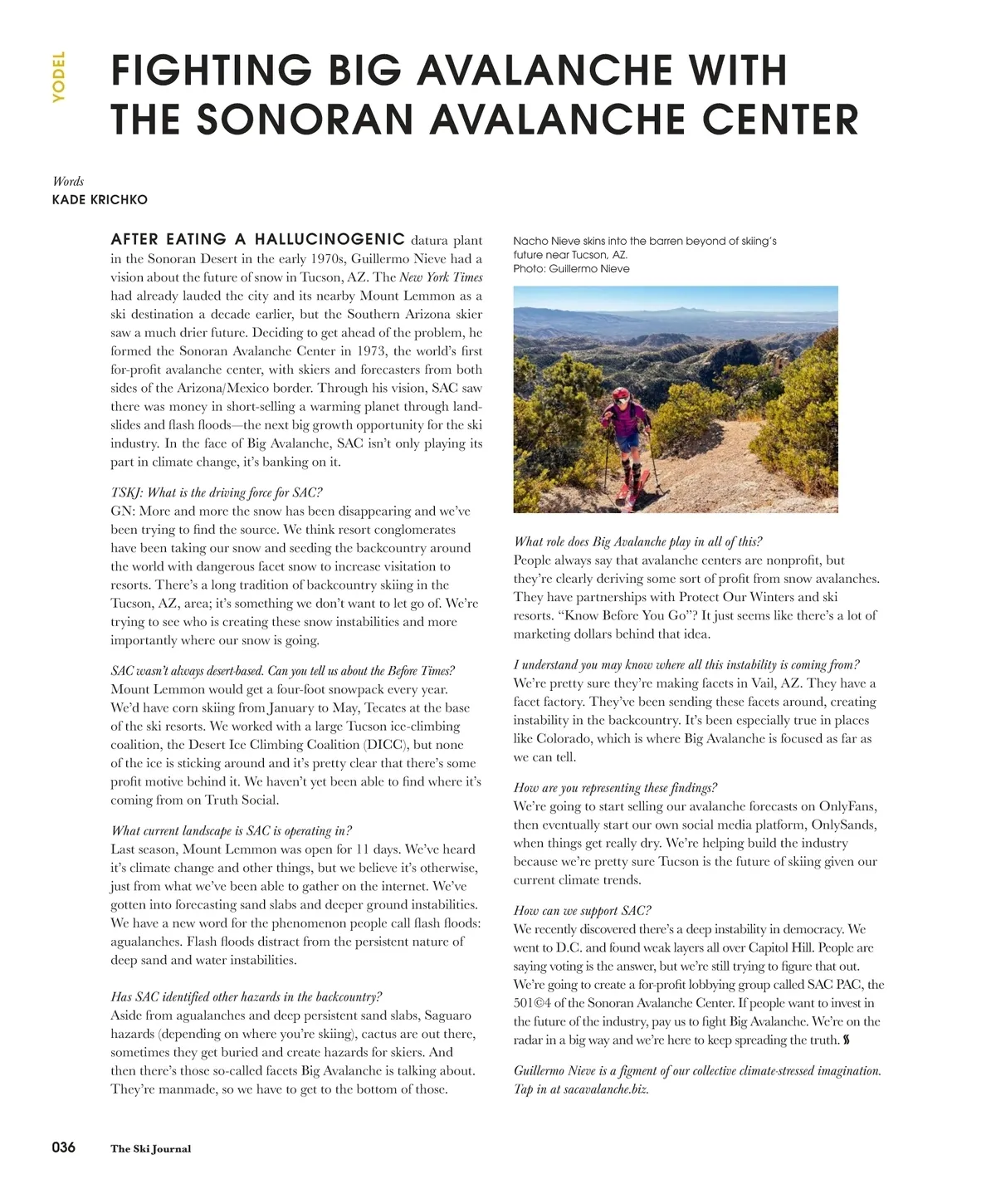
FIGHTING BIG AVALANCHE WITH THE SONORAN AVALANCHE CENTER AFTER EATING A HALLUCINOGENIC datura plant in the Sonoran Desert in the early 1970s, Guillermo Nieve had a vision about the future of snow in Tucson, AZ. The New York Times had already lauded the city and its nearby Mount Lemmon as a ski destination a decade earlier, but the Southern Arizona skier saw a much drier future. Deciding to get ahead of the problem, he formed the Sonoran Avalanche Center in 1973, the world’s first for-profit avalanche center, with skiers and forecasters from both sides of the Arizona/Mexico border. Through his vision, SAC saw there was money in short-selling a warming planet through land-slides and flash floods—the next big growth opportunity for the ski industry. In the face of Big Avalanche, SAC isn’t only playing its part in climate change, it’s banking on it. TSKJ: What is the driving force for SAC? GN: More and more the snow has been disappearing and we’ve been trying to find the source. We think resort conglomerates have been taking our snow and seeding the backcountry around the world with dangerous facet snow to increase visitation to resorts. There’s a long tradition of backcountry skiing in the Tucson, AZ, area; it’s something we don’t want to let go of. We’re trying to see who is creating these snow instabilities and more importantly where our snow is going. SAC wasn’t always desert-based. Can you tell us about the Before Times? Mount Lemmon would get a four-foot snowpack every year. We’d have corn skiing from January to May, Tecates at the base of the ski resorts. We worked with a large Tucson ice-climbing coalition, the Desert Ice Climbing Coalition (DICC), but none of the ice is sticking around and it’s pretty clear that there’s some profit motive behind it. We haven’t yet been able to find where it’s coming from on Truth Social. What current landscape is SAC is operating in? Last season, Mount Lemmon was open for 11 days. We’ve heard it’s climate change and other things, but we believe it’s otherwise, just from what we’ve been able to gather on the internet. We’ve gotten into forecasting sand slabs and deeper ground instabilities. We have a new word for the phenomenon people call flash floods: agualanches. Flash floods distract from the persistent nature of deep sand and water instabilities. Has SAC identified other hazards in the backcountry? Aside from agualanches and deep persistent sand slabs, Saguaro hazards (depending on where you’re skiing), cactus are out there, sometimes they get buried and create hazards for skiers. And then there’s those so-called facets Big Avalanche is talking about. They’re manmade, so we have to get to the bottom of those. Nacho Nieve skins into the barren beyond of skiing’s future near Tucson, AZ. Photo: Guillermo Nieve YODEL Words KADE KRICHKO What role does Big Avalanche play in all of this? People always say that avalanche centers are nonprofit, but they’re clearly deriving some sort of profit from snow avalanches. They have partnerships with Protect Our Winters and ski resorts. “Know Before You Go”? It just seems like there’s a lot of marketing dollars behind that idea. I understand you may know where all this instability is coming from? We’re pretty sure they’re making facets in Vail, AZ. They have a facet factory. They’ve been sending these facets around, creating instability in the backcountry. It’s been especially true in places like Colorado, which is where Big Avalanche is focused as far as we can tell. How are you representing these findings? We’re going to start selling our avalanche forecasts on OnlyFans, then eventually start our own social media platform, OnlySands, when things get really dry. We’re helping build the industry because we’re pretty sure Tucson is the future of skiing given our current climate trends. How can we support SAC? We recently discovered there’s a deep instability in democracy. We went to D.C. and found weak layers all over Capitol Hill. People are saying voting is the answer, but we’re still trying to figure that out. We’re going to create a for-profit lobbying group called SAC PAC, the 501©4 of the Sonoran Avalanche Center. If people want to invest in the future of the industry, pay us to fight Big Avalanche. We’re on the radar in a big way and we’re here to keep spreading the truth. Guillermo Nieve is a figment of our collective climate-stressed imagination. Tap in at sacavalanche.biz. 036 The Ski Journal
The Ski Journal Volume 16, Issue 2: Page 36