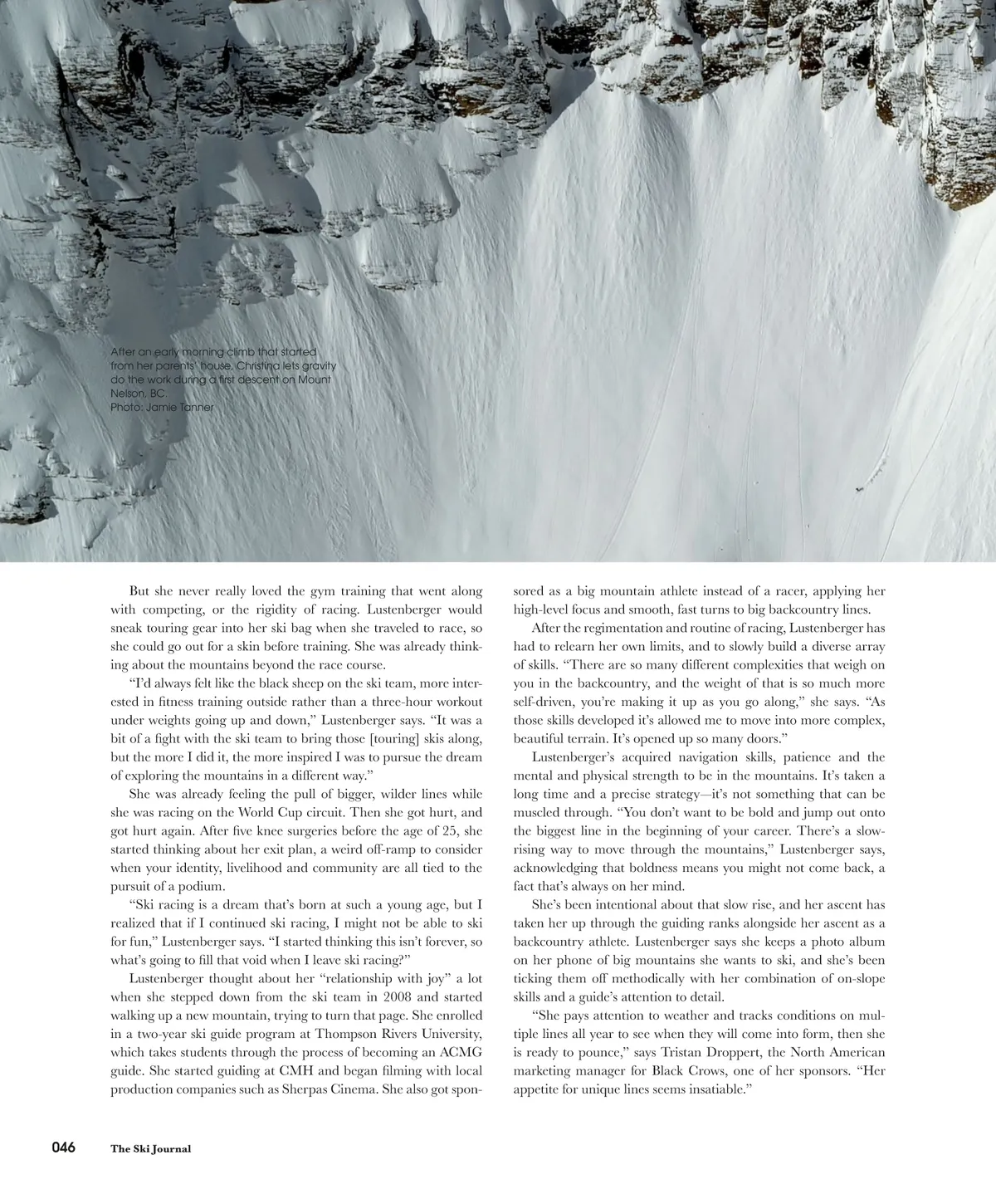
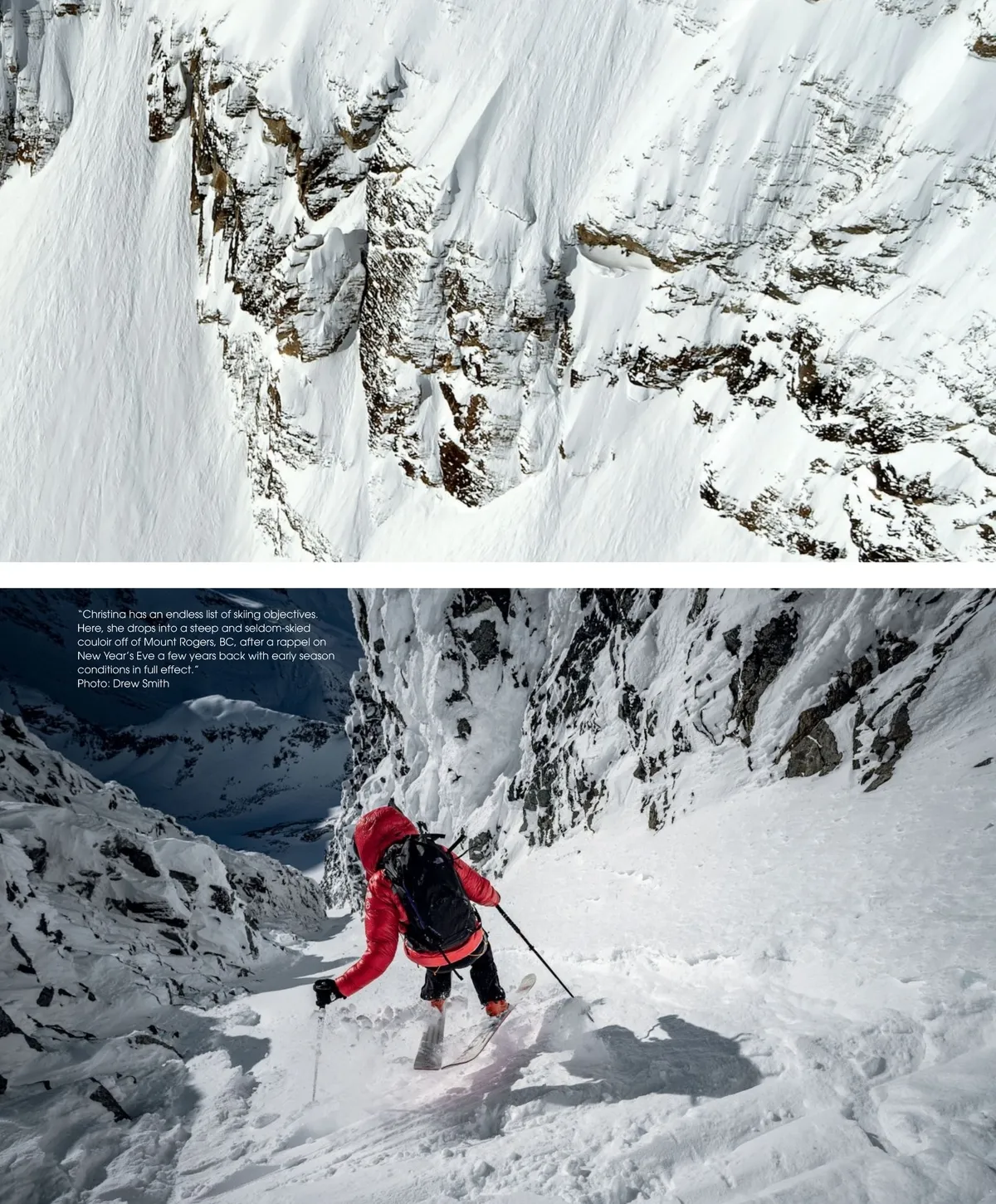
After an early morning climb that started from her parents’ house, Christina lets gravity do the work during a first descent on Mount Nelson, BC. Photo: Jamie Tanner But she never really loved the gym training that went along with competing, or the rigidity of racing. Lustenberger would sneak touring gear into her ski bag when she traveled to race, so she could go out for a skin before training. She was already think-ing about the mountains beyond the race course. “I’d always felt like the black sheep on the ski team, more inter-ested in fitness training outside rather than a three-hour workout under weights going up and down,” Lustenberger says. “It was a bit of a fight with the ski team to bring those [touring] skis along, but the more I did it, the more inspired I was to pursue the dream of exploring the mountains in a different way.” She was already feeling the pull of bigger, wilder lines while she was racing on the World Cup circuit. Then she got hurt, and got hurt again. After five knee surgeries before the age of 25, she started thinking about her exit plan, a weird off-ramp to consider when your identity, livelihood and community are all tied to the pursuit of a podium. “Ski racing is a dream that’s born at such a young age, but I realized that if I continued ski racing, I might not be able to ski for fun,” Lustenberger says. “I started thinking this isn’t forever, so what’s going to fill that void when I leave ski racing?” Lustenberger thought about her “relationship with joy” a lot when she stepped down from the ski team in 2008 and started walking up a new mountain, trying to turn that page. She enrolled in a two-year ski guide program at Thompson Rivers University, which takes students through the process of becoming an ACMG guide. She started guiding at CMH and began filming with local production companies such as Sherpas Cinema. She also got spon-sored as a big mountain athlete instead of a racer, applying her high-level focus and smooth, fast turns to big backcountry lines. After the regimentation and routine of racing, Lustenberger has had to relearn her own limits, and to slowly build a diverse array of skills. “There are so many different complexities that weigh on you in the backcountry, and the weight of that is so much more self-driven, you’re making it up as you go along,” she says. “As those skills developed it’s allowed me to move into more complex, beautiful terrain. It’s opened up so many doors.” Lustenberger’s acquired navigation skills, patience and the mental and physical strength to be in the mountains. It’s taken a long time and a precise strategy—it’s not something that can be muscled through. “You don’t want to be bold and jump out onto the biggest line in the beginning of your career. There’s a slow-rising way to move through the mountains,” Lustenberger says, acknowledging that boldness means you might not come back, a fact that’s always on her mind. She’s been intentional about that slow rise, and her ascent has taken her up through the guiding ranks alongside her ascent as a backcountry athlete. Lustenberger says she keeps a photo album on her phone of big mountains she wants to ski, and she’s been ticking them off methodically with her combination of on-slope skills and a guide’s attention to detail. “She pays attention to weather and tracks conditions on mul-tiple lines all year to see when they will come into form, then she is ready to pounce,” says Tristan Droppert, the North American marketing manager for Black Crows, one of her sponsors. “Her appetite for unique lines seems insatiable.” 046 The Ski Journal
The Ski Journal Volume 16, Issue 2: Page 46