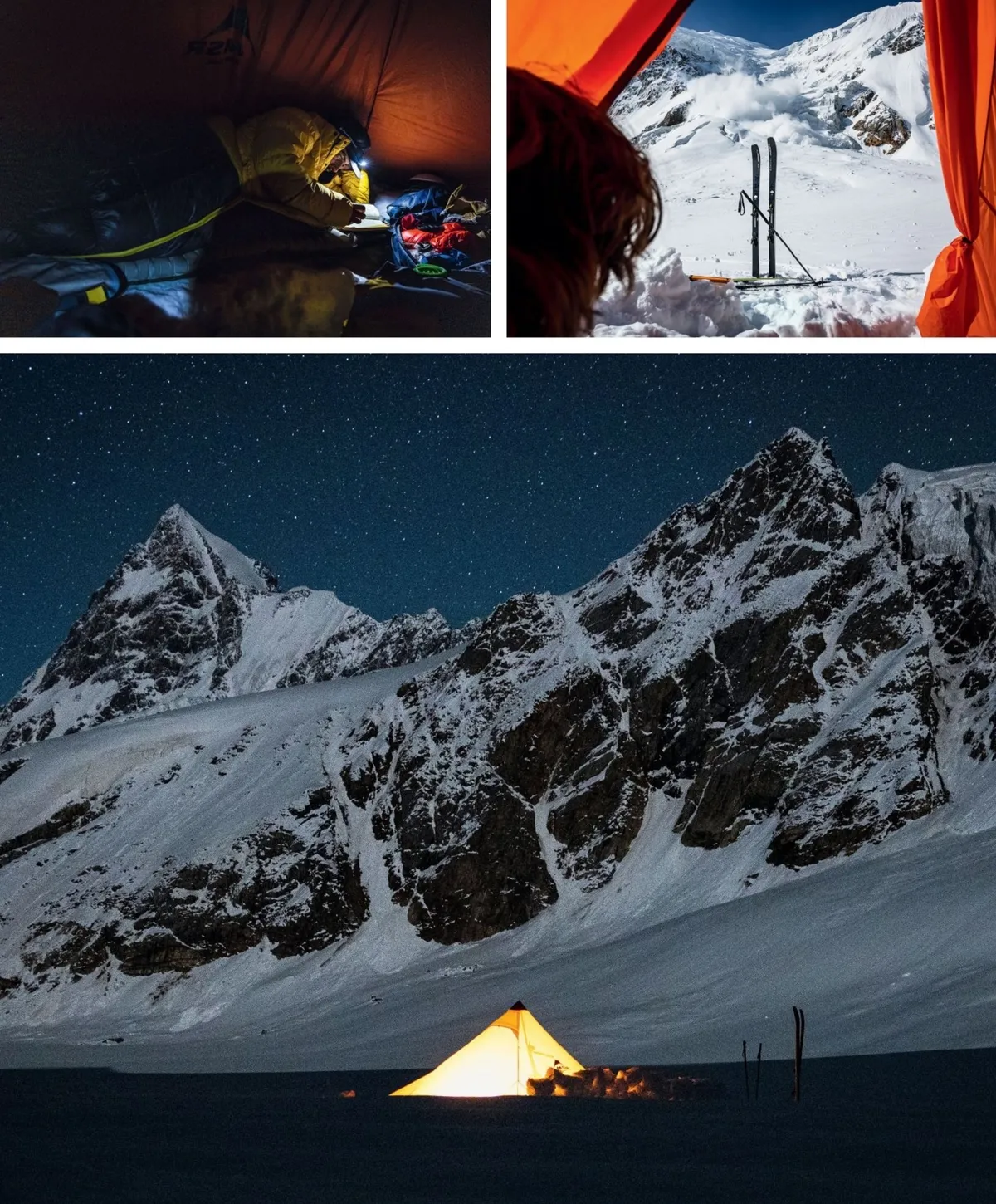
CLOCKWISE FROM TOP Every night before bed, Adrien and I journaled thoughts, ideas and the odd Kyrgyz or Russian phrases we’d learned that day. The journals gave a semblance of rhythm to a trip where days and even weeks flew by without notice. This serac fall triggered avalanches that shut down our proposed ascent route, instigating a new plan to climb via the steep ramp on looker’s right. Moonlight illuminates all the potential of a tiny corner of the Tien Shan. Words, Photos and Captions MATTHEW TUFTS match was as good as over. Checkmate in three, or as little as one, if he screwed up. But that wasn’t the point. Adrien Gra-binski hadn’t played in years; I’d been on an internet chess bender the month prior. I wanted to see how his brain worked. I asked how he’d move intuitively, what his immediate reaction would be—that he said, plainly, he wouldn’t. He didn’t have an intuitive sense for the game. A few days later, high above our glacier camp on a steep north face, our situation would flip: Adrien moving intuitively, myself a few steps behind, thinking about how each of the pieces could move. A mouse scuttled across the edge of the dusty rug that adorned the floor of a dilapidated canvas mess tent and disappeared behind Adrien’s monstrous pack. We wrapped the match and stepped into the fading evening light of Kyrgyzstan’s Terskey Ala-Too mountains. Lush meadows fed by braided glacial rivers lined the narrow trough of the steep valley. The horsemen that owned the accommodation had yet to arrive for the season, nor had the trekking tourists that follow. Thunder rumbled in the distance, mixed with the clatter of loose rockfall from large talus fields flanking the gorge. Storms blew in and out every day—it was impossible to predict when , but was never a question of if . These peaks create their own weather. It felt like monsoon season—a strange realization at the farthest point from an ocean in the world. Kyrgyzstan’s topography—not its weather or continental snowpack—brought us to Central Asia. More than 90 percent of the nation is mountainous, largely made up of the Tien Shan and Pamir ranges, each boasting peaks higher than 23,000 feet. Our first and primary objective—a “small” 17,000-foot peak in the Terskey, a subrange of the Tien Shan near the city of Karakol—began with a neglected 4x4 road followed by a 15-mile up-valley trundle to the toe of the glacier. Portering our gear took multiple trips. Skiing in the Greater Ranges of the world is an undertaking that commands respect for both the vastness of these regions and the lack of information about them. Alpinists who pursue lesser-known objectives in these ranges live (and die) by the understanding that, often, there’s no such thing as prior beta. THE KYRGYZSTAN is out there , a friend cautioned me. A former Soviet republic, the country established independence in 1991, but it’s clear it’s still feeling out a turbulent adolescence. Deteriorating monuments devoted to Stalin and overbearing concrete architecture still loom over its cities. Kyrgyz is the official language, but Russian remains the state language de jure, popular in the capital city of Bishkek and something locals suspect Putin, through shadowy influence from afar, has been keen to maintain as children learn English around the world with increasing frequency. Most people greet each other by saying “salam alaikum” with a warm two-handed handshake—an Arabic salutation common to Kyrgyzstan’s majority Muslim population. Urban centers market a pseudo-western lifestyle: fast food, fast fashion—fast-forwarding toward an appearance of luxury without the bedrock of quality. Well-to-do city folk proudly recount a half-dozen European and North American countries they’ve visited, yet many have never explored their own country beyond city limits. Kyrgyzstan 055
The Ski Journal Volume 16, Issue 2: Page 55