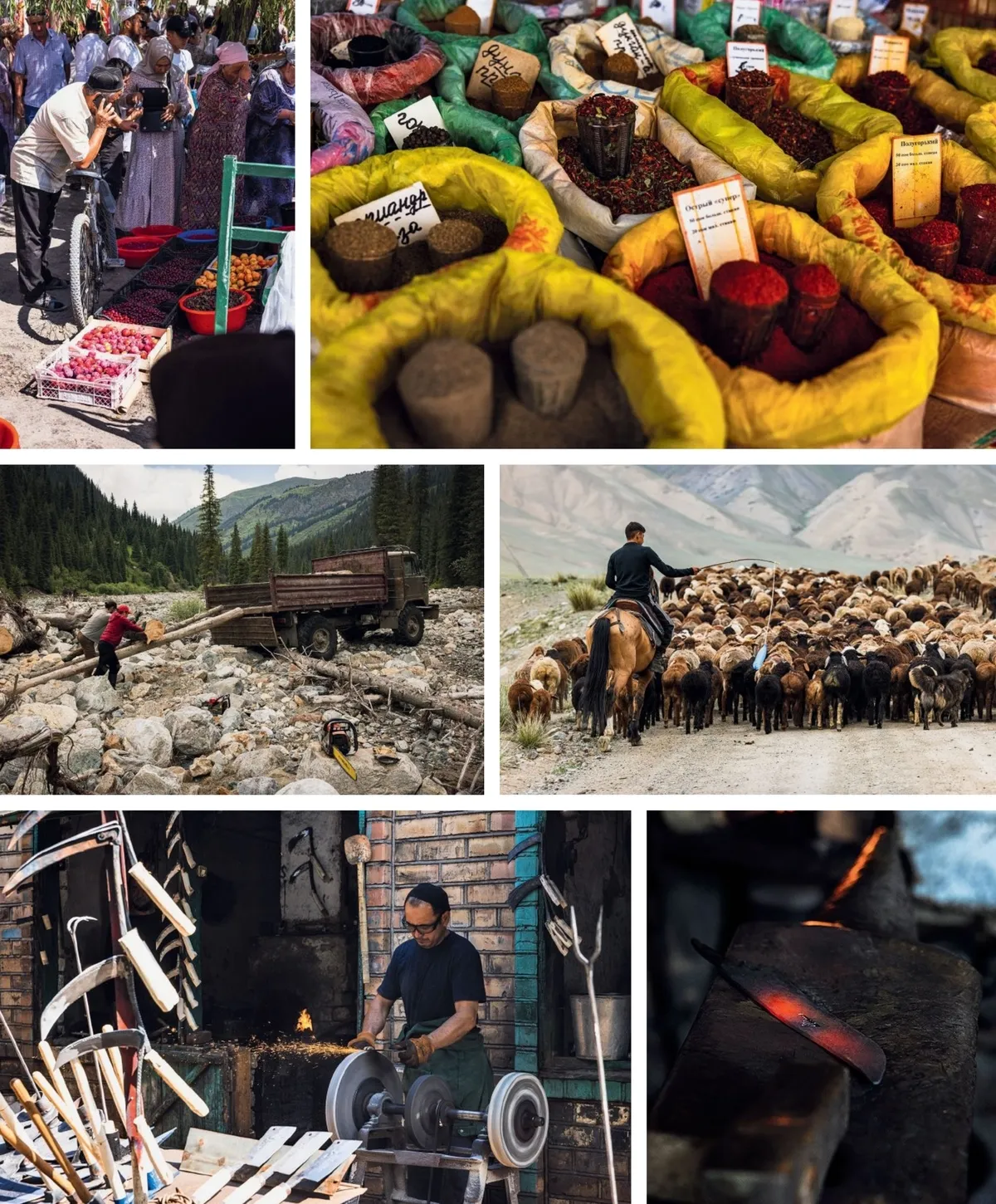
LEFT TO RIGHT, TOP TO BOTTOM The Jalal-Abad bazaar in the country’s southwest was the most vibrant (and tastiest) of all the major cities’ markets we sampled. After an uncomfortable night spent sleeping on our packs in the Bishkek airport, Adrien and I kicked off our culinary Tour de Kyrgyzstan at one of its colorful bazaars. From Bishkek, to Karakol, to Jalal-Abad, bazaars are both melting pots and juxtapositions—a window into a youthful nation grappling with its identity. Vibrant displays of local produce kaleido-scoped across our field of vision. The smell of hand-folded pastries, bountiful spices and fresh bread pulled us toward back-alley cafes while flies circling open-air meat markets urged us to give some offer-ings a wide berth. To build a bridge sustainably, this makeshift construction crew harvested driftwood timber from the riverbeds to be milled into lumber in town. One of many frequent traffic jams on Kyrgyzstan’s dirt highways. During the span of an hour we’d seen sheep, goats, cattle and horses shep-herded down the road. On some roads we encountered more locals on horseback than in cars. Industrious blacksmiths forge beautiful knives and farm tools from engine valves and other pieces of scrap metal at the central bazaar in Osh. A master bladesmith from Uzbekistan marks his knives with the seal of Osh at a bazaar in southwest Kyrgyzstan. Kyrgyzstan is a nation in the midst of rapid development, with contrasts old and new. Even if the roads are paved one day, the shepherds will still ferry their flocks down the pass come autumn. After moving camp up the glacier, Adrien set off for a quick solo scouting lap up a steep ramp on the same aspect as our objec-tive. We determined a photo would look better from the base, so I kept an eye on him through my long lens. Adrien enjoys skiing solo. He returned with mixed beta. On one hand, the climbing conditions couldn’t be better—a thin layer of firm, cold snow coated penetrable ice below, cruisy in crampons with a single piolet—but the skiing conditions left something to be desired. The very cold snow showed no signs of instability, but didn’t leave much room for edge hold—you could control your descent, but a full stop wasn’t guaranteed. The best skier I’d ever met told me he was survival skiing. That night was calm and clear. A gentle breeze ruffled the walls of the tent and moonlight illuminated the hulking massif before us. We slept soundly. The mountain, however, did not. We awoke to a scattershot of grapefruit-sized debris strewn across the crusty glacier, evidence of larger activity high above. No sooner had we mentioned the new landscaping when a monstrous serac high on the peak loosed another barrage—ice, snow and rock careening to a pluming crescendo across our proposed approach. We agreed we weren’t going to climb that route anymore, but we had left any world of certainties long ago. Seracs are notoriously unpredictable. Glacial ice moves, gravity pulls, seracs tumble. When and where is anyone’s guess. Just right of the line was a steep alternate route with access to the upper reaches of our face. The spines, we reasoned, were cold, much like the stretch Adrien skied the day prior. Three thousand feet up, north-facing and pitched enough that anything not solidly adhered had already sloughed. The first 1,800 feet of climbing were steep snow and ice directly under another serac. By contrast, this block of teetering ice was a fraction of the size and teetered at a far less dubious angle than the one we watched crash to Earth that morning. Serac fall in one location makes serac fall everywhere feel more probable, but ignores the fundamental rule of seracs: They’re unpredictable. We were comfortable with the risk prior to watching the other serac collapse. The odds hadn’t changed despite our observations, and our ascent was now more direct. After an hour of debate, we decided to go for it. Cruising up the initial ramp, we were careful not to dawdle underneath the looming hazard. The snow below was cold—icy at times, but with pockets that could make for great turns. The crux was an exposed traverse just below the serac—close enough to touch it, with slick granular crystals atop bulletproof gray glacial ice. Water dripped from large icicles. Somehow the air felt warmer. We pitched out the section—Adrien led, I followed, and the two of us pulled out from around the serac to what should have been views of the spines above. But during our brief climb, our vision blocked by overhanging ice, weather had moved in. Thin clouds let in flat light, obfuscating definition. Graupel began to fall. Not the usual sprinkles, but in torrents. I scooped a fistful from the bootpack and sifted it through my bare hand. I called up to Adrien excitedly—the weather should blow out, I said. We’d get our window. Even above the serac, our position was precarious. A double fall line funneled to cliffs below. Lateral movement exposed us to the precipitous edge of the serac we’d just circumvented. A bergschr-und lay between us and the spines. But we were on a good pace and making clear, team-oriented decisions. The first wet-loose slide ran off to our right, presumably releas-ing from the rock outcropping above. We adjusted our line and kept climbing. Topping out was our only safe zone. When the second ran next to the first, it was clear something had changed. The clouds didn’t clear; they simply thinned. Sunlight entered, bounced off the snow, and stayed trapped below the clouds, heat-ing up the mountain around us. We needed to get off the face. Immediately. We took off packs to pull skis and remove crampons. Adrien’s voice broke the shuffle, calm but direct. “Straight above us.” Kyrgyzstan 059
The Ski Journal Volume 16, Issue 2: Page 59