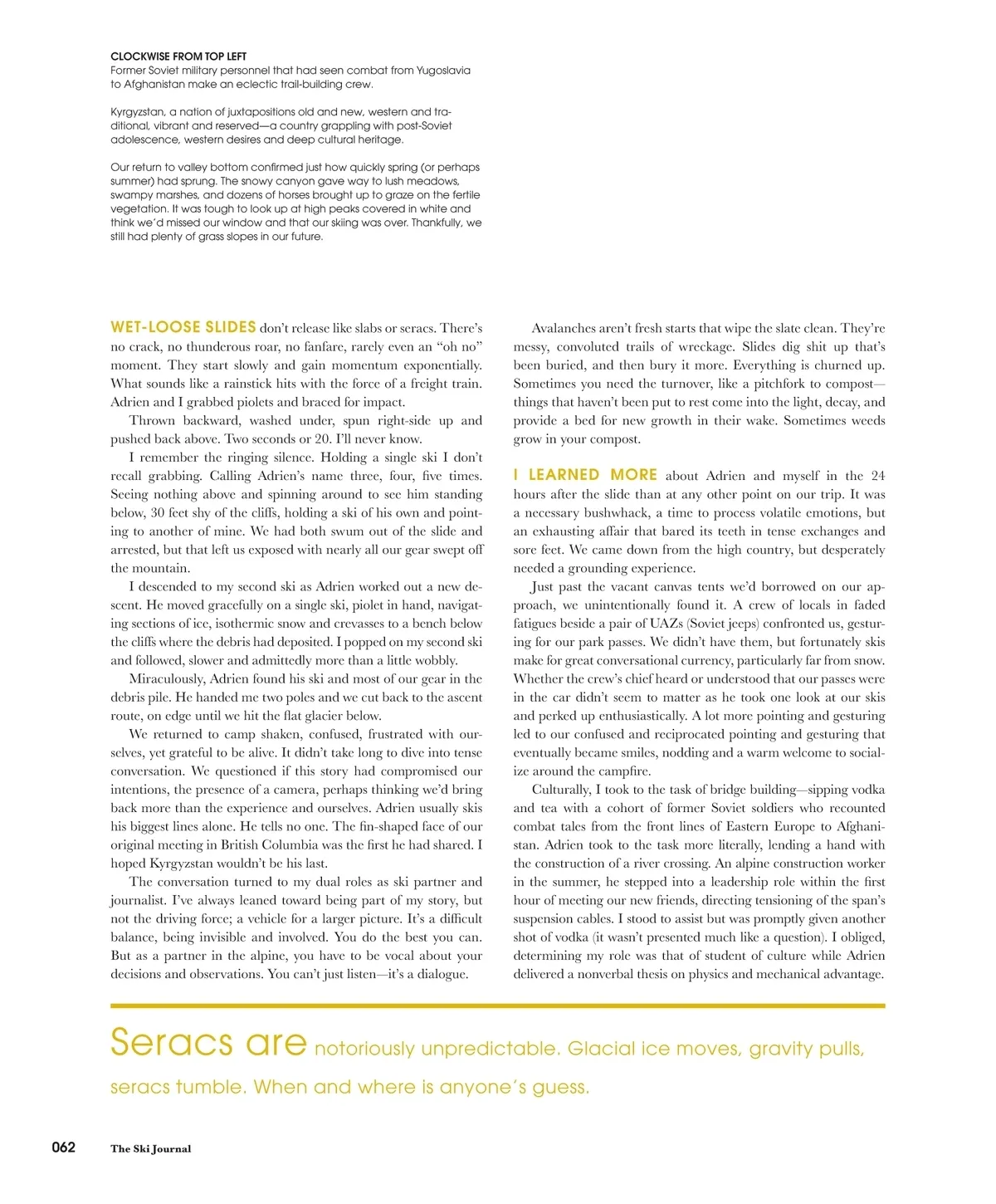
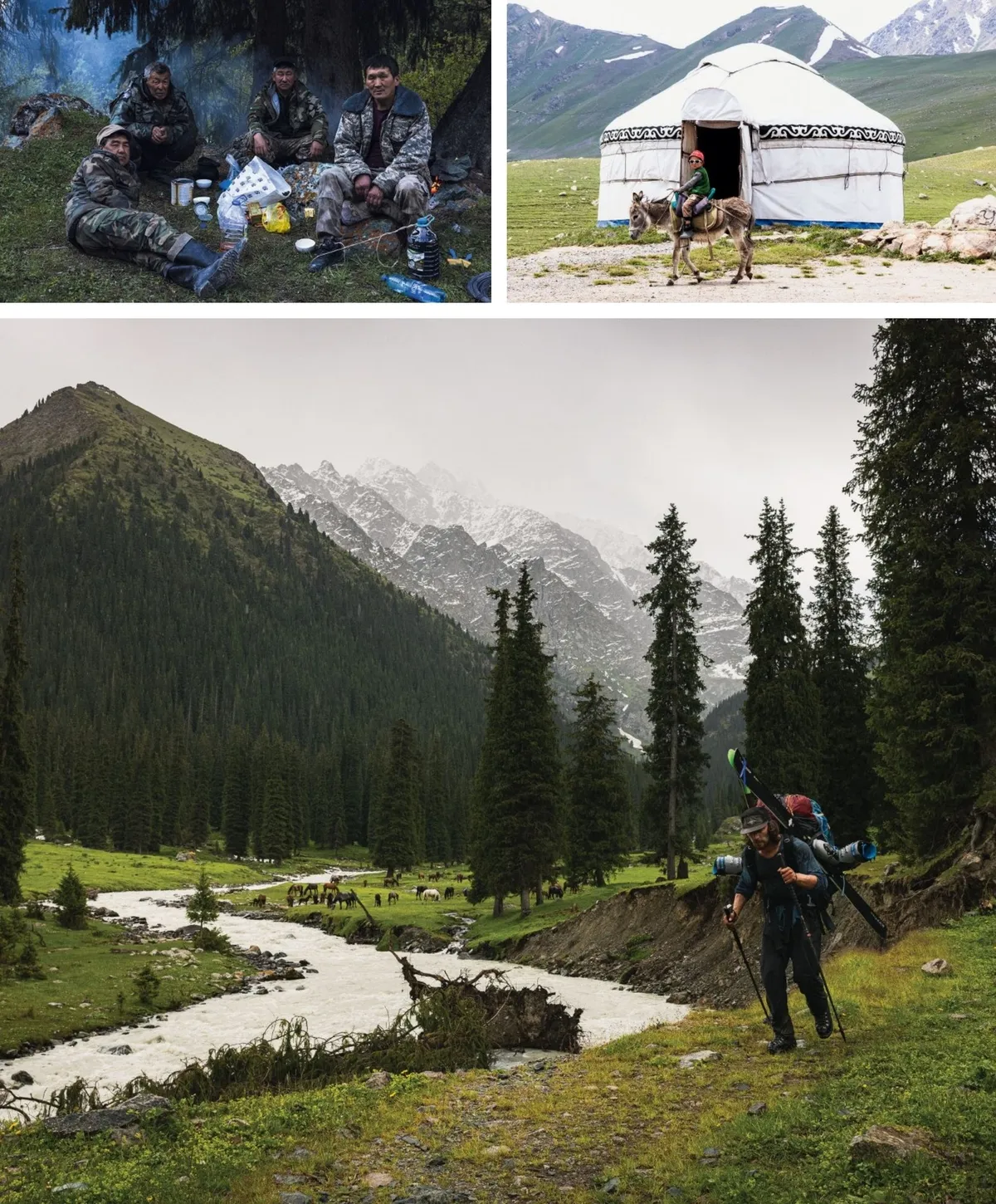
CLOCKWISE FROM TOP LEFT Former Soviet military personnel that had seen combat from Yugoslavia to Afghanistan make an eclectic trail-building crew. Kyrgyzstan, a nation of juxtapositions old and new, western and tra-ditional, vibrant and reserved—a country grappling with post-Soviet adolescence, western desires and deep cultural heritage. Our return to valley bottom confirmed just how quickly spring (or perhaps summer) had sprung. The snowy canyon gave way to lush meadows, swampy marshes, and dozens of horses brought up to graze on the fertile vegetation. It was tough to look up at high peaks covered in white and think we’d missed our window and that our skiing was over. Thankfully, we still had plenty of grass slopes in our future. WET-LOOSE SLIDES don’t release like slabs or seracs. There’s no crack, no thunderous roar, no fanfare, rarely even an “oh no” moment. They start slowly and gain momentum exponentially. What sounds like a rainstick hits with the force of a freight train. Adrien and I grabbed piolets and braced for impact. Thrown backward, washed under, spun right-side up and pushed back above. Two seconds or 20. I’ll never know. I remember the ringing silence. Holding a single ski I don’t recall grabbing. Calling Adrien’s name three, four, five times. Seeing nothing above and spinning around to see him standing below, 30 feet shy of the cliffs, holding a ski of his own and point-ing to another of mine. We had both swum out of the slide and arrested, but that left us exposed with nearly all our gear swept off the mountain. I descended to my second ski as Adrien worked out a new de-scent. He moved gracefully on a single ski, piolet in hand, navigat-ing sections of ice, isothermic snow and crevasses to a bench below the cliffs where the debris had deposited. I popped on my second ski and followed, slower and admittedly more than a little wobbly. Miraculously, Adrien found his ski and most of our gear in the debris pile. He handed me two poles and we cut back to the ascent route, on edge until we hit the flat glacier below. We returned to camp shaken, confused, frustrated with our-selves, yet grateful to be alive. It didn’t take long to dive into tense conversation. We questioned if this story had compromised our intentions, the presence of a camera, perhaps thinking we’d bring back more than the experience and ourselves. Adrien usually skis his biggest lines alone. He tells no one. The fin-shaped face of our original meeting in British Columbia was the first he had shared. I hoped Kyrgyzstan wouldn’t be his last. The conversation turned to my dual roles as ski partner and journalist. I’ve always leaned toward being part of my story, but not the driving force; a vehicle for a larger picture. It’s a difficult balance, being invisible and involved. You do the best you can. But as a partner in the alpine, you have to be vocal about your decisions and observations. You can’t just listen—it’s a dialogue. Avalanches aren’t fresh starts that wipe the slate clean. They’re messy, convoluted trails of wreckage. Slides dig shit up that’s been buried, and then bury it more. Everything is churned up. Sometimes you need the turnover, like a pitchfork to compost— things that haven’t been put to rest come into the light, decay, and provide a bed for new growth in their wake. Sometimes weeds grow in your compost. I LEARNED MORE about Adrien and myself in the 24 hours after the slide than at any other point on our trip. It was a necessary bushwhack, a time to process volatile emotions, but an exhausting affair that bared its teeth in tense exchanges and sore feet. We came down from the high country, but desperately needed a grounding experience. Just past the vacant canvas tents we’d borrowed on our ap-proach, we unintentionally found it. A crew of locals in faded fatigues beside a pair of UAZs (Soviet jeeps) confronted us, gestur-ing for our park passes. We didn’t have them, but fortunately skis make for great conversational currency, particularly far from snow. Whether the crew’s chief heard or understood that our passes were in the car didn’t seem to matter as he took one look at our skis and perked up enthusiastically. A lot more pointing and gesturing led to our confused and reciprocated pointing and gesturing that eventually became smiles, nodding and a warm welcome to social-ize around the campfire. Culturally, I took to the task of bridge building—sipping vodka and tea with a cohort of former Soviet soldiers who recounted combat tales from the front lines of Eastern Europe to Afghani-stan. Adrien took to the task more literally, lending a hand with the construction of a river crossing. An alpine construction worker in the summer, he stepped into a leadership role within the first hour of meeting our new friends, directing tensioning of the span’s suspension cables. I stood to assist but was promptly given another shot of vodka (it wasn’t presented much like a question). I obliged, determining my role was that of student of culture while Adrien delivered a nonverbal thesis on physics and mechanical advantage. Seracs are notoriously unpredictable. Glacial ice moves, gravity pulls, seracs tumble. When and where is anyone’s guess. 062 The Ski Journal
The Ski Journal Volume 16, Issue 2: Page 62